As an Amazon Associate I earn from qualifying purchases. This post contains affiliate links, which means we may earn a commission if you buy through them — at no extra cost to you.
Quick verdict
A well-built hydrating serum whose ingredient list is more interesting than its marketing. Eight hyaluronic acid forms is real formulation, not padding, and the capsule in the name is a liposome-forming ingredient rather than a physical bead. Buy it for hydration. The PDRN is present but sits low, so treat it as a bonus rather than the reason.
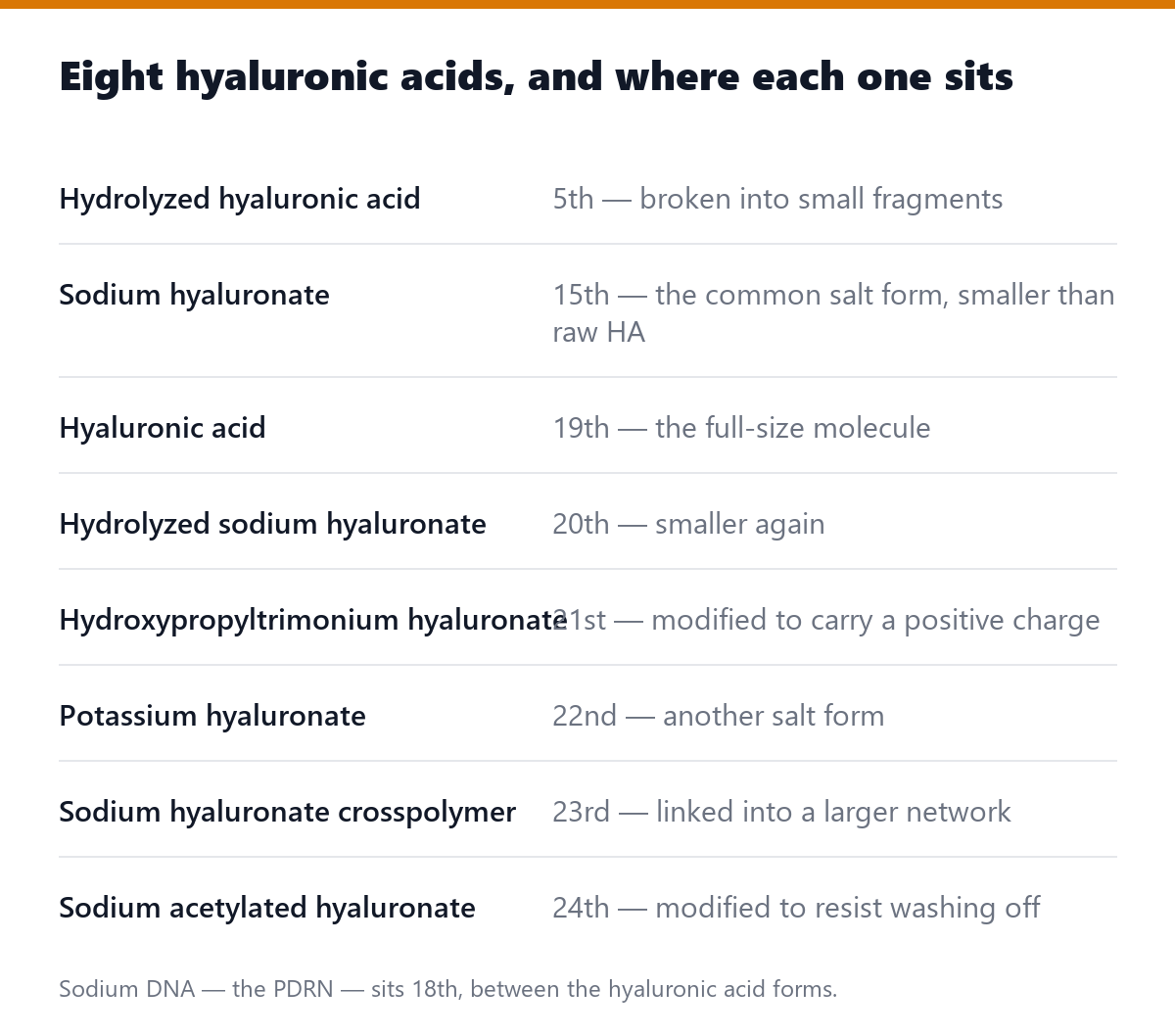
Most hydrating serums list one hyaluronic acid. This one lists eight, and that is the most interesting thing about it.
The Anua PDRN Hyaluronic Acid Capsule 100 Serum has been reviewed extensively as a viral product. The ingredient list has not, and it answers two questions the reviews mostly skip: what the eight forms are for, and what the word capsule is doing in the name.
Why a formula lists eight hyaluronic acids
Hyaluronic acid is not a fixed molecule. It is a chain, and the chain can be long or short, salted, cross-linked or chemically modified — and each version behaves differently on skin.
The short version of the theory: large molecules sit on the surface and hold water there, forming a film that reduces evaporation. Small fragments sit closer to the skin and hydrate the upper layers rather than the very top. Using several at once is meant to hydrate at more than one depth instead of only at the surface.
There is a real difference between that and marketing. A formula listing one HA under three trade names is padding. A formula listing hydrolyzed HA, a crosspolymer, an acetylated form and a cationic form is listing genuinely different materials that were bought separately and do different things.
This one is the second kind. Whether eight is meaningfully better than three is not something the ingredient list can tell you — but it is not a naming trick.
Two of the eight are worth naming
Hydroxypropyltrimonium hyaluronate is hyaluronic acid modified to carry a positive charge. Skin carries a slight negative charge, so a cationic ingredient is attracted to it and stays put rather than rinsing away. It is the same principle that makes hair conditioners work, applied to a serum.
Sodium acetylated hyaluronate is modified to be more water-resistant than plain hyaluronate, for the same practical reason — it stays on the skin longer.
Those two are the ones that suggest somebody thought about the formula rather than assembling it from a catalogue.
What the capsule actually is
Not a bead. There is nothing suspended in this serum that you can see.
The relevant ingredient is hydrogenated lecithin, twelfth in the list — a phospholipid used to form liposomes, which are microscopic spheres with a water-loving outside and an oil-loving inside. Ingredients packed into them are shielded from the surrounding formula and released as the sphere breaks down on skin.
That is a legitimate delivery technology and a common one. It is also invisible, which is why the name has to tell you it is there.
What it is not is a guarantee. Encapsulation improves the stability of what is inside it; it does not turn a small dose into a large one, and no ingredient list can tell you what was encapsulated or how much. Treat the word as a description of the formulation, not a claim about strength.
Where the PDRN sits
Sodium DNA is the eighteenth ingredient. That is the INCI name for PDRN.
PDRN is the ingredient the product is named after and the one people buy it for, so it is worth being clear about what its position means. Eighteenth in a thirty-four-ingredient list, below the emulsifiers and the glutathione, is a supporting position. It is present. It is not the bulk of the formula.
This is the same conversation as the one about clinic-branded PDRN products: the injectable and the topical share a name and very little else, because a molecule that size does not cross intact skin in quantity. If you want the background, we covered what PDRN is and what it is claimed to do, and separately that not all of it comes from salmon.
None of that makes it a bad serum. It makes it a hydrating serum with PDRN in it, which is a different product from the one the name implies.
Check the current price on Amazon
The rest of the list
Short, and better than average.
Niacinamide is seventh — high enough to matter, and the most reliably useful active here. Glutathione is thirteenth and hydrolyzed collagen fourteenth; collagen in a serum functions as a humectant rather than as collagen, for the reasons we set out in the piece on collagen versus peptides. Adenosine is seventeenth.
The base is water, butylene glycol, propanediol and glycerin — humectants, which is correct for a hydrating serum. There is no fragrance in the list, which is worth noting for reactive skin, and the botanical extracts sit at the bottom.
Thirty-four ingredients total. That is a short list by Korean serum standards, and short lists are generally easier for sensitive skin to tolerate.
Who it suits
Dehydrated skin of any type. This is a humectant serum and it is a well-made one. Oily skin gets hydration without oil; dry skin gets a layer to seal over.
Sensitive skin. No fragrance, no acids, no retinoid, a short list. There is little here to react to.
Anyone layering under sunscreen. A thin humectant serum is the easiest thing to wear under an SPF without pilling.
Who should skip it
If you want the PDRN to be the point. Covered above. It is eighteenth.
If your skin is dry rather than dehydrated. Hyaluronic acid pulls water in; it does not supply oil. Used alone on genuinely dry skin in dry air it can leave you no better off — the same limitation we described in the Torriden DIVE IN review. Seal it with a cream.
If you already own a good HA serum. Eight forms is interesting. It is not a reason to replace something that works.
Using it so the hydration stays
Humectant serums have one failure mode, and it is worth spelling out because it is the reason people conclude that hyaluronic acid does not work for them.
A humectant moves water toward itself. If there is water available — from a damp face, from a humid room — it pulls from there. If there is not, it pulls from the deeper layers of your own skin, and then that water evaporates off the surface. In dry winter air, applied to a dry face and left unsealed, a hyaluronic acid serum can leave skin worse than it started.
Three habits prevent it entirely. Apply to damp skin, within seconds of washing rather than minutes. Do not let it dry alone — a moisturiser goes on while the serum is still tacky. Use less than you think; two or three drops covers a face, and more does not hydrate more.
The serum is also thin enough to layer under anything, which makes it a good second step. Cleanser, this, then whatever your routine is built around.
FAQ
Does Capsule 100 mean 100% of something?
No. It is a product name, not a concentration. The ingredient list is the concentration information, and it runs in descending order.
Do I apply it to damp or dry skin?
Damp. Humectants pull water from whatever is nearest, so applying to a damp face gives them water to work with. Then seal with a moisturiser, or the water leaves again.
Is this the same as the Anua PDRN cream or mist?
No. Anua sells several products under the PDRN name across different lines, and they are formulated differently. We mapped which Anua line does what if you are trying to work out where to start.
Keep reading
SKIN1004 Water-Fit Sun Serum: What “Serum” Buys You
Squalane vs Squalene: One Letter, Two Outcomes
The bottom line
A short, fragrance-free, well-constructed hydrating serum with a genuinely varied hyaluronic acid blend and a real encapsulation ingredient. The eight HA forms are the reason to buy it; the PDRN in the name is a supporting player.
If you want hydration, this is a good one. If you want the salmon DNA to do something dramatic, no topical PDRN product is going to.