As an Amazon Associate I earn from qualifying purchases. This post contains affiliate links, which means we may earn a commission if you buy through them — at no extra cost to you.
Quick verdict
A softening step is the sensible middle ground between squeezing and giving up. It loosens compacted sebum so it lifts with far less force, which protects the pore wall. It is not a cure — the pore refills, because producing sebum is what pores do. Treat it as maintenance every few days on the nose and chin, not a full-face product.
Everyone eventually squeezes. It works, briefly, and then the skin around the pore is red for three days and the blackhead comes back anyway.
A blackhead softener is the step most routines skip: instead of forcing the plug out, you make it loose enough that it barely needs forcing at all.
What is actually in the pore
A blackhead is a pore filled with a plug of sebum mixed with dead skin cells. Over time that mixture compacts and hardens.
The black tip is not dirt. It is the top of the plug oxidising on contact with air — the same browning that happens to a cut apple. This is why scrubbing does nothing: the colour is a chemical change in the plug, not something sitting on the surface.
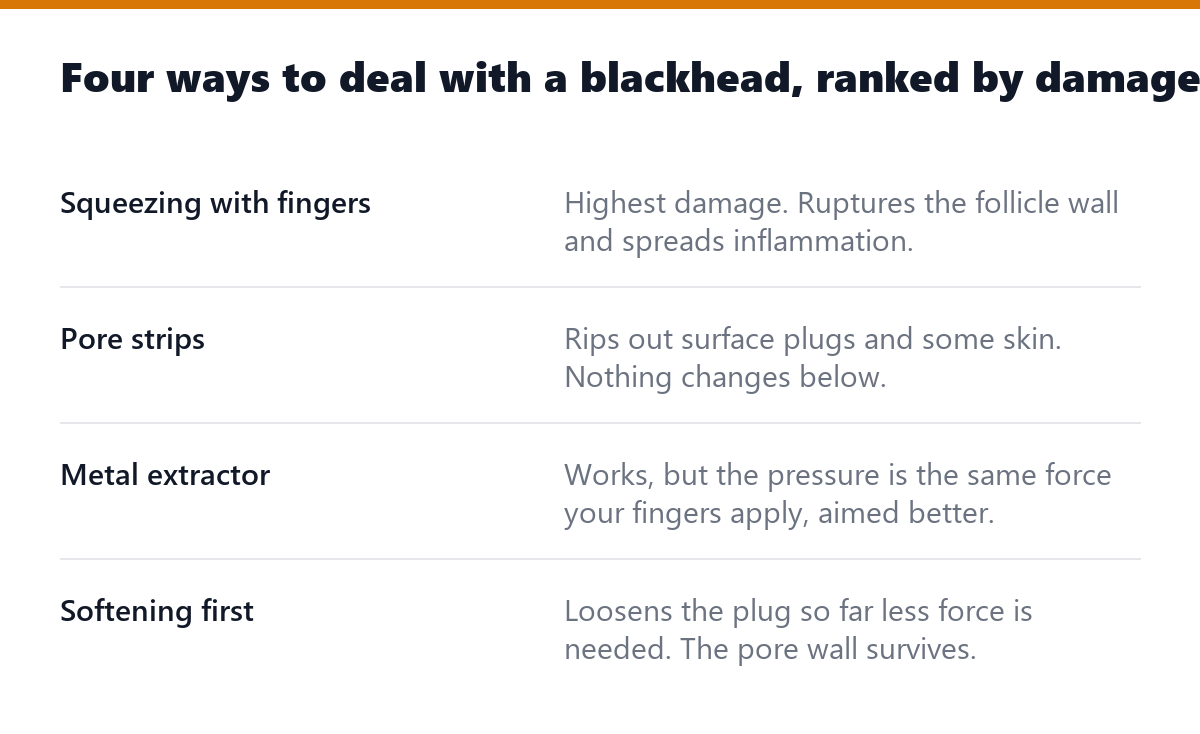
It also explains the two failure modes. Washing more cannot reach into the follicle. Squeezing applies enough pressure to the surrounding tissue to rupture the follicle wall, which is what turns a harmless blackhead into an inflamed spot that lasts a fortnight.
What a softener does differently
It attacks the plug’s consistency rather than its position.
The ilso Super Melting Sebum Softener is the Korean product that made this category popular, and its ingredient list shows the approach clearly. It is a watery formula whose working parts are mild plant-derived surfactants — polyglyceryl-10 oleate sits tenth, polyglyceryl-10 isostearate fourteenth — which emulsify hardened oil so it can mix with water and lift out.
Further down there is papain, a fruit enzyme that breaks down protein. The plug is sebum plus keratin from dead cells, and an enzyme works on the keratin half.
There is also white willow bark extract near the top. This is worth being precise about, because it is often described as natural salicylic acid. It contains salicin, a related compound, and it does not behave like the BHA in an exfoliant. If you want actual salicylic acid, buy a product that lists it.
One claim we could not confirm: several reviews describe this as an alkaline, high-pH product. The published ingredient list includes citric acid as a buffer and no alkaline agent, and the brand does not state a pH figure we could verify. So we are leaving the pH out rather than repeating a number we cannot check.
How to use it without wrecking your nose
The method matters more than the product, and the common instruction — soak cotton pads and leave them on — is where people overdo it.
Target zones only. Nose, chin, the inner edges of the cheeks. This is not a full-face step, and your dry areas have nothing to soften.
Ten to fifteen minutes, not longer. The surfactants are mild but they are still surfactants sitting on one patch of skin.
Two or three times a week at most. Daily use strips the area and your skin compensates by producing more oil.
Then remove gently. This is the whole point. Wipe with the pad, or press with a clean tool if you must — but if the plug does not come with light pressure, leave it. It will be looser next time.
Rebuild afterwards. A softened, cleared pore area is freshly stripped skin. Follow with a hydrating layer, and do not pile an acid on top the same night.
Check the current price on Amazon
Where it sits against the alternatives
Versus pore strips. Strips remove the protruding tips and some surface skin with them, and the pore refills within days. They are satisfying and they are the worst option for skin.
Versus clay. Clay absorbs surface oil and can draw at the top of a plug. It is a good routine step for oily skin — we compared the powder and clay cleansers — but it does not soften a compacted plug the way surfactants and enzymes do.
Versus BHA. Salicylic acid is oil-soluble, so it gets into the pore and works on the plug over weeks. It is the better long-term tool. A softener is the faster one, and they are not in conflict — use the acid as routine, the softener as occasional maintenance.
Versus an exfoliating pad. Pads work on the surface and on the pore opening. They are a good habit, and they do not reach a hardened plug either.
Why it is always the nose
Blackheads cluster on the nose, the inner cheeks and the chin for a structural reason, not a hygiene one.
Those areas carry the highest density of sebaceous glands on the face, and the follicles there are wider. More oil produced into a larger opening is simply more material available to compact and oxidise. The same person can have a nose full of plugs and completely clear cheeks.
Two things follow. First, this is not caused by being unclean — washing harder targets a surface that is not the problem, and strips the skin around it. Second, it will recur, because the glands keep working. Anyone promising permanent clearance is selling something.
There is one habit genuinely worth changing: a stripping cleanser prompts skin to compensate with more oil, which gives the plugs more raw material. A gentle, low-pH wash does more for the T-zone over a month than any single extraction session.
Who it suits
Oily and combination skin with a visibly textured nose. The clearest case, and the one the format is designed for.
Anyone who squeezes. If you are going to interfere with your blackheads regardless — and most people are — doing it after softening is far less damaging than doing it dry.
People who have tried acids and want faster feedback. BHA takes weeks. This takes one sitting, and it can keep you patient enough to stay on the acid.
Who should skip it
Dry or sensitised skin. Surfactants on a patch of skin for fifteen minutes is the wrong move if your barrier is already struggling.
Anyone with active, inflamed acne. Pustules and cysts are a different problem, and manipulating them is how scarring happens.
If you expect the pores to close. They will not. Pore size is largely genetic, and an empty pore simply looks smaller than a full one.
FAQ
Are those little white threads sebaceous filaments or blackheads?
Mostly filaments, especially on the nose. Sebaceous filaments are the normal lining of a pore and they refill within days no matter what you do. Blackheads are compacted and oxidised. The practical difference: filaments are not a problem to solve.
How long until they come back?
Days to a few weeks. Your skin keeps making sebum, so this is maintenance, not a cure. Anything promising permanent removal is overselling.
Can I use it with retinol or acids?
Not on the same night. Space them out, and if your skin is already reacting to an active, skip the softener that week.
Does steaming first help?
Warmth softens sebum slightly and makes the step more comfortable. A warm flannel for a minute is enough; long steaming mostly dehydrates skin.
Keep reading
Fungal Acne Safe Skincare: Read Your Own Label
Sunscreen Pilling: It’s Usually Not the Sunscreen
The bottom line
Blackheads are compacted, oxidised plugs, and the reason squeezing fails is that force damages the pore wall while leaving the cause untouched.
A softening step is the sensible compromise: loosen first, remove gently, accept that it is maintenance. Use it on the nose and chin a couple of times a week, keep a BHA in the routine for the slow work, and stop buying pore strips.