As an Amazon Associate I earn from qualifying purchases. This post contains affiliate links, which means we may earn a commission if you buy through them — at no extra cost to you.
Quick verdict
A strong cationic conditioning mask that works, marketed on proteins that sit low in its own ingredient list. Excellent for coarse, bleached or chemically treated hair that tangles. A poor choice for fine hair, which it will flatten, and for anyone avoiding strong fragrance.
Every damaged-hair mask is sold on protein. Almost none of them are actually built on it.
The UNOVE Deep Damage Treatment is one of the better ones, and it is a clean example of the gap between what a hair product advertises and what its ingredient list says is doing the work.
What is actually at the top of the list
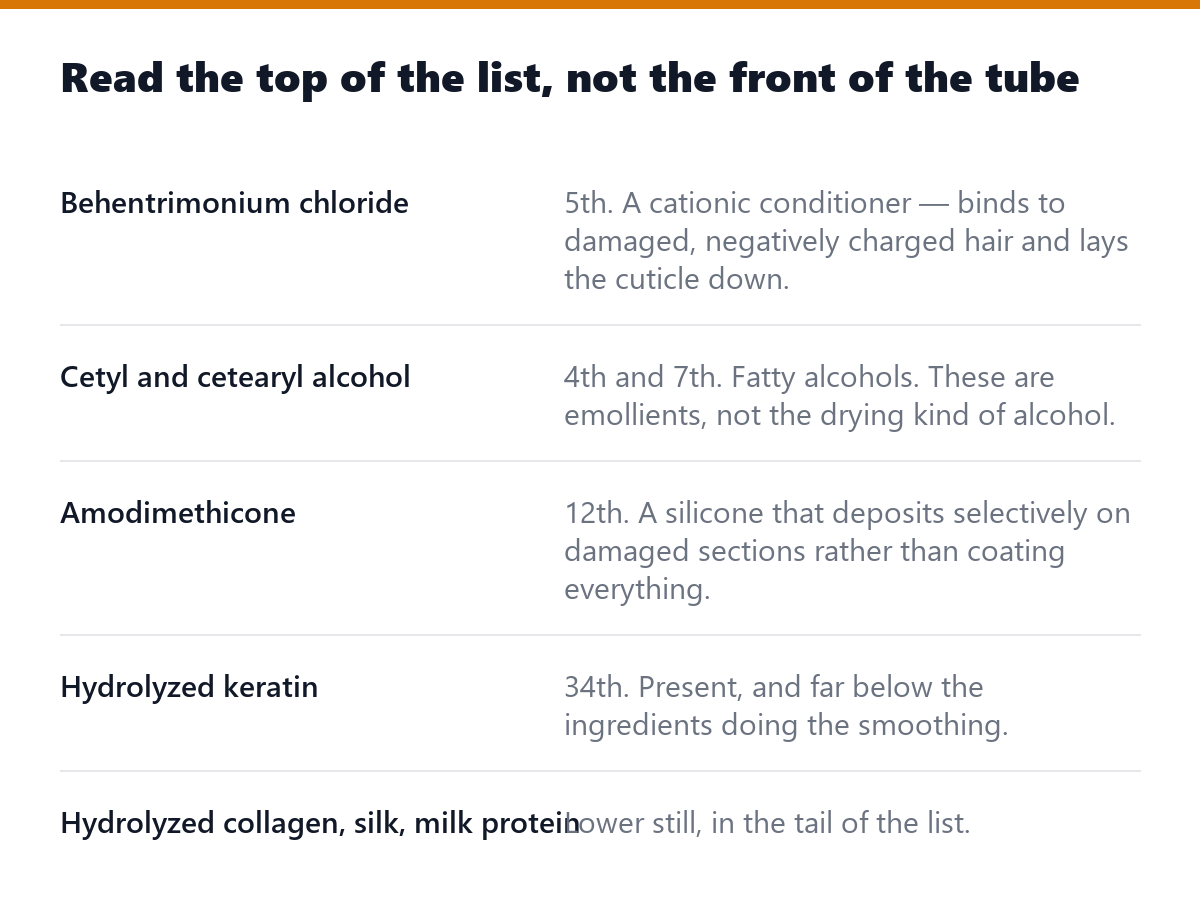
After water and glycerin: dimethicone, cetyl alcohol, and then behentrimonium chloride in fifth position.
That fifth ingredient is the one to know. Behentrimonium chloride is a cationic — positively charged — conditioning agent. Damaged hair carries a negative surface charge, and it carries more of it the more damaged it is, because that is what happens when the cuticle is stripped.
A positively charged conditioner is therefore attracted most strongly to the most damaged parts of the hair. It binds there, lays the raised cuticle flat, and the strand goes from rough to smooth. That is the mechanism behind the result people describe, and it is a genuinely good mechanism.
Behentrimonium methosulfate, stearamidopropyl dimethylamine, steartrimonium chloride and cetrimonium chloride appear further down. This formula is stacked with conditioning agents, and that is a compliment.
The proteins are real, and they are 34th
Hydrolyzed keratin appears at the 34th position. Hydrolyzed collagen, hydrolyzed silk, hydrolyzed milk protein and a run of individual amino acids sit below it.
They are in the product. They are not the reason it works.
This matters for a practical reason rather than a pedantic one. Protein treatments have a real failure mode — protein overload, where repeated heavy protein use leaves hair stiff and brittle rather than soft. People who have run into that avoid protein products on principle.
If that is you, this is worth reconsidering: the protein content here sits low in the list, and what you would actually be buying is the conditioning system near the top.
Claims about specific protein percentages circulate widely for this product. We have not been able to verify any of them against a primary source, and the ingredient order does not support the larger figures, so we are leaving the numbers out.
What amodimethicone is doing
Twelfth in the list, and the most interesting silicone choice in the formula.
Ordinary dimethicone coats the entire strand evenly. Amodimethicone is amine-functionalised, which gives it the same selectivity as the cationic conditioners — it deposits preferentially on damaged sections and builds up less on healthy ones.
Practically: it is the silicone least likely to leave hair feeling progressively weighed down over weeks of use. It still builds up eventually, and a clarifying wash every few weeks is sensible.
Check the current price on Amazon
Who it suits
Bleached, coloured or chemically straightened hair. The most damage means the most negative charge means the most conditioner deposition. This is the hair type the formula is designed around.
Coarse or thick hair that tangles. Slip is what cationic conditioners deliver, and detangling without breakage is where the real damage prevention happens.
Anyone burnt by protein overload. As above — the proteins here are minor.
Who should skip it
Fine or low-density hair. A conditioning system this heavy will flatten fine hair, and no amount of careful application changes that. Use a lighter mask.
Anyone sensitive to fragrance. Fragrance appears tenth, and hexyl cinnamal, geraniol, citronellol and limonene are all declared. This is a strongly scented product by design.
Scalp-focused users. This is a mid-length-to-ends treatment. Heavy cationic conditioners on the scalp are a route to buildup and flat roots.
What hair damage physically is
Worth two minutes, because it explains why some products help and others cannot.
A hair strand has a cuticle — overlapping scales, like roof tiles — wrapped around a protein cortex. On undamaged hair the scales lie flat, which is what makes hair shiny and slippery: light reflects off a smooth surface, and smooth strands slide past each other instead of catching.
Bleach, heat and friction lift and chip those scales. Three things follow. Light scatters instead of reflecting, so hair looks dull. Strands catch on each other, so hair tangles. And the exposed surface carries a stronger negative charge, because the protective lipid layer that normally sits on it has been stripped away.
That last consequence is the one products exploit. It is why a positively charged conditioner finds the damage on its own, and it is why the same product does more for bleached hair than for healthy hair.
The thing no rinse-off product does is repair the cortex. Hair is not living tissue and does not heal. What a good mask does is smooth the outside so the strand behaves like undamaged hair — which is a real, worthwhile, entirely cosmetic result.
The oils, and what they are for
The formula includes a set of plant oils, and their role is different from the conditioning agents above them.
Oils sit on the surface and reduce water loss and friction. They do not penetrate the cortex in any meaningful way, with coconut oil being the well-known partial exception. What they add is slip, shine and a softer hand feel — the finishing touch on top of the work the cationics do.
Brand materials give a specific count and specific oils for this product. The ingredient panel we could verify does not line up cleanly with those lists, so we are describing what the oils do rather than repeating a number we cannot confirm.
Also present: tocopheryl acetate (vitamin E, an antioxidant), trehalose and sorbitol (humectants), and lactic acid and citric acid, which are there to hold the pH down. Acidic pH keeps the cuticle closed, and a mask that left hair alkaline would undo its own work.
How to apply it properly
Most of the complaints about heavy hair masks are application problems.
Squeeze the water out first. Not towel-dry, but not dripping either. Product diluted by a full load of shower water reaches the hair at a fraction of its strength.
Mid-lengths and ends only. Start a hand’s width below the roots. The hair near your scalp is the youngest and least damaged and does not need this.
Comb it through. A wide-tooth comb distributes the product and detangles at the moment hair is most slippery, which is exactly when detangling causes the least breakage.
Rinse until it stops feeling slick. Under-rinsing is the usual cause of hair that feels coated the next day.
FAQ
How long should I leave it on?
Cationic conditioners deposit on contact rather than over time, so the difference between two minutes and twenty is smaller than the packaging of most masks implies. Apply to damp, towel-dried hair, comb it through, wait a few minutes, rinse.
Do I still need conditioner?
On a mask day, no. This is a conditioner at high strength, not a treatment that sits underneath one.
Will the silicones damage my hair?
No. Silicones do not damage hair; they can accumulate on it. Amodimethicone accumulates less than most, and a clarifying shampoo resets it when it does.
Keep reading
Squalane vs Squalene: One Letter, Two Outcomes
Bakuchiol vs Retinol: Gentler Is the Whole Point
The bottom line
A well-built conditioning mask that will do exactly what damaged hair needs, sold under a protein story that its own ingredient list does not support.
Buy it for coarse or chemically treated hair that tangles. Skip it if your hair is fine, and do not buy it for the keratin.