As an Amazon Associate I earn from qualifying purchases. This post contains affiliate links, which means we may earn a commission if you buy through them — at no extra cost to you.
Quick verdict
PDRN is worth trying if you want a comfortable, hydrating layer and you treat the regeneration claims as unproven for topical products. If you are buying it expecting the results people get from PDRN injections, the molecule cannot get deep enough to deliver that.
PDRN skincare is on the front of half the K-beauty shelf right now — toners, essences, creams, sheet masks, all promising regeneration from salmon DNA. PDRN skincare is the fastest-moving ingredient trend Korea has produced in years.
It is also the one where the gap between what the research shows and what the label implies is widest. That gap is worth understanding before you spend anything, because it decides whether you will be happy with what you get.
What PDRN actually is
PDRN stands for polydeoxyribonucleotide. It is purified DNA, most often extracted from salmon — the fish’s genetic material shares a high degree of similarity with human DNA, which is why the body tolerates it well rather than treating it as foreign.
The extraction process strips out proteins and allergens, leaving chains of nucleotides. The proposed mechanism is that these fragments activate adenosine A2A receptors and supply raw nucleotide material to cells, encouraging fibroblast activity and tissue repair.
That mechanism is real, and it is well documented. The catch is where it has been documented.
The part almost nobody mentions
Nearly all the impressive PDRN research involves injection, not application.
Injectable PDRN has clinical data behind it — studies have shown meaningfully faster wound healing versus placebo, and it has a long safety record across a very large number of prescriptions. When you read that PDRN regenerates tissue, that is the form being described. It is delivered underneath the skin barrier, straight to the layer where the work happens.
Topical PDRN — the serums and creams you can actually buy — is a different proposition. DNA fragments are large molecules, and the skin barrier exists specifically to keep large molecules out. Published evidence for cosmetic topical PDRN is limited, and researchers describing it as promising also describe it as under-studied for this use.
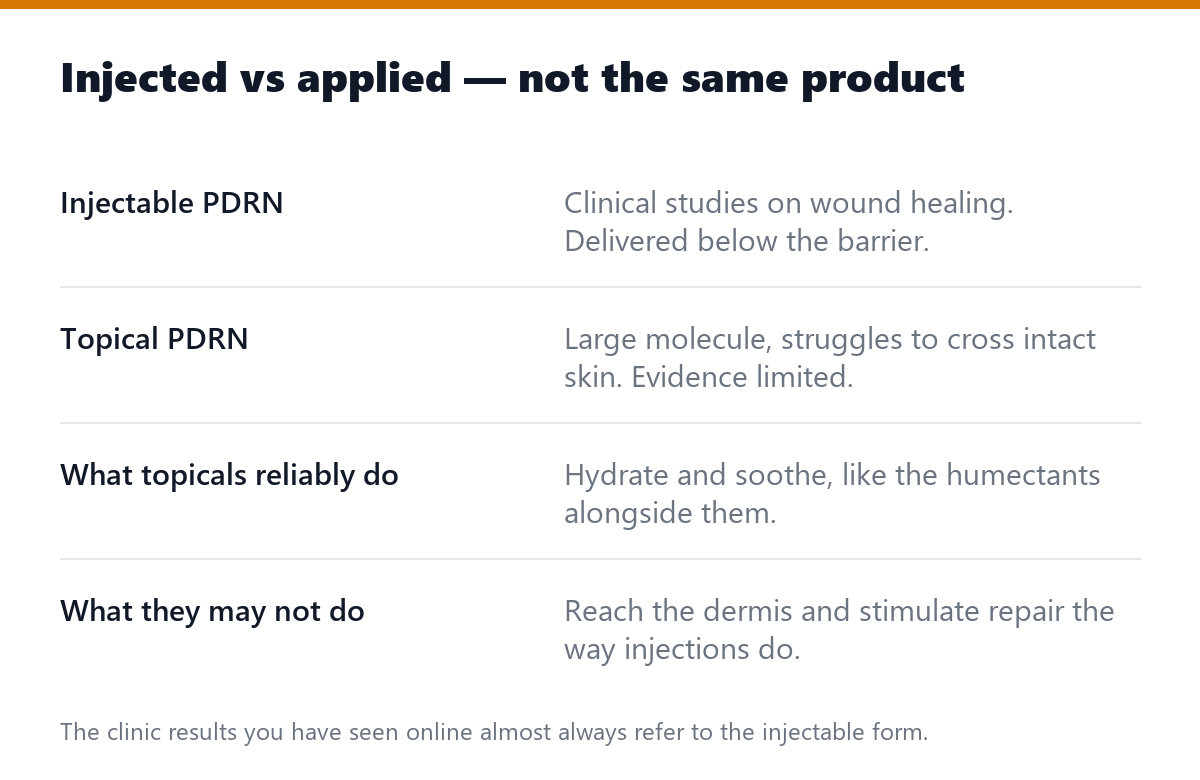
This is not a claim that these products do nothing. It is a claim that the dramatic before-and-afters circulating online belong to a procedure you get in a clinic, not to a bottle you buy online — and the marketing for the bottle leans heavily on the reputation of the procedure.
So what do you actually get?
PDRN formulas are usually built on a base of humectants — hyaluronic acid, glycerin, panthenol — and those work exactly as they always do. Skin holds more water, looks plumper, feels more comfortable. Many of these products are genuinely pleasant and well formulated.
Users consistently describe skin looking calmer and more even after a few weeks. That is a believable outcome from good hydration and a well-supported barrier. Whether the PDRN itself is responsible, or the surrounding formula is doing the work, is not something current published evidence can separate.
Buy it on the basis that you are getting a good hydrating product with an interesting ingredient that may add something. Do not buy it as a substitute for a clinical treatment.
What to look for in PDRN skincare
- Ignore the ppm number. Products advertise concentrations in the tens of thousands of ppm, and the figure sounds precise while telling you almost nothing — it usually describes a proprietary blend whose composition is not published. A big number can describe a dilute mixture.
- Read the rest of the ingredient list. Since the supporting formula is doing verifiable work, that is the part worth judging. Look for hyaluronic acid, panthenol, ceramides, centella.
- Match the format to your routine. The step you will actually keep up with beats the one with the highest concentration.
- Be wary of anything promising injectable-level results. That is the clearest signal a brand is trading on the clinical reputation of a different delivery method.
The entry point: a PDRN toner
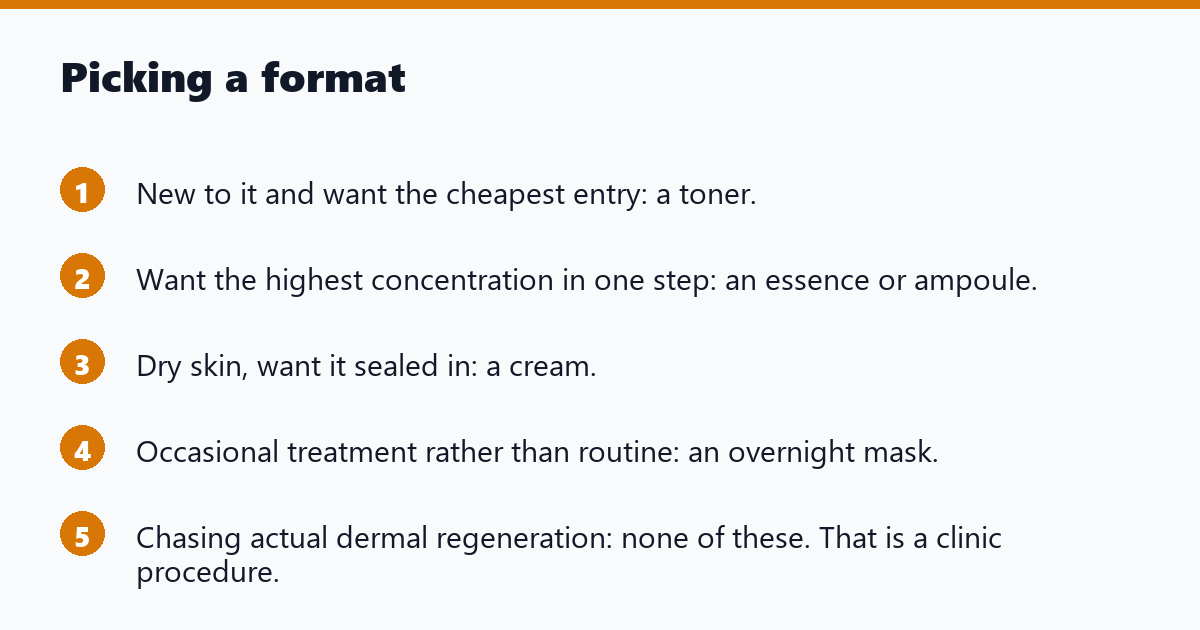
A toner is the cheapest way to find out whether your skin likes this category at all. It goes on right after cleansing, layers under everything else, and does not commit you to replacing a step you already have.
The numbuzin No.9 NAD+ Salmon PDRN Toner pairs PDRN with NAD+, another cell-energy ingredient having its moment in Korean formulations. As a first step it is low-risk: if the category does nothing for you, you have not rebuilt your routine around it.
Check the current price on Amazon
The concentrated step: an essence
If you want PDRN as the centrepiece rather than an add-on, an essence or ampoule is where brands put the highest concentrations.
VT’s PDRN 100 Essence leads with a very large ppm figure in its name. Treat that number as positioning rather than data, for the reason above — but the format itself is the right one if you want this ingredient front and centre in your routine, and VT is one of the more established names in the category.
Check the current price on Amazon
For dry skin: a cream
Everything discussed here is water-based, which means it evaporates without something to hold it in. If your skin is dry, a cream format solves that in one step instead of two.
Anua’s PDRN Hyaluronic Acid 100 Moisturizing Cream is the sensible pick if you would otherwise be layering a PDRN serum under a separate moisturizer. Anua has also built a reputation on barrier-friendly formulations rather than aggressive actives, which suits this category.
Check the current price on Amazon
As an occasional treatment: an overnight mask
If you want PDRN as a reset rather than a daily habit, an overnight wrapping mask concentrates the effect into one night and seals it in with an occlusive layer.
COSRX’s PDRN Exosome Glaze Wrapping Overnight Mask adds exosomes, another regeneration-adjacent ingredient with the same evidence caveat attached. The occlusion is doing a lot of the visible work here — sealed skin holds substantially more water overnight, which is why these masks produce the biggest next-morning difference of any format.
Check the current price on Amazon
Who should skip PDRN entirely
Anyone expecting the clinic result. If you have seen PDRN injection before-and-afters and want that, buy the procedure, not the cream. No topical version of this ingredient is a substitute, and framing it as one is where disappointment comes from.
Anyone with a fish or shellfish allergy. The purification process is designed to remove allergenic proteins, but if you react to fish, this is worth raising with a doctor rather than testing on your own face.
Anyone still missing the basics. A daily sunscreen and a moisturizer you use consistently will outperform any PDRN product for visible skin quality, at a fraction of the cost. Trending ingredients are a layer on top of a routine that works, not a replacement for one.
FAQ
Is PDRN the same as salmon sperm facials?
Same ingredient family, entirely different delivery. Those treatments inject PDRN below the skin barrier. A topical product sits on top of it. The ingredient name being identical is exactly why the marketing works — and why expectations get set wrong.
How long before I see results?
Hydration effects appear immediately and are real. Anything beyond that, if it happens at all, takes months of consistent use — and current published evidence cannot confirm topical PDRN delivers it. Set your expectations at “comfortable, well-hydrated skin” and treat anything more as a bonus.
Can I use PDRN with retinol or acids?
Generally yes. PDRN products are typically soothing rather than active, which makes them reasonable partners for a retinoid — apply the retinoid first, then the PDRN layer to help with the dryness. As always, introduce one new product at a time.
Keep reading
VT Cica Daily Soothing Mask: Worth a 30-Day Supply?
Medicube Kojic Acid Turmeric: Gel Mask or Wrapping Mask?
The bottom line
PDRN skincare is a well-formulated, comfortable category riding on the reputation of a clinical procedure it cannot replicate. The products are not a scam; the framing frequently is.
If you want a hydrating layer with a genuinely interesting ingredient in it, pick the format that fits your routine and enjoy it. If you want regeneration, that conversation belongs in a clinic — and no bottle at this price is going to change that.