As an Amazon Associate I earn from qualifying purchases. This post contains affiliate links, which means we may earn a commission if you buy through them — at no extra cost to you.
Quick verdict
NAD+ is genuinely central to how cells make energy and repair themselves, and that is not in dispute. What is unproven is whether applying it to skin raises it inside cells — the molecule is large and unstable, and human evidence is thin. Niacinamide is the precursor your body converts into NAD+, it is cheap, and it is far better studied. Buy a NAD essence for the whole formula if you like it, not for the three letters.
NAD+ has moved from longevity supplements to serum bottles, and the claim arrives with real science attached to one half of it and very little to the other.
NAD skincare is worth understanding precisely, because the gap between “this molecule matters enormously in biology” and “putting it on your face does something” is where the entire marketing case sits.
What NAD+ actually is
Nicotinamide adenine dinucleotide is a coenzyme present in every living cell. It is a shuttle: it carries electrons through the reactions that turn food into usable energy, and it is required by enzymes involved in DNA repair and cell signalling.
NAD+ levels decline with age. That observation is well established, and it is the engine of the entire longevity-supplement industry.
So the premise is sound. Cells need NAD+, and older cells have less of it. The question is whether a bottle can change that through skin.
The problem is getting in
NAD+ is a large, unstable molecule. It is poorly suited to crossing the stratum corneum — the compact outer barrier whose entire function is keeping molecules like this out — and it degrades in formulation.
Clinical work on topical NAD+ is limited. What exists tends to use precursors or specialised delivery systems rather than NAD+ itself, and much of it is in animals or in small studies. There are human trials under way; there is not yet a body of evidence.
This is the same barrier that defeats collagen in a jar, for the same reason — size decides what gets in, which is why peptides exist as the workaround.
Niacinamide is the part that works
Here is the detail that makes this whole category easier to think about.
Your cells make NAD+ from niacinamide. Niacinamide — vitamin B3, the ingredient already in half your shelf — is the precursor. The salvage pathway that converts it is how your skin maintains its own NAD+ supply.
And niacinamide has what NAD+ lacks: it is small, stable, cheap, and backed by a large body of research for barrier function, uneven tone and oil control. We have written about where it stops helping, because even good ingredients have a ceiling.
Now look at the numbuzin No.9 NAD essence, which is the Korean product that popularised this claim. In its ingredient list of over a hundred entries:
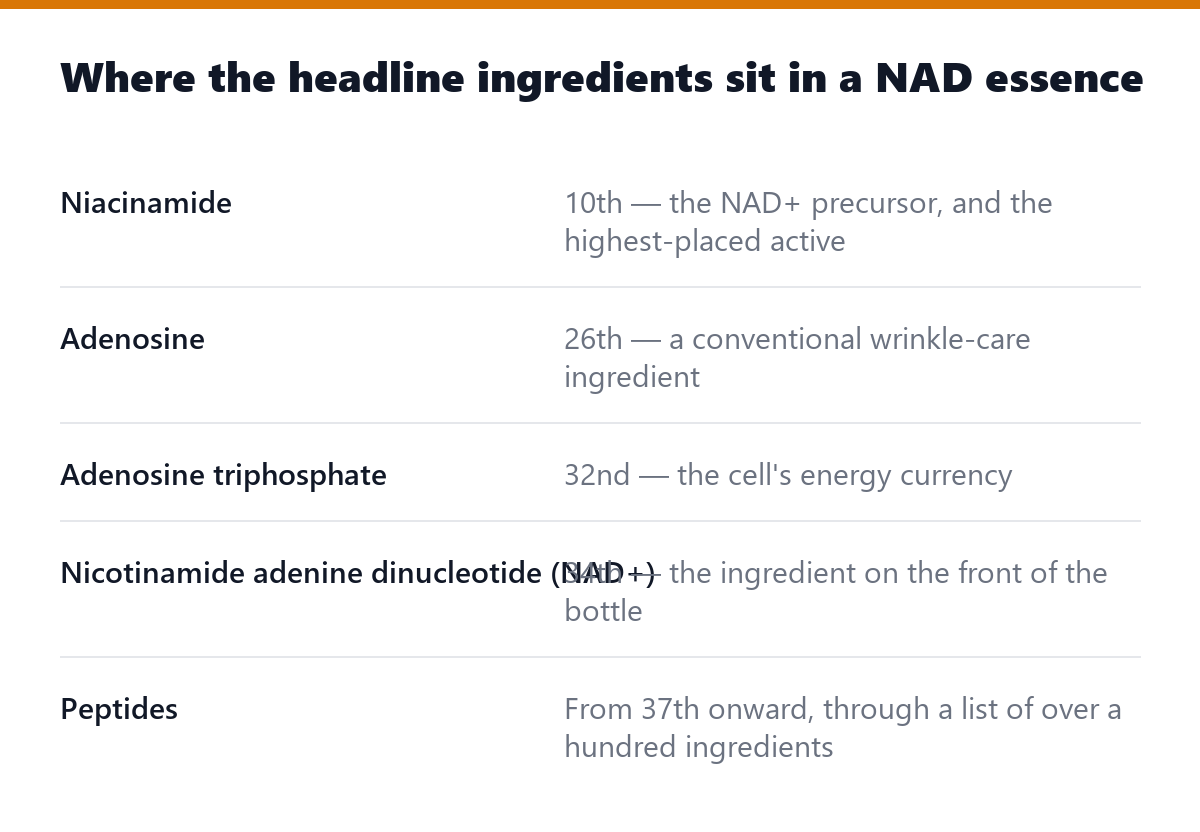
Niacinamide is tenth. NAD+ itself is thirty-fourth — below palmitic acid, stearic acid and cholesterol, and just after hydroxypropyl cyclodextrin, an encapsulating sugar that is presumably there to keep it stable.
Read plainly, the formula is a well-dosed niacinamide essence with a trace of NAD+ near the bottom. Which is not a criticism of the product — it is a description of what you are buying.
What else is in it
Adenosine at twenty-sixth is the conventional wrinkle-care active here, and a common one in Korean anti-ageing formulas. Adenosine triphosphate at thirty-second is ATP, the cell’s energy currency, which faces the same delivery question as NAD+.
Peptides begin at thirty-seventh with palmitoyl tripeptide-5 and continue through the list — the brand counts around fifty of them. As with any long peptide complex, a large count divided across one small fraction of the formula means no single peptide is present in quantity.
The base is substantial: shea butter, hydrogenated vegetable oil, dimethicone and cetearyl alcohol make this a rich essence rather than a watery one.
Check the current price on Amazon
A test for the next longevity ingredient
NAD+ will not be the last molecule to arrive from the supplement aisle. Exosomes, growth factors and ATP are already here, and the questions are identical each time. Four of them settle most cases.
Can it physically get in? Large molecules do not cross intact skin in meaningful amounts. This single question disposes of collagen, and it is the open question for NAD+ and exosomes alike.
Is the evidence in humans, on skin? Cell-culture and mouse results are where these stories start, and they frequently stop there. “Shown to boost collagen” often means shown in a dish.
Where does it sit on the panel? An ingredient below the thickeners and the fatty acids is present in trace amounts, whatever the front of the box says.
Is there a precursor that already works? This is the most useful question and the least asked. For NAD+, the answer is niacinamide — smaller, stable, cheap, and backed by decades of work.
None of this means new ingredients are fake. It means the burden of proof sits with the claim, and the ingredient list is the cheapest evidence you have access to.
Who it suits
Dry or mature skin that likes a rich essence. The texture is the honest selling point. It is comfortable, and it is doing real moisturising work.
Anyone who wants niacinamide plus adenosine in one step. That combination is sensible and well supported, whatever the bottle is named after.
People curious about the category who will not be disappointed by modest results. It is a decent essence. It is not a new mechanism.
Who should skip it
If you are buying the three letters. NAD+ is thirty-fourth and the human evidence for topical NAD+ is not there yet.
Oily or congestion-prone skin. Shea butter and hydrogenated vegetable oil high in a formula is not what oily skin wants nightly.
If you already use a good niacinamide serum. You are already supplying the precursor, at a higher position and a lower price.
FAQ
Is NAD+ just a fancy niacinamide?
Not quite — they are different molecules. But niacinamide is what your cells convert into NAD+, so for skincare purposes it is the practical, proven way to support the same system.
Do NAD supplements do more than serums?
They are a different question with its own unsettled evidence, and one for a doctor rather than a skincare site. Nothing in this article is an argument for taking them.
Why do brands use NAD+ if it cannot get in?
Because it is a genuinely important molecule with a strong story, and because encapsulation technologies keep improving. Promising does not mean proven, and ingredient lists tell you about quantity rather than performance.
Is an essence the right format for this?
For a rich, occlusive essence like this one, the format is doing more of the work than the acronym. Shea butter, hydrogenated vegetable oil and dimethicone sit high in the list, and those are the ingredients responsible for how skin feels the next morning.
That is not a complaint. Comfortable, well-moisturised skin looks smoother and reflects light more evenly, which is a real and immediate result. It is simply a different mechanism from the one the name points at, and worth knowing which one you are paying for.
How long should I give it?
Judge the essence as a moisturiser in two to four weeks, and anything to do with fine lines at eight to twelve. Sunscreen does more for ageing than any of these ingredients.
Keep reading
Fungal Acne Safe Skincare: Read Your Own Label
Sunscreen Pilling: It’s Usually Not the Sunscreen
The bottom line
NAD+ matters in cells, and that part is not marketing. Whether a cosmetic can raise it through intact skin is unproven, and in the product that popularised the claim, NAD+ sits thirty-fourth while niacinamide — the precursor your own cells use — sits tenth.
If you like the texture and want niacinamide, adenosine and peptides in one rich step, it is a reasonable essence. Just buy it for the formula rather than for the acronym.