As an Amazon Associate I earn from qualifying purchases. This post contains affiliate links, which means we may earn a commission if you buy through them — at no extra cost to you.
Quick verdict
A gentle, stable vitamin C serum built on a derivative at 50,000 ppm, with pure vitamin C present only as a 10 ppm label mention. Good for dull or uneven skin that has reacted badly to strong L-ascorbic acid serums. Not the product if you specifically want high-strength pure vitamin C — this is a different, milder category.
Vitamin C is not one ingredient. It is a family of them, and the one on the label decides how the serum behaves.
The Arencia Vitamin C Booster Shot is sold on a “dual vitamin C complex” of a derivative plus pure vitamin C. The ingredient panel is unusually specific about both — it prints the concentrations — and those two numbers tell you almost everything worth knowing about this serum.
Pure vitamin C and its derivatives are different products
Pure vitamin C appears on labels as ascorbic acid, often called L-ascorbic acid. It is the form with the deepest research behind it for brightening and antioxidant protection. It is also notoriously difficult: it breaks down on contact with air, light and water, it needs a low pH to work, and at useful strengths it stings reactive skin.
Derivatives are vitamin C molecules with something attached to make them stable. They survive in a formula for far longer and are much gentler. The trade-off is that the evidence for most of them is thinner than for the pure form, and some have to be converted by the skin before they do anything.
Neither is simply better. They are two different bets: potency with difficulty, or stability with a gentler, less proven effect. We covered where vitamin C fits against other brightening ingredients in the piece on dark spots. This serum sits firmly in the derivative camp.
The working ingredient: 3-O-ethyl ascorbic acid at 5%
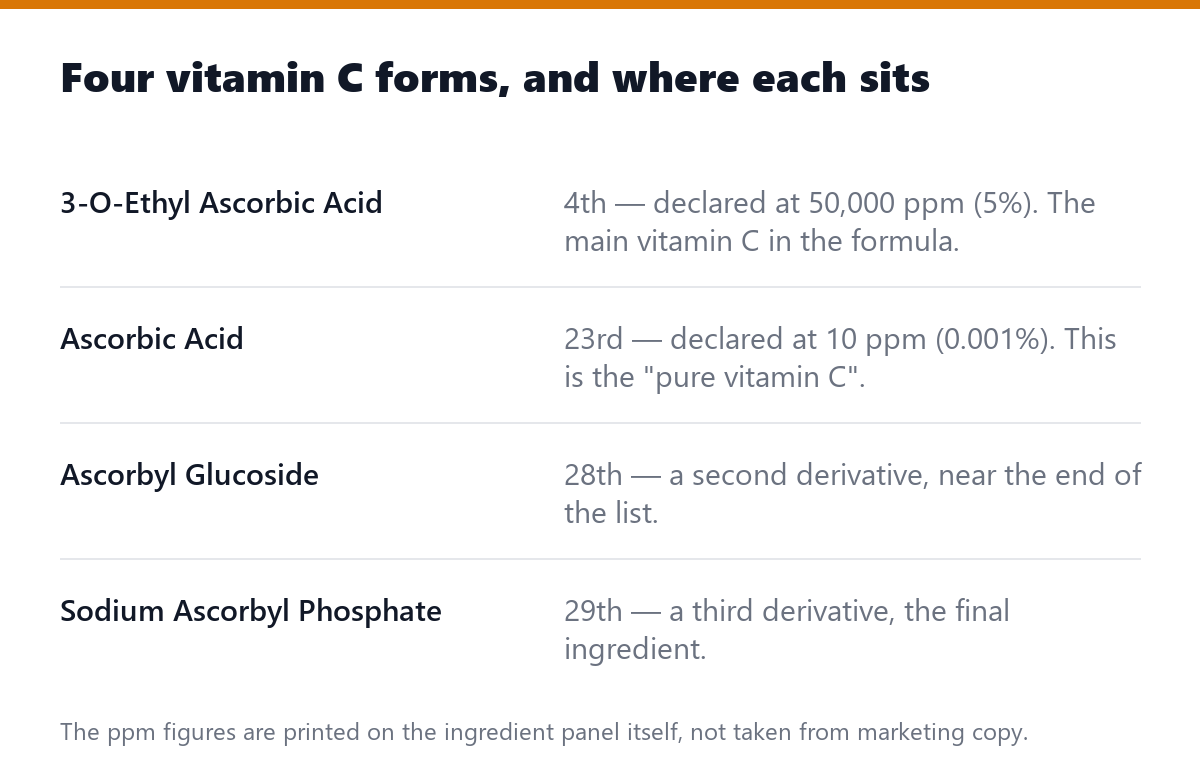
Fourth in the list, straight after water, glycerin and methylpropanediol, and declared on the panel at 50,000 ppm — five percent.
3-O-ethyl ascorbic acid is vitamin C with an ethyl group attached at the third carbon. That single change is what makes it stable. It dissolves in both water and oil, and it does not degrade the way pure vitamin C does, so the serum does not need an airless dropper, a dark bottle or a race against oxidation.
The honest caveats matter. The claim that it converts into pure vitamin C inside the skin comes mainly from ingredient manufacturers rather than independent human studies. The best-supported benefit is brightening, where there is clinical data at concentrations lower than the five percent used here. Antioxidant and collagen claims for this derivative are much less established.
So read the five percent as a meaningful, real dose of a stable brightening ingredient — not as the equivalent of a five percent pure vitamin C serum.
The “pure vitamin C” is 10 ppm
This is the detail most reviews skip, and it is printed right on the panel.
Ascorbic acid is the 23rd ingredient, declared at 10 ppm. Ten parts per million is 0.001%. For comparison, pure vitamin C serums that are sold on their vitamin C usually work in the range of several percent — thousands of times more.
At 10 ppm, the pure vitamin C is a label mention. It lets the product say it contains pure vitamin C, which it does. It is not contributing to what the serum does on your skin.
The other two forms — ascorbyl glucoside and sodium ascorbyl phosphate — are the last two ingredients in the entire list. They are there, but at the tail end.
None of this makes the serum bad. It makes it a 5% ethyl ascorbic acid serum, which is a perfectly good thing to be. It simply is not a dual-strength serum in any practical sense.
Check the current price on Amazon
The supporting cast
Niacinamide is eighth, high enough to matter, and a sensible partner for a brightening serum — it works on uneven tone through a different route. If you already use a strong niacinamide product, it is worth knowing you are doubling up; we looked at when more niacinamide stops helping in the COSRX Niacinamide 15 review.
Adenosine sits 21st, glutathione 24th, and panthenol and allantoin add a soothing layer. Tocopherol — vitamin E — is present near the end.
The base is a light emulsion: caprylic/capric triglyceride, cetyl ethylhexanoate and olive-derived emulsifiers. That is why it reads as a soft milky serum rather than the thin, sharp water that pure vitamin C serums tend to be.
There is no fragrance listed, which is a point in its favour for a product meant for daily use.
Who it suits
Anyone who has given up on vitamin C because it stung. This is the clearest case. A stable derivative in a cushioned base is a far easier daily habit than a low-pH pure vitamin C serum.
Dull or uneven skin wanting a gradual lift. Brightening is the benefit with the best support for this derivative, and it is a patient, cumulative effect.
People who hate the oxidation problem. No turning orange in the bottle, no pressure to finish it in six weeks.
Who should skip it
If you want pure vitamin C at real strength. Covered above — the pure form here is 10 ppm. Buy a product that leads with ascorbic acid instead.
If your main concern is deep, established pigmentation. A gentle derivative is a slow tool. Stubborn pigment usually needs a more targeted approach and, above all, consistent sunscreen.
If you are mid-way through a retinoid routine. The brand itself advises against combining this with retinoids, strong actives or exfoliants. Alternate nights instead, or keep it to the morning — if you are weighing retinoid options, retinal and retinol are one conversion step apart.
How to use it
The brand’s own instructions are conservative, and they are sensible: start every other day and let your skin adjust before using it daily.
In the morning, apply to clean, dry skin and follow with sunscreen. A brightening serum without daily sunscreen is working against a tide — UV exposure creates pigment faster than any serum clears it. If your sunscreen pills over serums, a thin formula like a sun serum layers more easily.
At night, apply a thin layer before moisturiser. It comes in a 30 ml size, and a couple of pumps covers a face.
FAQ
Is 5% vitamin C too weak to do anything?
For this derivative, no. Five percent of ethyl ascorbic acid is a real, deliberate dose, and brightening has been shown at lower levels. What it is not is comparable to five percent pure vitamin C — the two are measured on different scales.
Does it need to be kept in the fridge?
No. The whole point of ethyl ascorbic acid is that it is stable. Keep it out of direct sun and heat like any skincare.
Can I use it with niacinamide?
It already contains niacinamide. The old warning against combining vitamin C and niacinamide was based on pure vitamin C under conditions that do not apply to normal skincare use, and it does not apply to this derivative.
Keep reading
UNOVE Deep Damage Treatment: It’s Not the Keratin
BIOHEAL BOH 3D Lifting Cream: 17 Peptides, One Question
The bottom line
A gentle, stable, sensibly formulated 5% ethyl ascorbic acid serum, marketed as a dual vitamin C complex. The derivative is the real product; the pure vitamin C is a 10 ppm mention.
Buy it if strong vitamin C has irritated you and you want a brightening habit you can actually keep. Look elsewhere if high-strength pure vitamin C is specifically what you are after.