As an Amazon Associate I earn from qualifying purchases. This post contains affiliate links, which means we may earn a commission if you buy through them — at no extra cost to you.
Quick verdict
Most Korean SPF claims hold up, but a label number is only as good as the test behind it — and in 2021 one popular SPF 50+ sunscreen measured around SPF 19. The practical filter is whether a brand publishes independent lab results. Beauty of Joseon does, for Relief Sun; Purito rebuilt its sunscreens after the scandal but its current product page does not show the figures.
The SPF number is the one thing on a sunscreen you cannot check yourself. You are trusting a test you will never see.
For most Korean sunscreen SPF claims, that trust is warranted. But in 2021 it very publicly was not, and what happened then is the most useful guide there is to reading a sunscreen label now.
What an SPF test actually measures
The internationally used method, ISO 24444, is a test on people, not on a machine. Sunscreen is applied to volunteers’ backs at 2 milligrams per square centimetre, small areas are exposed to measured doses of UV light, and the SPF is how much more UV the protected skin can take before reddening compared with unprotected skin.
The revised standard calls for at least ten volunteers for a result worth putting on a label, with their skin tone measured by instrument.
Two consequences follow, and both matter.
SPF tests vary between labs. This is a biological test on human skin, and it is notoriously hard to reproduce. A widely cited example: when one manufacturer sent the same SPF 100 sunscreen to five labs, the results ranged from roughly 37 to 75. Lab-to-lab spread is normal, which is exactly why a single test is weaker evidence than two.
2 mg/cm² is far more than most people apply. The label number is measured at a generous layer. That is the point we made in the piece on sticks versus creams — the format that gets you closest to that amount protects you best in practice.
There is also in vitro testing, which measures UV passing through a thin film on a plate. It is cheaper and useful for screening, but it correlates poorly with results on skin, so it is not what a label SPF should rest on.
What happened with Purito in 2021
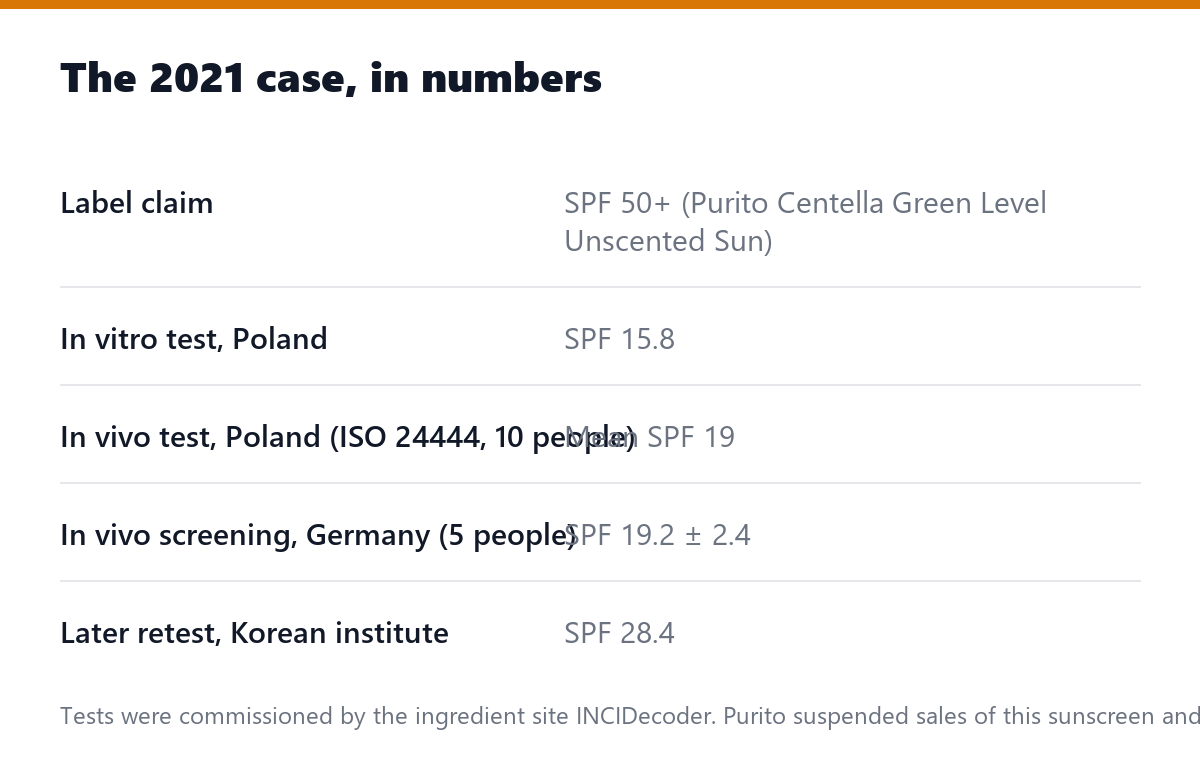
Purito’s Centella Green Level Unscented Sun was one of the most recommended Korean sunscreens in English-speaking skincare communities, labelled SPF 50+.
The founder of the ingredient site INCIDecoder doubted that its filter system could reach that level, and commissioned independent tests. An in vitro test in Poland measured SPF 15.8. An in vivo test at the same lab, following ISO 24444 with ten people, measured a mean SPF of 19. A separate in vivo screening in Germany, with five people, measured SPF 19.2 ± 2.4.
Purito suspended sales of that sunscreen and two others, and said it had relied on the SPF claim supplied by its third-party manufacturer without questioning it. A later retest at a Korean institute put the product at SPF 28.4 — better than 19, still well short of 50.
The lesson is not that Korean sunscreens are unreliable. Korea requires test results to be submitted before a sunscreen can carry an SPF claim, and most products hold up. The lesson is narrower and more useful: a claim resting on one test, supplied by a manufacturer, is only as good as that one test. That is true in every market.
The better signal: published, independent results
After 2021, some brands started doing the obvious thing — testing at more than one independent lab and saying so publicly.
That is what to look for. Two results from two labs, published with their margins, tell you far more than a number printed on a tube.
Beauty of Joseon Relief Sun: Rice + Probiotics
Who it suits: normal, oily and combination skin wanting a light chemical sunscreen with no white cast. Who should skip it: anyone avoiding niacinamide, or wanting a mineral filter.
Beauty of Joseon publishes results from two labs, one in Korea and one in Spain: SPF 52.5 ± 5.8 in Korea and SPF 63.1 ± 0.6 in Spain. Both clear 50.
The ± figures are worth reading. The Korean result has a wider spread across volunteers than the Spanish one — which is exactly the lab-to-lab variability described above, and is why two labs agreeing above 50 is more convincing than either alone.
The filter system is four modern organic filters: Uvinul A Plus, Uvinul T 150, Tinosorb M and Uvasorb HEB. None are FDA-approved, which is why this is a Korean-market formula — the gap we covered in the piece on Korean sunscreens sold in the US. It is the same four-filter combination used in the SKIN1004 Water-Fit Sun Serum. Niacinamide is eighth in the list.
Purito Seoul Daily Soft Touch Sunscreen
Who it suits: dry, dehydrated and sensitive skin, and anyone avoiding niacinamide. Who should skip it: very oily skin wanting a matte, lightweight finish.
This is one of the sunscreens Purito released after rebuilding its line. It uses four filters — Uvinul A Plus, Uvinul T 150, Tinosorb S and Tinosorb M. Tinosorb S and Tinosorb M are both broad-spectrum and photostable, and this is a notably stronger filter system than the one at the centre of 2021.
It also carries five ceramides — NP, AS, AP, NS and EOP — alongside cholesterol, which is the barrier-lipid combination that makes it the better pick of the two for dry skin. There is no niacinamide in the list.
One honest note, given the history: Purito’s current product page for this sunscreen states SPF 50+ PA++++ but does not publish lab test figures. Given what happened in 2021, published results would be the most persuasive thing the brand could show, and they are not on the page.
Check the current price on Amazon
A checklist for any sunscreen
Look for published results from more than one lab. Not a requirement, but the clearest trust signal available.
Read the filters, not just the number. A long list of modern, photostable filters makes a high SPF plausible. A thin filter system claiming SPF 50+ is what raised the alarm in 2021.
Be wary of very high claimed values. High SPFs are measured less precisely than moderate ones, and the difference between 50 and 80 matters far less than applying enough.
Apply enough, then reapply. No test result survives a thin layer applied once. If you prefer a physical filter instead, mineral sunscreens come with their own trade-offs.
FAQ
Are Korean sunscreens safe to trust after the Purito case?
Generally, yes. The case showed a failure of one manufacturer-supplied claim, not a systemic problem. Choosing products with published independent results removes most of the remaining doubt.
Why do two labs give different SPF numbers for the same sunscreen?
Because the test uses human skin and human judgement of redness. Variation between labs is expected. What matters is whether independent results consistently clear the labelled level.
Is SPF 63 much better than SPF 52?
Not meaningfully in practice. Both block the large majority of UVB when applied properly. Amount and reapplication decide real-world protection far more than the difference between those two numbers.
Keep reading
UNOVE Deep Damage Treatment: It’s Not the Keratin
BIOHEAL BOH 3D Lifting Cream: 17 Peptides, One Question
The bottom line
Korean sunscreen SPF claims are usually sound, and the 2021 Purito case is the reason to prefer brands that show their evidence rather than just print a number.
If you want a sunscreen with published results from two labs, Beauty of Joseon Relief Sun is the straightforward pick. If your skin is dry and you want ceramides and no niacinamide, the Purito Daily Soft Touch has a strong filter system — with the caveat that the brand’s page does not show its test figures.