
As an Amazon Associate I earn from qualifying purchases. This post contains affiliate links, which means we may earn a commission if you buy through them — at no extra cost to you.
Quick verdict
Marks left behind by acne usually fade on their own and respond well to vitamin C and niacinamide. Melasma is hormonal, does not resolve on its own, and is where tranexamic acid earns its place. Both are undone by sun exposure faster than any serum repairs them, which makes sunscreen the actual treatment and the serum the accelerator.
Choosing a dark spot serum usually starts in the wrong place — with the ingredient rather than with the mark. Two very different problems get sold the same solutions, and that is why so many of these purchases end in disappointment.
Before you buy anything, work out which one you are looking at.
Post-acne marks
These are the flat brown or reddish patches left behind after a spot heals. They sit exactly where the spot was, they are irregularly scattered, and they appeared after a breakout.
The important thing about them: they fade on their own. The pigment was deposited during inflammation and your skin clears it gradually over weeks to months. A product is speeding up a process that was already going to happen.
That makes this the easier of the two problems, and the one where gentler ingredients are sufficient. Vitamin C and niacinamide both interfere with pigment reaching the surface, and both are well tolerated enough for daily use.
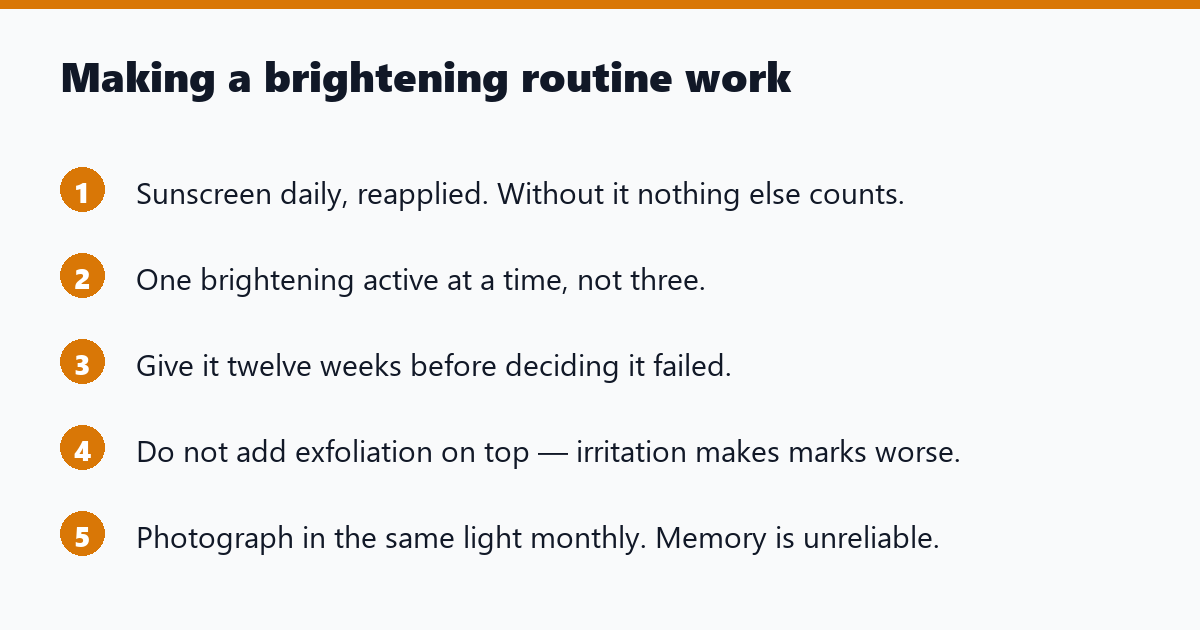
The mistake people make here is aggression. Marks from inflammation get worse with more inflammation, so attacking them with strong exfoliation on top of a strong serum tends to extend the problem rather than shorten it.
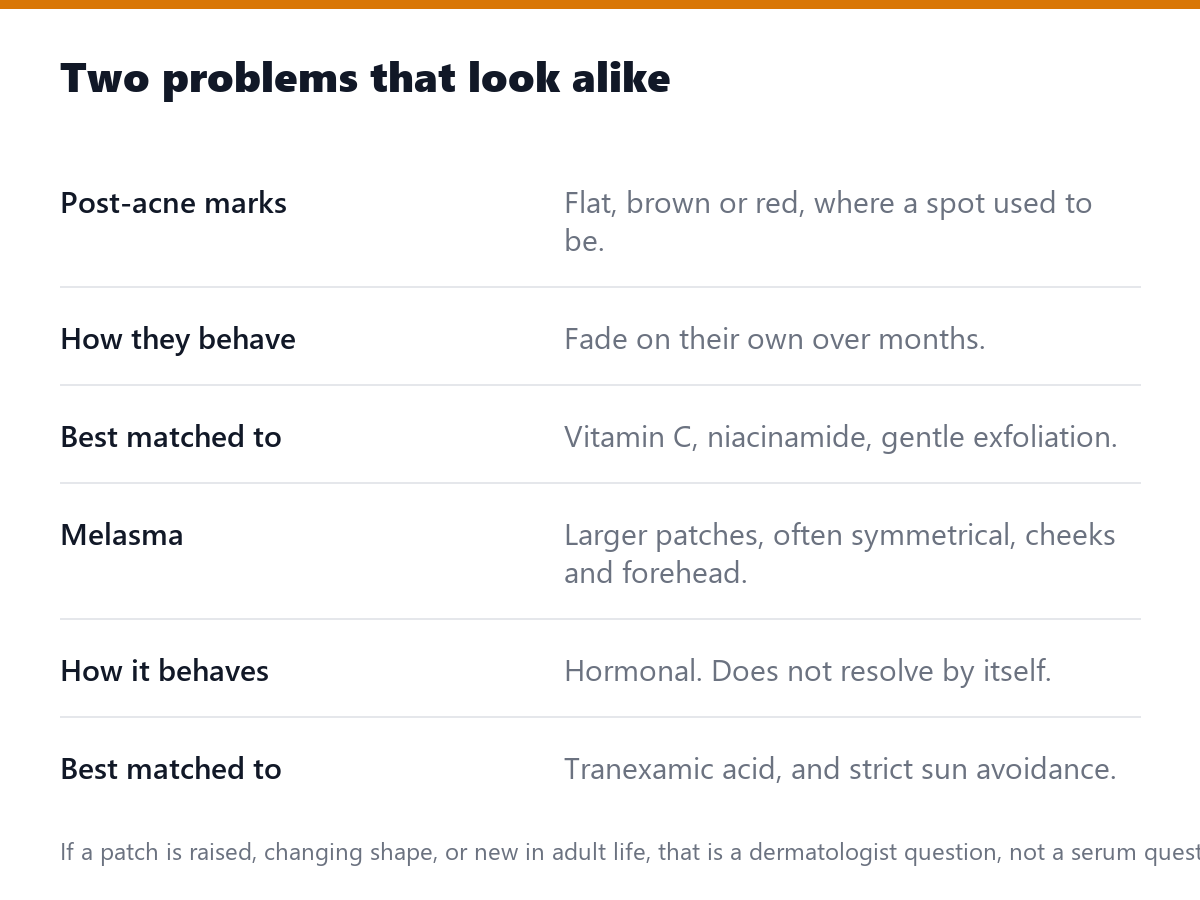
Melasma
This looks different once you know what to look for. Larger, more diffuse patches, often roughly symmetrical across the cheeks, forehead or upper lip. It is associated with hormones — pregnancy, contraception — and it is aggravated by both sunlight and heat.
Melasma does not fade on its own, and it recurs. This is where the gentler approach runs out of road.
Tranexamic acid is the ingredient that has moved this category. It works on a different pathway from vitamin C, and there is published clinical work on a topical combination of tranexamic acid and vitamin C for melasma that had resisted other treatment. Two mechanisms, one problem — which is why you see the pairing on so many Korean labels now.
It is still slow. Several weeks minimum before anything is visible, and it manages rather than cures.
Check the current price on Amazon
What the ingredients actually do
- Vitamin C. Antioxidant and pigment inhibitor. Good for general dullness and post-acne marks. Unstable in many formulas, which is why derivatives are common.
- Tranexamic acid. Interrupts the signalling between skin cells and pigment cells. The best-supported option for melasma specifically.
- Niacinamide. Blocks pigment transfer to surface cells. Gentle, slow, and useful in both cases. We looked at how much is actually needed separately.
- Propolis and antioxidant extracts. Comfort and general radiance rather than targeted pigment work. Pleasant, not corrective.
Check the current price on Amazon
The step that decides everything
Every brightening ingredient is working against ultraviolet exposure, and ultraviolet exposure wins.
Sunlight drives pigment production directly. It reverses months of progress in a summer. For melasma, heat alone can do it — which is why it flares in warm weather even under a hat.
So the honest hierarchy is: daily sunscreen is the treatment, and the serum is the accelerator. A brightening routine without sun protection is not a slower version of the same thing. It is a different thing that does not work.
If you are unsure what to use, the Korean sunscreen you buy in the US is worth understanding before you commit.
Who this suits
Anyone with marks from old breakouts. The most reliably solvable version of this problem, and the one where a gentle serum plus sunscreen genuinely delivers.
Anyone with diagnosed melasma looking for maintenance. Tranexamic acid belongs in that routine, alongside — not instead of — medical advice.
People with general dullness. Vitamin C is a reasonable everyday antioxidant even when there is no specific mark to treat.
Who should skip it
Anyone still breaking out. New marks appear faster than a serum clears old ones. Treat the acne first — the marks follow.
Anyone not wearing sunscreen daily. This is not a scolding, it is arithmetic.
Anyone with irritated skin. Brightening actives on a compromised barrier cause inflammation, and inflammation causes exactly the pigment you are trying to remove.
FAQ
How long before I see a difference?
Twelve weeks is a fair minimum for either problem, and melasma is measured in months rather than weeks. Photograph your skin in the same light once a month — memory is a poor instrument for gradual change.
Can I use vitamin C and tranexamic acid together?
Yes, and they are frequently formulated together for exactly that reason. They work through different pathways, so the combination is additive rather than redundant.
Will a dark spot serum work on freckles?
Not meaningfully. Freckles are genetic and sun-responsive. They will darken in summer and lighten in winter regardless of what you apply.
What about a mark that is raised or changing?
That is not a skincare question. Anything raised, changing shape or colour, or newly appearing in adult life should be looked at by a doctor rather than treated with a serum.
Keep reading
Collagen Can’t Get In. A Peptide Serum Can.
Korean Face Mists: What Water in a Bottle Can Do
The bottom line
A dark spot serum works when it is matched to the mark. Post-acne marks want vitamin C and niacinamide and patience; melasma wants tranexamic acid and a much longer horizon.
Get that match right and both improve. Get the sunscreen wrong and neither will, whichever bottle you bought.