As an Amazon Associate I earn from qualifying purchases. This post contains affiliate links, which means we may earn a commission if you buy through them — at no extra cost to you.
Quick verdict
Retinal sits one enzymatic step from retinoic acid where retinol sits two, which is why it is commonly cited as roughly ten times more potent at the same percentage. That makes it a faster route to results and a faster route to a damaged barrier if you start there. Begin with retinol if you have never used a retinoid, and treat retinal as the step after that — not the starting point.
The retinal vs retinol question comes up constantly and gets answered badly, usually with some version of “retinal is just stronger.” That is true and it is not the useful part.
The difference is a single chemical step, and understanding that step tells you which one you should be using, how fast you can expect anything, and why starting at the wrong end is how people end up abandoning retinoids entirely.
Your skin can only use one form
Vitamin A does its work in the skin as retinoic acid. That is the only form that binds to the receptors and changes anything.
Everything sold over the counter is a precursor. Your skin converts it, one enzymatic step at a time, and each conversion loses some of the material along the way.
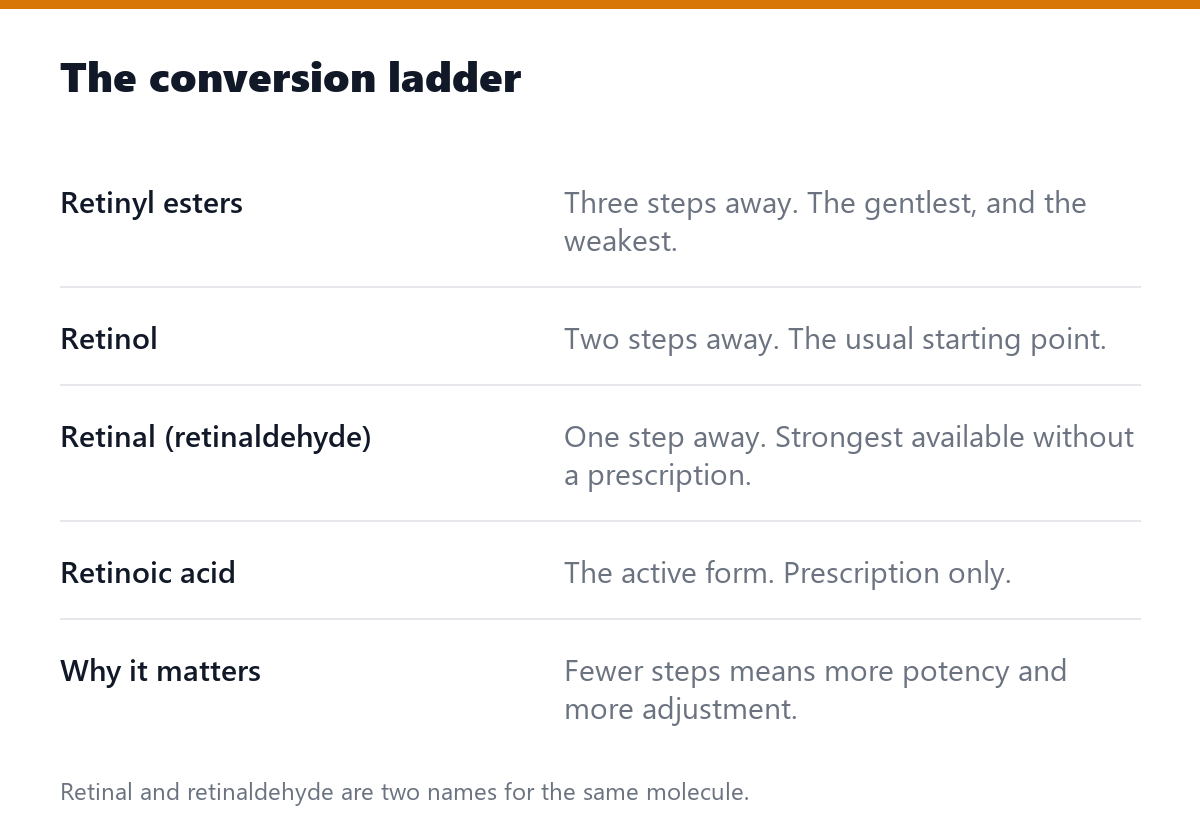
The ladder runs: retinyl esters → retinol → retinal → retinoic acid.
Retinyl palmitate is three steps out, which is why it is gentle and largely ineffective. Retinol is two steps out and has the most consumer research behind it. Retinal is one step out — the closest you can get to the active form without a prescription.
Prescription tretinoin skips the ladder entirely. It is retinoic acid, which is why it works fastest and irritates most.
What the retinal vs retinol strength gap means
You will see retinal described as roughly ten times more potent than retinol at the same percentage. Treat that as a widely repeated approximation rather than a precise conversion factor — it comes from the number of steps and the losses at each one, not from a single definitive study.
What it means practically is more useful than the number:
- 0.1% retinal is not a beginner product. It is closer in effect to a much higher retinol percentage than the small number suggests.
- Results arrive sooner. Weeks rather than months, for texture and fine lines.
- So does the adjustment period. Dryness, flaking and sensitivity show up faster too.
The instability problem
Here is the part that decides whether a retinal product is worth buying at all.
Retinal is unstable. Retinol is already awkward to formulate around — light, air and heat all degrade it — and retinal is worse. A poorly packaged retinal product loses potency on the shelf, and there is no way to tell by looking.
So the packaging is part of the product. Opaque, airless, and small is what you want. A clear jar with a screw lid is a bad sign regardless of what the ingredient list says. Small volumes are a feature here rather than poor value — you want to finish it before it degrades.
Encapsulation and liposomal delivery, which several Korean formulas advertise, address the same problem: protecting the molecule until it is on your skin.
Check the current price on Amazon
The adjustment period is not damage
Most people who quit retinoids quit in the first month, and they quit because nobody told them what was normal.
Expected: mild dryness, some flaking, skin that feels slightly tight for a few weeks. This settles as your skin adapts.
Not expected: burning, persistent redness, raw or weeping skin. That is not adjustment, that is a damaged barrier, and pushing through it makes things worse for months.
The difference is whether your skin is getting better week by week or worse. If it is worse in week three than week two, reduce the frequency rather than continuing.
How to start
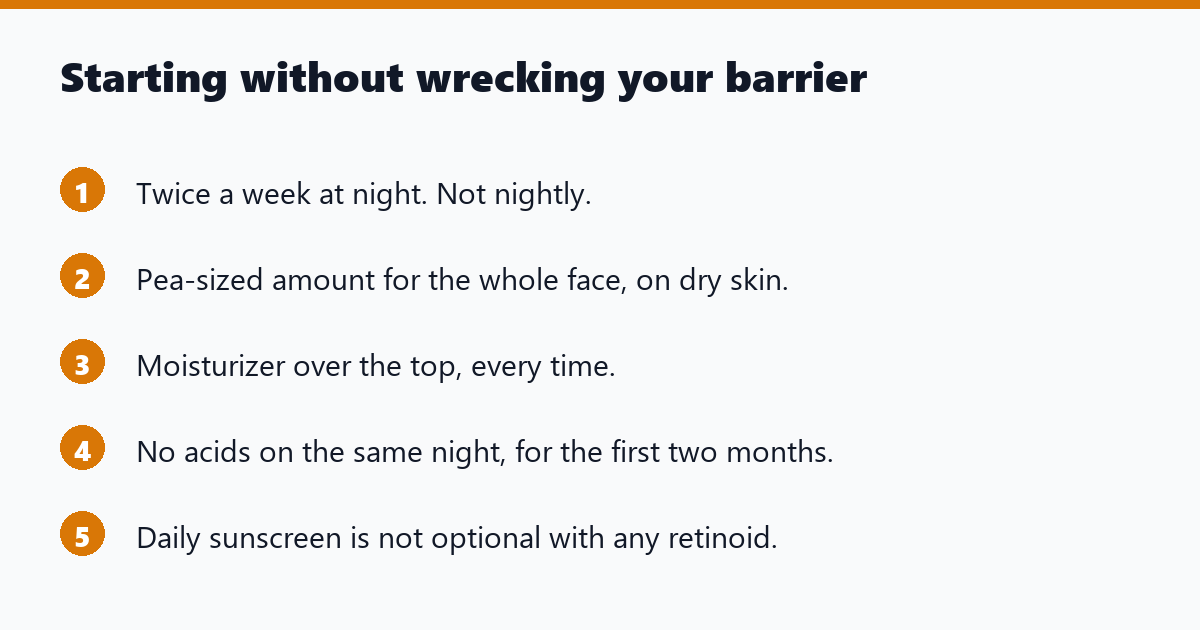
Twice a week, at night, on dry skin. A pea-sized amount covers the whole face — more does not work faster, it just irritates.
Follow with a moisturizer every time. If your skin is reactive, apply the moisturizer first and the retinoid over it — this buffers the delivery and costs you very little effectiveness.
Do not use acids on the same night for the first two months. Both are working on cell turnover and stacking them is the most common way to end up with a barrier you have to spend a month repairing.
And sunscreen daily, without exception. Retinoids increase sun sensitivity, and sun exposure undoes the collagen work you are doing.
Which one should you buy
The retinal vs retinol decision comes down to where you already are.
Never used a retinoid: start with retinol. Establish that your skin tolerates vitamin A at all before moving up the ladder. Some products pair a retinal booster with a gentler retinol serum for exactly this reason.
Check the current price on Amazon
Comfortable on retinol, want more: retinal is the logical next step and the reason to make it is speed, not because retinol stopped working.
Sensitive or reactive skin: stay on retinol, buffer it, and go slowly. Retinal will get you to the same place faster and with more collateral damage.
Already on prescription tretinoin: there is no reason to add retinal. You are past both.
Check the current price on Amazon
Who should not use either
Anyone pregnant or trying to conceive. Retinoids are contraindicated in pregnancy. This is not a caution to weigh — speak to a doctor and use something else in the meantime.
Anyone with a currently damaged barrier. Repair first. Retinoids on compromised skin are how a two-week problem becomes a two-month one.
Anyone unwilling to wear sunscreen. This is not a moral point. You will be increasing sun sensitivity while undoing the benefit.
FAQ
Is retinal the same as retinaldehyde?
Yes — two names for the same molecule. It is also easy to misread as “retinol” on packaging, which is worth checking when the difference in strength is this large.
How long before I see results?
Texture and fine lines improve over weeks with retinal and months with retinol. Pigmentation takes longer than either. Twelve weeks is a fair point to judge.
Can I use it with niacinamide?
Yes, and it helps. Niacinamide supports barrier function during the adjustment period, which is exactly when you need it. Same for cica.
Morning or night?
Night. Retinoids degrade in light and increase photosensitivity, so there is no upside to daytime use.
Do I need to stop before a beach holiday?
Reducing frequency for a week of heavy sun exposure is sensible, particularly if you are still in the adjustment phase. Restart at a lower frequency afterwards rather than where you left off.
Keep reading
haruharu wonder Black Rice: Toner or Essence?
numbuzin Numbers: They Aren’t Strengths or Steps
The bottom line
The retinal vs retinol choice is really a question about where you are, not which molecule is better. Retinal is one conversion step from the active form and retinol is two, and that single step is worth roughly an order of magnitude in strength.
If you have never used a retinoid, that gap is not an advantage — it is the reason most people give up. Start two steps out, get comfortable, then move up.