As an Amazon Associate I earn from qualifying purchases. This post contains affiliate links, which means we may earn a commission if you buy through them — at no extra cost to you.
Quick verdict
A serum-textured SPF 50+ built on four modern filters the US has never approved, which is the whole reason it feels the way it does. Good for oily and combination skin that abandons thick sunscreen by noon, and for anyone reapplying over makeup. Skip it if you want a mineral filter, or if you need something that survives swimming.
Sunscreen you actually reapply beats sunscreen you apply once and resent. Texture is not a vanity concern here — it is the compliance concern.
The SKIN1004 Water-Fit Sun Serum takes that argument literally: an SPF 50+ built to the consistency of a hydrating serum rather than a cream. Whether that is worth anything to you depends entirely on why your current sunscreen annoys you.
What “sun serum” means on a label
Nothing regulated. There is no serum category in sunscreen rules. A product is a sunscreen at the SPF it tests to, and everything else is formulation choice.
What it means in practice is the base. The second ingredient here is dibutyl adipate, a thin fast-spreading ester, and the emollients following it are lightweight ones. There is no heavy occlusive load and no mineral powder to suspend, so the product spreads like an essence and dries down without a film.
We have made the case before that the format you choose changes how much product you actually apply. A serum sits at the far end of that scale: it is the easiest texture to apply generously, and generosity is the entire mechanism of sun protection.
The trade-off is the other side of the same coin. Thin, fast-absorbing, non-greasy formulas are generally not the ones that hold up through sweat and water.
The filter list is the real story
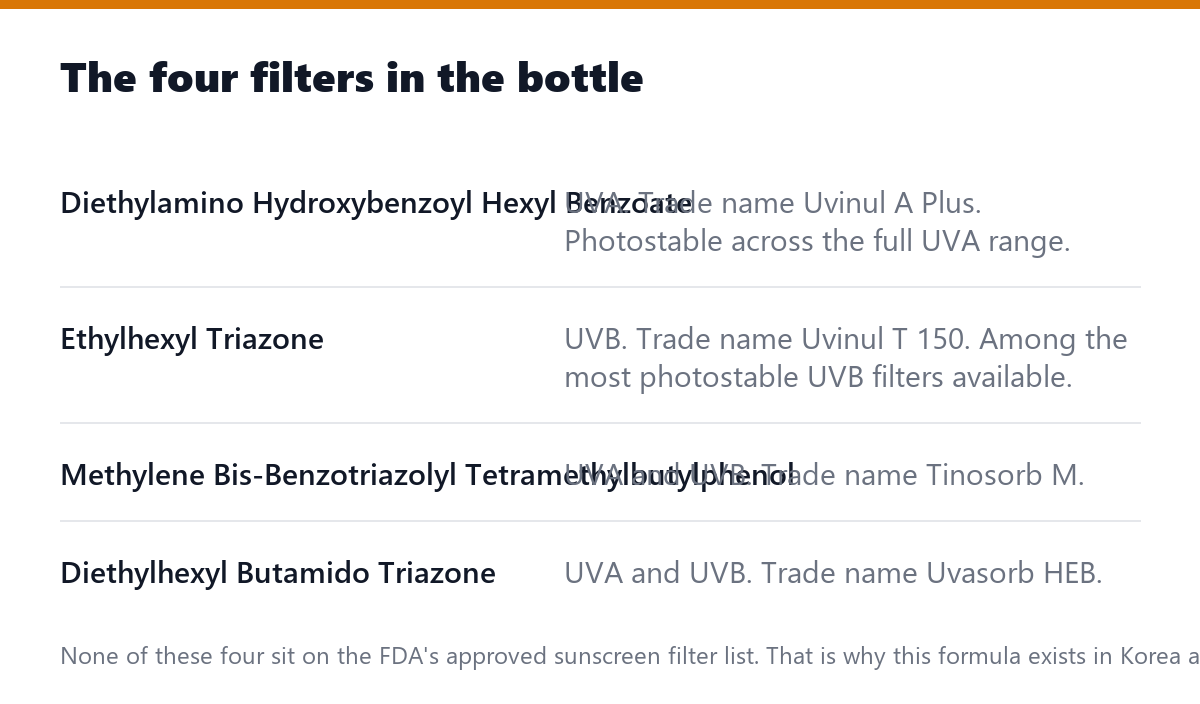
Four UV filters, all of them the modern organic kind: Uvinul A Plus for UVA, Uvinul T 150 for UVB, and Tinosorb M and Uvasorb HEB covering both ranges.
Two things follow from that list.
First, this is why it feels like a serum. These filters dissolve cleanly and work at low use levels, so the formula does not need the heavy oil load or the whitening mineral powder that older filter systems require to reach SPF 50.
Second, this is a Korean formula and it stays that way. None of the four appear on the FDA’s approved filter list, which is why an American-made sunscreen cannot be built like this. It is exactly the gap we mapped in the piece on Korean sunscreens sold under one name in two countries — and it is worth checking which version is in front of you, because reformulated US editions are common.
The centella and the hyaluronic acid, honestly
The name promises both. The ingredient list quantifies both, which is unusually candid, and the two numbers are not remotely comparable.
Centella asiatica extract is declared at 9,800 ppm — just under one percent, positioned above the botanical extracts that follow it. That is a real inclusion. Centella is the calming ingredient in nearly every Korean soothing product for good reason, and we have covered when it earns its place and when it is decoration. Here it is a supporting act in a sunscreen, not a treatment.
The hyaluronic acid is declared in single-digit parts per million. Sodium hyaluronate at 10 ppm, hydrolyzed hyaluronic acid at 1 ppm, hyaluronic acid at 0.01 ppm. Those are label-claim quantities. The hydrated feel comes from the propanediol, glycerin and butylene glycol far higher in the list, not from the hyaluronic acid in the product name.
Niacinamide sits eighth, above the botanicals, making it the highest-placed active in the formula after the filters themselves.
Who it suits
Oily and combination skin. The clearest case. If your objection to sunscreen is the film it leaves by mid-afternoon, a serum base removes the film.
Anyone reapplying over makeup. A thin fluid layers over a made-up face better than a cream does, and reapplication is where most sun protection is lost in real life.
Deeper skin tones avoiding white cast. No mineral filters means no cast. That is a property of the filter system, not a claim about the brand.
Who should not buy it
If you want mineral only. This is entirely organic filters. Zinc oxide belongs to a different category of product with a different set of compromises.
If you need water resistance. A light serum base is the wrong tool for swimming or heavy sweating. Reach for something built for it.
If your skin reacts to botanical blends. There is no added fragrance in the list, which helps, but the plant extract section is long, and long botanical lists are a reasonable thing for reactive skin to be cautious about.
Check the current price on Amazon
How to use it without wasting it
The thin texture invites under-application, which is the failure mode of every serum sunscreen. Two finger-lengths for the face is the standard measure and it applies here regardless of how light the product feels.
Let it set for a couple of minutes before makeup. Organic filters form their film as the vehicle evaporates, and rushing that step is what causes pilling.
Reapply every couple of hours outdoors. This is the part everyone skips, and it is the part a serum texture is genuinely better at — a cream you have to blend into a made-up face is a cream you will not reapply.
What SPF 50+ and PA++++ mean
Two different scales measuring two different things, and Korean sunscreens print both.
SPF measures UVB protection, the wavelengths responsible for burning. The number is a ratio derived from how much longer protected skin takes to redden. The plus sign after 50 exists because most regulators cap the printed figure there — a formula testing above 50 is labelled 50+ rather than given a larger number, on the reasoning that the differences past that point are small and easy to over-trust.
PA measures UVA protection, the wavelengths associated with long-term photoageing rather than burning. It runs from PA+ to PA++++, with four pluses being the top of the scale.
The practical point is that a high SPF alone tells you nothing about UVA. A formula can protect well against burning and poorly against the wavelengths that matter over decades. The filters in this one — two of them dedicated UVA or broad-spectrum — are why the UVA rating sits where it does.
How it fits with the rest of the line
SKIN1004 built its reputation on centella, and this is the sunscreen in a range where the ampoule is the better-known product. The two are complementary rather than redundant: the ampoule is a treatment step with centella as the point, and this is a sunscreen with centella as a supporting ingredient.
If you are layering both, the order is ampoule, moisturiser if you use one, then this last before makeup. Sunscreen always goes on top of skincare and under colour. Nothing goes over sunscreen except makeup.
One habit worth avoiding: mixing sunscreen into moisturiser to save a step. Dilution reduces the film, and the film is the product. Apply them separately even when it takes an extra minute.
FAQ
Is a sun serum weaker than a sun cream?
No. SPF is measured on the finished product at a fixed application amount, so an SPF 50+ serum and an SPF 50+ cream tested to the same figure protect the same when applied the same way. The difference is in how likely you are to apply enough.
Can I use it as my moisturiser too?
On oily skin, often yes — the humectants sit high in the list. On dry skin, no. Apply your moisturiser first, let it settle, then this on top.
Is the US version the same formula?
Check the ingredient panel before assuming. Korean sunscreens frequently ship a different filter system to the US market because of the approval gap, and the packaging can look nearly identical.
Keep reading
Squalane vs Squalene: One Letter, Two Outcomes
Bakuchiol vs Retinol: Gentler Is the Whole Point
The bottom line
This is a well-built modern sunscreen whose main selling point is textural, and texture is a legitimate thing to buy. The filter system is the good part, the centella inclusion is real, and the hyaluronic acid in the name is a rounding error.
Buy it if your problem with sunscreen is that you stop wearing it. Do not buy it expecting a treatment product, and do not take it in the water.