As an Amazon Associate I earn from qualifying purchases. This post contains affiliate links, which means we may earn a commission if you buy through them — at no extra cost to you.
Quick verdict
Tested SPF assumes a thick, measurable layer, and most people apply a fraction of it. A cream lets you judge the quantity; a stick makes that judgement almost impossible, which is why sticks under-deliver in practice. Use a cream or serum as your morning base where the amount matters, and keep a stick for reapplication over makeup where nothing else works.
The number on a sunscreen bottle is not a property of the bottle. It is the result of a test performed with a specific quantity of product on skin, and that quantity is far more than almost anyone applies.
That single fact decides the whole sunscreen stick versus cream question, and it decides it more clearly than any comparison of textures.
The number assumes a thick layer
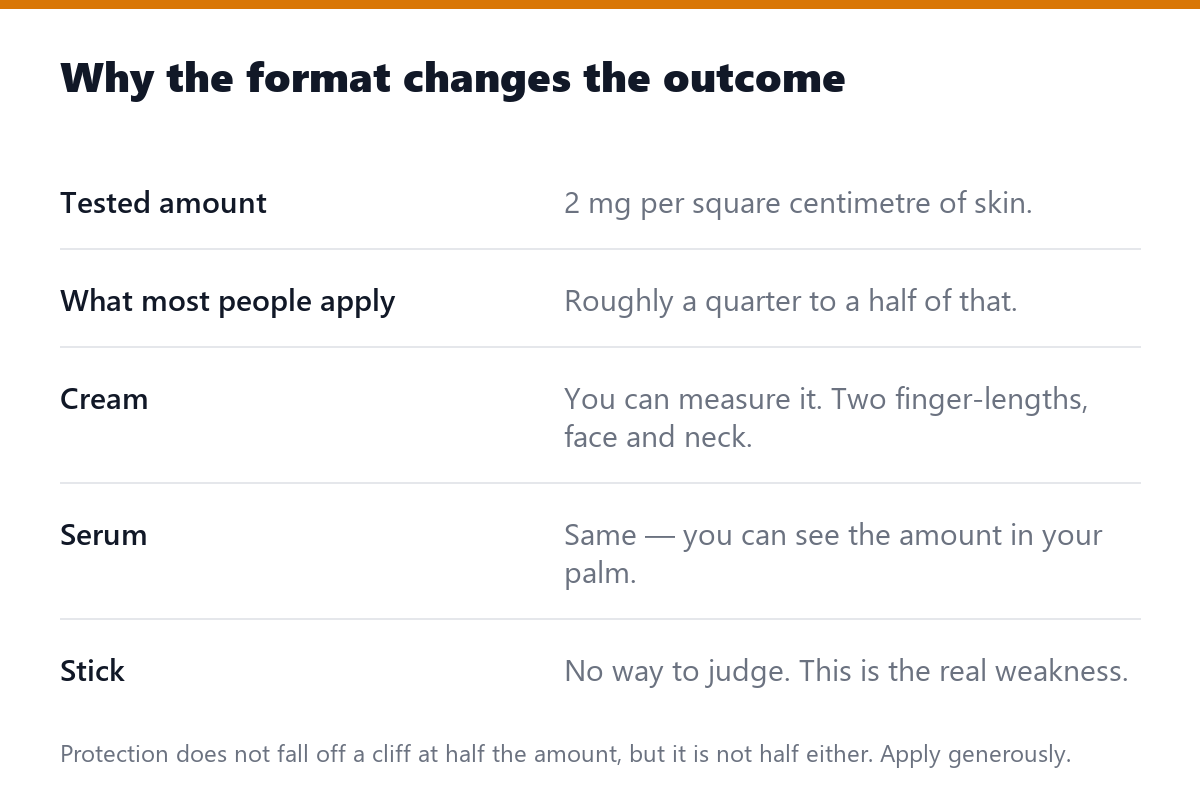
SPF testing uses 2 milligrams of product per square centimetre of skin. That is a genuinely thick layer — more than most people would consider a normal application.
Studies of real-world use consistently find people applying roughly a quarter to a half of that. So the SPF 50 on the tube is not the SPF 50 on your face.
Protection does not scale in a simple straight line, and half the amount is not exactly half the protection. But it is meaningfully less, and the gap is the single largest source of sunscreen failure — bigger than the choice of filters, bigger than the brand.
Why a cream wins on this
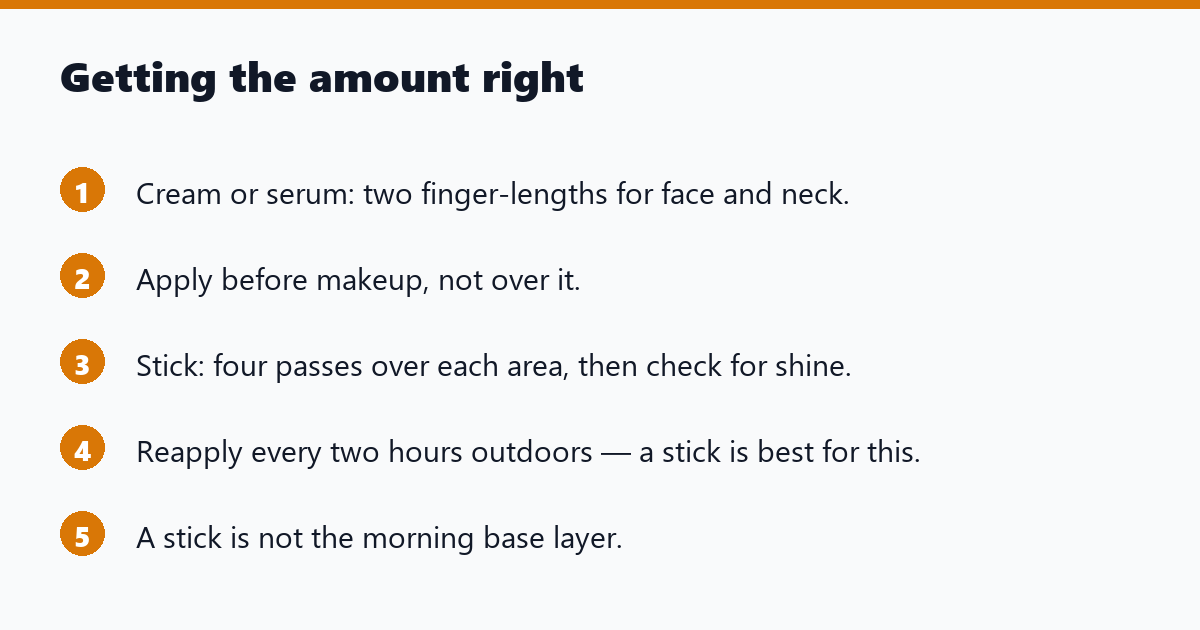
With a cream or a serum you can see the amount in your hand. The two-finger rule — a length of product along each of two fingers, for face and neck — exists because it is a rough physical measure of the tested quantity.
It is imprecise, and it is infinitely better than guessing. You have a visible reference before it touches your face.
Check the current price on Amazon
Serum-format sunscreens have the same advantage with a lighter finish. For anyone who avoids sunscreen because creams feel heavy, this is the format that fixes the compliance problem — and a sunscreen you actually wear beats a better one you skip.
Check the current price on Amazon
Why a stick loses on it
Here is the honest problem with the format.
You cannot judge how much you have applied. There is no measurable quantity in your hand, no visible layer to compare against. “Swipe it a few times” is not a measurement, and the number of passes needed to reach the tested amount is more than most people do.
This is not a formulation flaw. A stick can contain exactly the same filters at the same percentages as its cream sibling and test to the same SPF in a laboratory. It under-delivers because of how it gets used.
If you use one as your base layer, four or five deliberate passes over each area, then checking for an even sheen, is the minimum. Most people do one or two.
Where the stick genuinely wins
One job, and it is a job nothing else does.
Reapplication over makeup. Sunscreen needs reapplying every couple of hours outdoors, and there is no practical way to reapply a cream over a finished face. A stick goes over makeup without disturbing it.
That makes a sunscreen stick a genuinely useful second product rather than a replacement for the first. Cream in the morning where the amount matters, stick in your bag for the afternoon.
It is also the sensible choice for awkward areas — around the eyes, the hairline, the tops of ears — where a cream is fiddly and people simply skip.
Check the current price on Amazon
Before you compare brands
Two things matter more than which sunscreen you pick.
Amount. Covered above, and it dwarfs everything else.
Which version you are buying. Korean sunscreens sold in America are frequently reformulated with a different filter system, because the filters used in Korea are not FDA-approved. We went through how to tell the two apart — and the mineral versions are the exception.
Who should buy which
Cream or serum as your base, everyone. This is where the amount matters and where you can control it.
Stick as a second product, if you are outdoors or wear makeup. Reapplication is the reason to own one.
Serum specifically, if you dislike sunscreen texture. The lightest option that still lets you measure.
Who should skip the stick
Anyone planning to use it as their only sunscreen. The amount problem is not solvable by good intentions.
People with very dry skin. Sticks are wax-based and can drag on dry skin, which discourages the generous application they already need more of.
FAQ
How much sunscreen is enough for the face?
Roughly two finger-lengths for face and neck together. It will look like too much. That is the correct amount.
Do sunscreen sticks actually work?
Yes, when enough is applied. The formula is not the weakness — the inability to judge the quantity is.
How often should I reapply?
Every two hours outdoors, and after swimming or heavy sweating. Indoors away from windows, a single morning application is generally sufficient.
Can I skip moisturizer if my sunscreen is hydrating?
You can, but many people then apply less sunscreen because it is doing two jobs. Keep them separate if that risk applies to you.
The bottom line
A sunscreen stick is a reapplication tool that gets sold as a sunscreen, and used as a base layer it quietly delivers a fraction of the protection printed on it.
Buy a cream or a serum for the morning, where you can see how much you are using. Buy a stick for the afternoon, where nothing else works. The formats are not competing — they are doing different jobs.