As an Amazon Associate I earn from qualifying purchases. This post contains affiliate links, which means we may earn a commission if you buy through them — at no extra cost to you.
Quick verdict
If you want a Korean sunscreen whose active ingredient is the same one sold in Korea, buy a mineral one. Zinc oxide is approved in both markets, so it does not have to be swapped out the way the newer chemical filters do. The trade-off is the one mineral sunscreens always carry: a heavier finish and some cast risk on deeper skin tones.
A Korean mineral sunscreen is the one case where the usual warning does not apply, and it is worth understanding why before you spend money on either kind.
We have covered the general problem already: Korean sunscreens sold in America are frequently rebuilt with a completely different set of UV filters, because the filters used in Korea are not approved by the FDA. Same brand, same name, different product. Mineral sunscreens are the exception, and the exception is instructive.
Why chemical formulas get rebuilt
Sunscreen is regulated as a drug in the United States and as a cosmetic almost everywhere else. That means an American sunscreen can only use UV filters on the FDA’s approved list, and that list barely moved for twenty-five years.
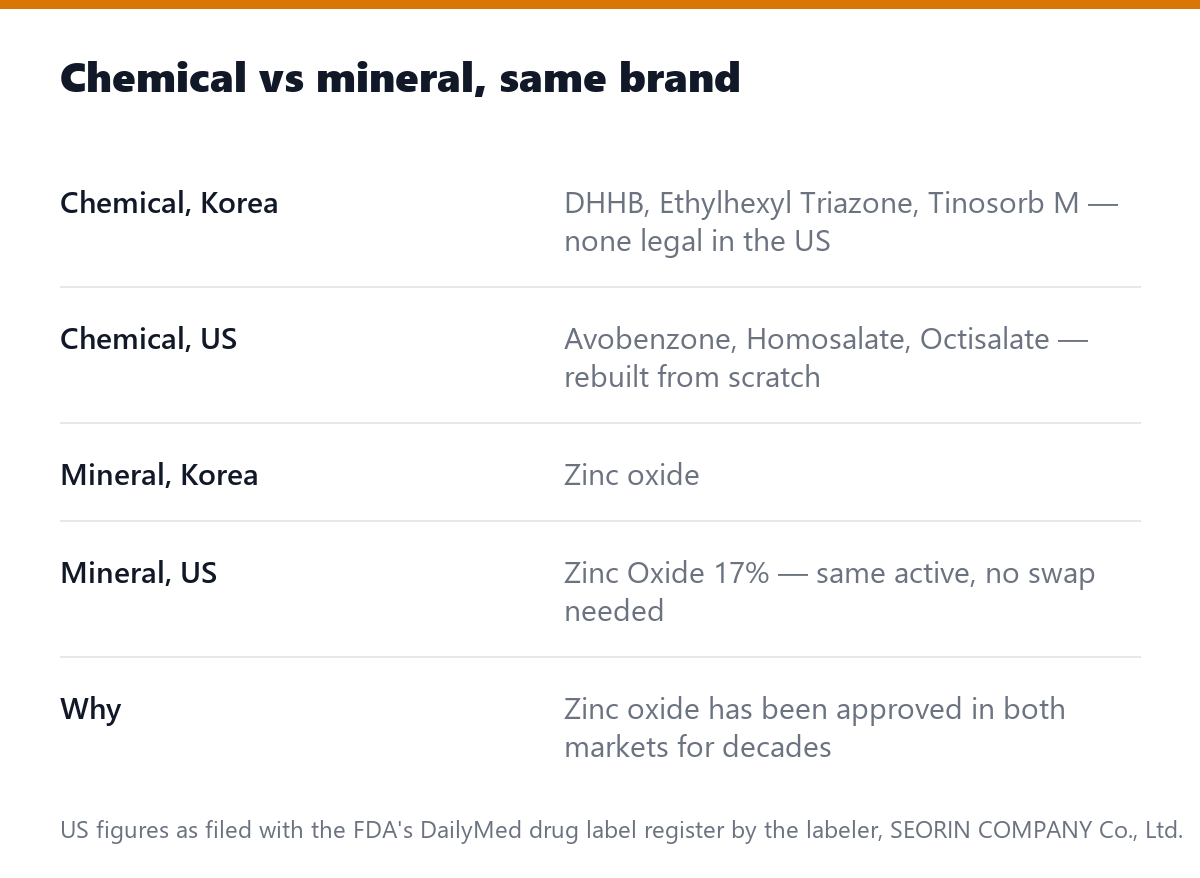
Korean formulators spent those decades working with filters like DHHB, Ethylhexyl Triazone and Tinosorb M — newer, lighter, and unapproved in the US. To sell here, a brand has to rebuild the formula around what the FDA permits, which in practice means avobenzone, homosalate and octisalate.
That is why the SPF number, the texture and the finish all change between markets, and why the reviews you read do not transfer.
Zinc oxide is the exception
Zinc oxide has been approved as a sunscreen active in the United States for decades. It is also used freely in Korea. There is no regulatory reason to swap it out.
Round Lab is a useful example because both of its formats are documented. The chemical version had to be rebuilt entirely. The mineral version — the Mild-Up UVLock — is filed with the FDA’s drug label register as SPF 50 Broad Spectrum with a single active: Zinc Oxide 17%.
That is the same active you would buy in Seoul. Not a substitute, not a workaround — the same ingredient doing the same job, because it was never the problem.
Worth stating plainly, because this gets overclaimed: the active is the same, not necessarily the entire formula. Brands adjust bases, textures and preservative systems between markets for reasons that have nothing to do with the FDA. What you can rely on is that the part doing the actual sun protection has not been substituted.
What 17% zinc oxide actually means
The FDA permits zinc oxide up to 25%, so 17% sits high in the usable range without being at the ceiling.
Two things follow from that. The first is that a single mineral filter at that concentration reaching SPF 50 Broad Spectrum is a real formulation achievement — zinc oxide is a weaker UVB absorber than the chemical filters, so getting there without help takes work.
The second is the trade-off, and it is unavoidable. Zinc oxide is a white powder. Modern grades are milled fine enough to reduce the effect dramatically, but the physics does not go away entirely. If you have deeper skin, a mineral sunscreen is always the higher-risk purchase for cast, whatever the marketing says.
Mineral is not the safer option
This is the part of the Korean mineral sunscreen pitch that deserves pushback.
Mineral sunscreens are widely marketed as gentler, cleaner, or safer than chemical ones. The evidence for that framing is thin. What is true is narrower and more useful: zinc oxide sits on the skin rather than absorbing into it, which makes it a reasonable first choice if you have previously reacted to a chemical sunscreen, and which is why it appears in products aimed at irritated or post-procedure skin.
That is a real advantage for a specific group of people. It is not a general safety ranking, and choosing mineral for vague purity reasons means accepting a heavier finish for no benefit you can point at.
If your skin is currently unhappy, the sunscreen is not the first thing to change — the barrier is.
How to tell what you are actually buying
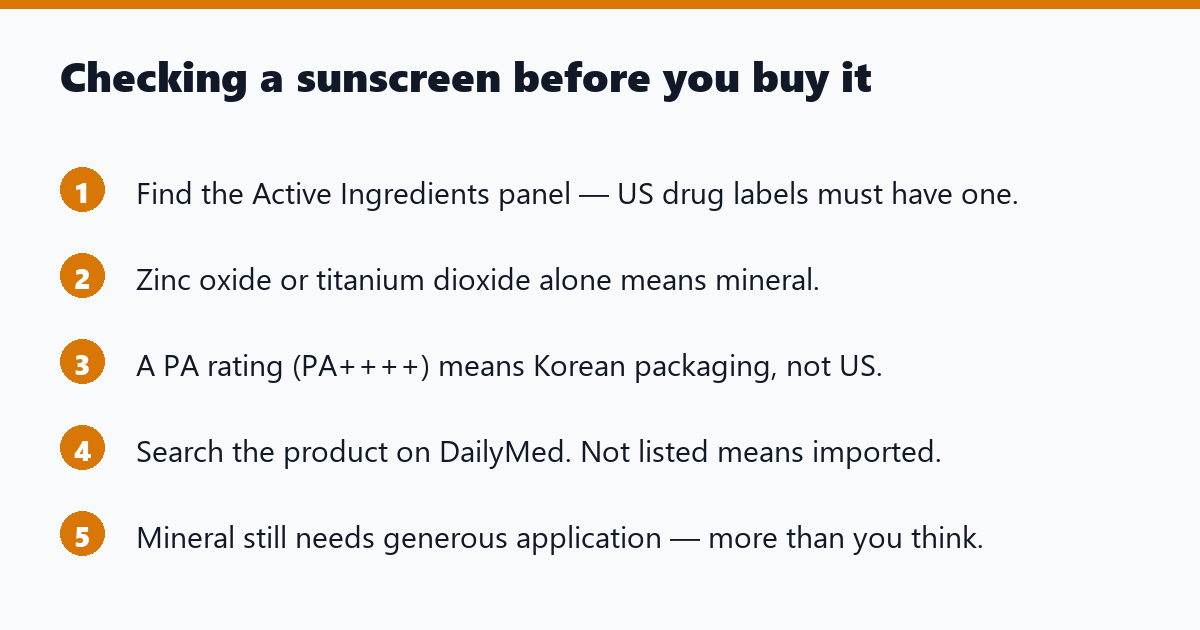
The active ingredients panel answers this faster than any review.
- Zinc oxide or titanium dioxide, alone — mineral, and almost certainly the same active as the Korean version.
- Avobenzone, homosalate, octisalate, octocrylene — a US-market chemical formula, rebuilt for this market.
- Tinosorb, Uvinul, DHHB, Ethylhexyl Triazone — the Korean chemical formula, imported.
- A PA rating on the packaging — Korean labelling. US drug labels do not carry PA.
If you want to be certain, search the product on the FDA’s DailyMed register. Every sunscreen legitimately sold in the US has to be filed there. Several popular Korean sun products on American marketplaces are not — which tells you what they are.
Check the current price on Amazon
Who this suits
A Korean mineral sunscreen makes the most sense for three groups in particular.
Anyone who reacted to a chemical sunscreen. This is the clearest case. Switching to a single-active mineral formula removes several variables at once.
Anyone who wants the Korean product, not a substitute. If the reformulation issue is what has been putting you off, mineral sidesteps it.
Oily and combination skin. Zinc oxide has a naturally matte, slightly absorbent finish, which is a drawback on dry skin and useful here.
Who should look elsewhere
Deeper skin tones, if cast is a dealbreaker. A well-formulated modern mineral sunscreen is far better than it used to be, but a chemical formula remains the lower-risk choice for invisibility.
Dry skin in cold weather. The matte finish that helps oily skin works against you here. Layer it over a richer moisturizer or pick a chemical formula.
Anyone who under-applies. Mineral sunscreens are less forgiving of a thin layer than chemical ones, and most people apply well under the tested amount regardless.
FAQ
Is mineral sunscreen better for sensitive skin?
It is a reasonable first thing to try if you have reacted to a chemical sunscreen, because zinc oxide stays on the surface rather than absorbing. That is a narrower claim than “better for sensitive skin” in general, and worth treating as such.
Does SPF 50 from zinc oxide alone actually work?
Yes. The Broad Spectrum designation on a US label is earned through a critical-wavelength test performed after UV exposure, so a product carrying it has demonstrated UVA protection that survives irradiation. The number is tested, not asserted.
Why does the Korean version say SPF 50+ PA++++ and the US one SPF 50?
Labelling conventions, not formula. The US does not use the PA system at all — it has a single pass-or-fail Broad Spectrum designation instead. Different scales measuring overlapping things.
Will it pill under makeup?
Mineral sunscreens pill more readily than chemical ones because they sit as a layer rather than sinking in. Letting it set for a few minutes before the next step solves most of it.
Keep reading
Korean Sunscreen in the US: Same Name, Different Bottle
SKIN1004 Centella Ampoule: Seven Ingredients, One Job
The bottom line
A Korean mineral sunscreen is the version that arrives in America more or less intact, and that is a genuine reason to prefer one if the reformulation problem has been bothering you.
It is not the safer option, or the cleaner one, or the one everybody should buy. It is the one where the active ingredient survives the trip — and you pay for that with a heavier finish and a cast risk that mineral formulas have never fully escaped.