As an Amazon Associate I earn from qualifying purchases. This post contains affiliate links, which means we may earn a commission if you buy through them — at no extra cost to you.
Quick verdict
A well-built centella moisturiser whose most active ingredient is the niacinamide near the top of the list, not the retinol near the bottom. Good for dry or dull skin that wants one calming cream doing several small jobs. Not the product to buy if you want a real retinoid, and check your seller carefully — this line is heavily counterfeited.
Centella creams all make the same promise, so the only way to tell them apart is to read what is in them and in what order.
Madeca Cream Time Reverse is one of the biggest of them, from a brand built on a pharmaceutical company’s centella research. The ingredient list is long, unusually informative, and says something rather different from the marketing.
TECA is not one ingredient
The brand sells this on TECA — Titrated Extract of Centella Asiatica. It sounds like a single proprietary compound. It is not.
TECA is a standardised fraction of the centella plant: the extract is purified until the three characteristic compounds sit at fixed proportions rather than at whatever the harvest happened to give. On a label, that shows up as those compounds listed individually.
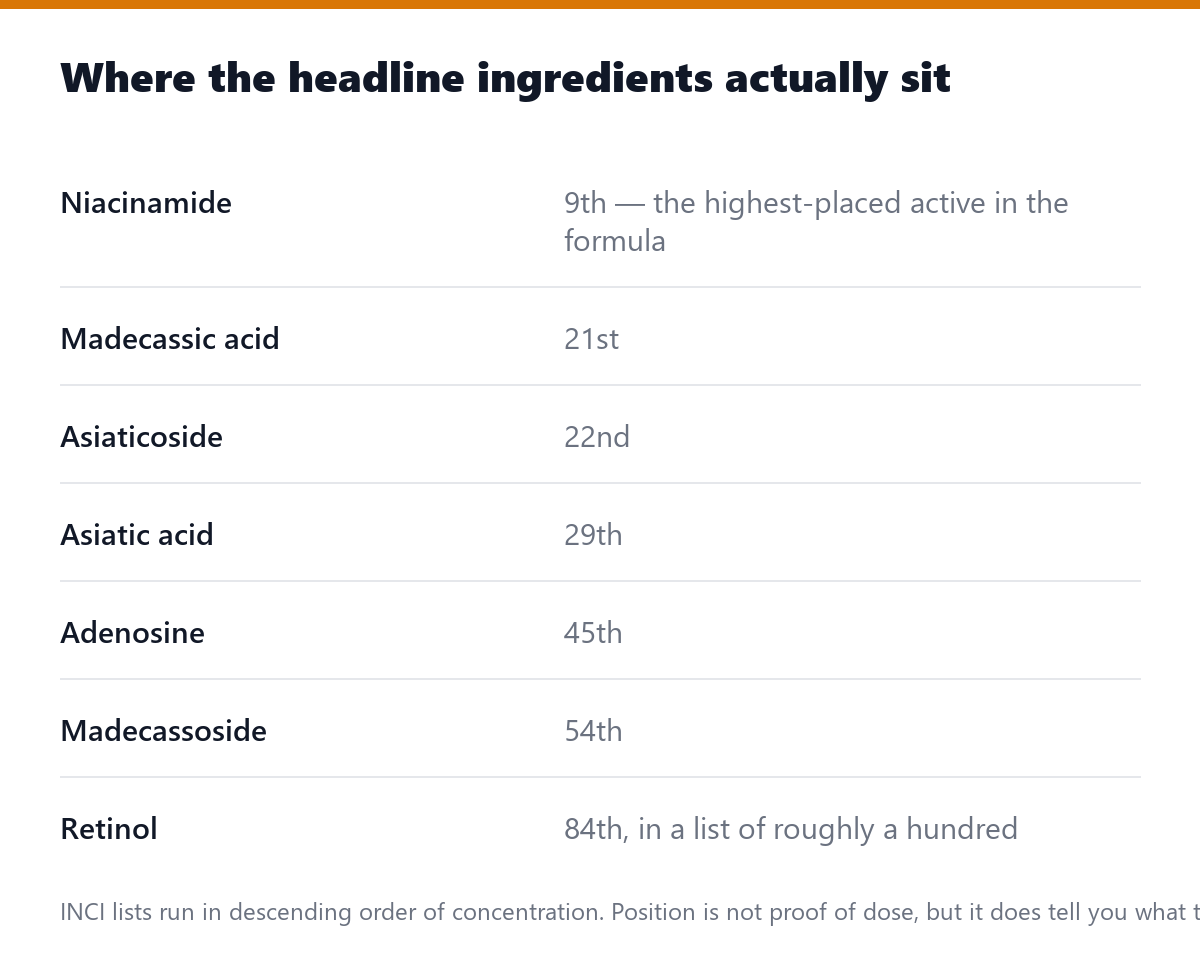
Here they are the 21st, 22nd and 29th ingredients — madecassic acid, asiaticoside, asiatic acid — with madecassoside appearing much further down at 54th, alongside centella protein extract, centella oil and centella leaf extract scattered through the rest of the list.
That is the difference between a titrated extract and a plain one, and it is the same distinction we drew in the piece on reading centella labels. A product naming the individual compounds is telling you more than one naming only “Centella Asiatica Extract”.
The ingredient doing the visible work is the niacinamide
Ninth in the list, above every centella fraction and above every botanical. Nothing else with a mechanism sits that high.
Niacinamide is the most reliably useful thing in this jar: it supports barrier function, moderates the look of uneven tone, and is well tolerated. If you notice the cream doing anything over a few weeks, this is the likeliest reason.
That is not a criticism. It is a correction of emphasis. The cream is sold on centella and time reversal, and the workhorse is a well-dosed niacinamide moisturiser with a good centella fraction supporting it.
The retinol is 84th
It is in there. It is also below the fragrance oils, below the ferment ingredients, and below most of the botanical extracts, in a list of roughly a hundred entries.
This matters because retinol is dose-dependent in a way that few skincare ingredients are. A retinol at that position is not going to behave like a retinol product. If retinol is what you want, buy something that leads with it — and if the reason you are avoiding one is irritation, the gentler alternatives are a genuine conversation rather than a trace inclusion.
Adenosine, at 45th, is the other wrinkle-associated ingredient here, and it is a common one in Korean anti-ageing formulas.
Check the current price on Amazon
Who it suits
Dry or dehydrated skin wanting one cream to do several small things. That is what this is, and it is genuinely good at it. The base is rich without being heavy — hydrogenated polydecene, caprylic/capric triglyceride and jojoba esters rather than a wall of butters.
Skin that gets red and stays red. The centella fraction is the reason to choose this over a plain moisturiser, and it is the part of the formula that is honestly well built.
Anyone building a simple routine. One cream with niacinamide, a titrated centella fraction, panthenol, allantoin and ceramide NP in it removes several other steps.
Who should skip it
If you want an actual retinoid. Covered above. This is not that product.
If fragrance is a problem for you. There is a long list of citrus, lavender, rosemary and rose oils in the second half of this formula. Fragrant essential oils are a common trigger on reactive skin, and there are unscented centella creams — we have compared several.
If you are shopping purely on price. This line is widely counterfeited, and a suspiciously cheap listing is a red flag rather than a bargain. Buy from a seller you can identify.
The base is quietly the best part
Skip past the actives for a moment and read the structure of the cream, because that is what you feel every morning.
The emollient system is hydrogenated polydecene and caprylic/capric triglyceride — light, silky, non-greasy esters rather than heavy butters. Glycerin and dipropylene glycol carry the hydration. Cetyl alcohol, stearyl alcohol and beeswax build the body. Jojoba esters and a small amount of olive oil sit in the middle.
That is why it reads as rich without reading as heavy, and it is a more deliberate piece of formulation than most centella creams manage. There is also ceramide NP, panthenol and allantoin in here — the standard barrier-support trio, and a sensible thing to have alongside a soothing extract rather than instead of one.
If barrier repair is specifically what you are after, it is worth understanding what that phrase actually describes before you shop on it, because it is applied to almost everything.
On counterfeits, which is a real problem here
This product is copied at scale. That is what happens to anything selling in the volumes this line does, and it is the single most practical thing to know before ordering.
Three habits that help. Check who the seller is, not just the listing — a brand-operated or major-retailer storefront is a different risk profile from an unfamiliar third party. Compare the ingredient panel on what arrives against the brand’s own published list. And treat an unusually low price as information, because a counterfeit is priced to look like a deal.
None of this is unique to this brand. It is simply more relevant here than for a product nobody bothers faking.
How to layer it
This is the last step of a morning routine before sunscreen, or the last step at night. It is a cream, not a treatment, and it belongs on top of anything thinner.
If you use an ampoule or serum, that goes first. If you are wondering which of those words means what, the categories are less defined than they look — the practical rule is thinnest first.
Give it thirty seconds to settle before sunscreen. A cream that is still wet under sunscreen is the usual cause of pilling, and people blame the sunscreen for it.
FAQ
Is TECA better than madecassoside?
They are not competing options. Madecassoside is one compound; TECA is a standardised blend that includes related compounds. A product can contain both, and this one does.
Does the season number on the packaging matter?
The line has been reformulated across releases, so the ingredient panel on the box you receive is the only reliable guide. Do not assume a review of one release describes another.
Can I use it with a separate retinol product?
Generally yes, and that is a more sensible structure than relying on the trace amount here. Apply the treatment first and this as the cream over it, and introduce the retinoid slowly.
Keep reading
Squalane vs Squalene: One Letter, Two Outcomes
Bakuchiol vs Retinol: Gentler Is the Whole Point
The bottom line
A genuinely well-formulated centella cream that is being marketed on the wrong ingredient. The niacinamide and the titrated centella fraction are the reasons to buy it; the retinol at 84th is not.
If you want a calming daily moisturiser with a real centella fraction in it, this is a strong one. If you came for the time reversal in the name, adjust your expectations before you order.