As an Amazon Associate I earn from qualifying purchases. This post contains affiliate links, which means we may earn a commission if you buy through them — at no extra cost to you.
Quick verdict
Topical glutathione has modest, real support for reducing the look of pigmentation — and the effect fades once you stop, because nothing permanently changes how your skin makes melanin. Worth buying if it sits high in the list alongside niacinamide and tranexamic acid, which carry more evidence than glutathione does. Not worth buying as a lightening treatment, and useless without daily sunscreen.
Glutathione is the ingredient behind most of the skin-lightening industry, and almost none of that industry is topical. That gap is the whole story of a glutathione serum.
What glutathione is
It is a small protein your cells already make — three amino acids joined together — and its day job is antioxidant defence. It is one of the main things keeping your cells from oxidative damage.
The pigment connection is real. Glutathione interferes with tyrosinase, the enzyme that starts melanin production, and it pushes melanin synthesis toward pheomelanin, a lighter pigment, rather than eumelanin, the darker one.
That mechanism is why glutathione is sold as injections and pills across Asia — a practice with real safety concerns attached, and well outside what any serum is doing.
What the topical research supports
Less than the marketing, more than nothing.
Reviews of the published trials describe modest improvements in brightness and in hyperpigmented patches over roughly eight to ten weeks, in formulas using fractions of a percent. The studies are small, and the effect sizes are moderate.
Two caveats come up repeatedly and both matter for a buying decision.
The effect is not permanent. It reverses after you stop. You are suppressing an ongoing process, not resetting it.
It is inconsistent. Results vary between people and between areas of the same face.
That is an honest picture of a supporting ingredient. It is not the picture the category name implies.
Reading one of these formulas
The PURCELL L-Glutathione Flexible Liposome is a useful example because its list is short — twenty-one ingredients — and the order is informative.
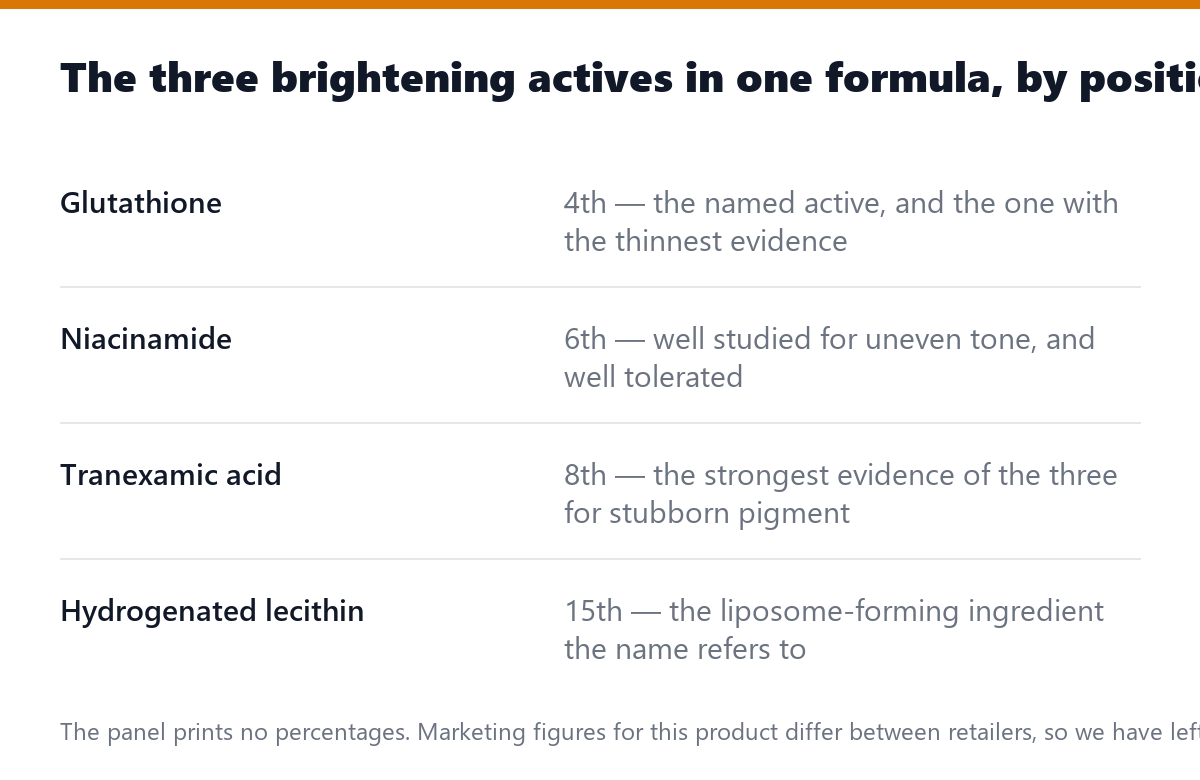
Glutathione is fourth, after water, butylene glycol and glycerin. For the named active, that is a genuine inclusion rather than a sprinkle.
But look at what follows. Niacinamide is sixth and tranexamic acid eighth — and between them they carry considerably more evidence for uneven tone than glutathione does. Tranexamic acid in particular is the ingredient dermatology reaches for with stubborn pigment, which we covered in the piece on why not all dark spots are the same problem.
So the serum is better than its headline ingredient. If it works for you, all three are contributing, and the two you did not buy it for may be doing more of the work.
Cysteine appears at eighteenth — a glutathione building block. Dipotassium glycyrrhizate, from liquorice root, sits at seventeenth and is a mild soothing and tone ingredient in its own right.
The panel prints no percentages, and the figures quoted for this product differ between retailers, so we are not repeating them.
Check the current price on Amazon
What “flexible liposome” means
The relevant ingredient is hydrogenated lecithin, fifteenth, with cholesterol just after it.
Lecithin forms liposomes — microscopic spheres that carry an ingredient and shield it from the rest of the formula. This matters more for glutathione than for most actives, because glutathione oxidises readily. Encapsulation is a sensible formulation answer to a real stability problem.
What encapsulation does not do is turn a modest ingredient into a strong one, and no ingredient list can tell you how much was encapsulated. It is the same caution we set out when another Korean serum put “capsule” in its name.
Where a brightening serum fits in a routine
Brightening is the area of skincare where people buy the most products and change the least, usually because the routine around the serum is working against it.
Apply it in the morning and at night. Glutathione, niacinamide and tranexamic acid are all stable enough for daytime use, and twice-daily application is how the trial protocols run.
Put it on before anything rich. It is a thin, water-based serum, so it goes on early — straight after cleansing, or after a watery toner.
Do not stack four brightening products. A vitamin C serum, a glutathione serum, a niacinamide serum and an arbutin essence is not four times the effect; it is four times the chance of irritation, and irritation itself causes pigment in darker skin tones.
Give it a season, not a fortnight. Pigment turns over slowly. If you cannot commit to two months of consistent use, the money is better spent on sunscreen.
The rest of the formula
The short list is worth finishing, because what is absent matters as much as what is present.
Panthenol sits ninth and dipotassium glycyrrhizate seventeenth — both soothing, which is a sensible inclusion in a product aimed at pigment, since inflammation drives pigmentation.
Carnitine at eleventh is an unusual choice, more often seen in body products.
And the absences: no fragrance, no essential oils, no silicones, no alcohol. For a brightening serum intended for twice-daily use on skin that may already be reactive, that is the right set of omissions — and it also makes this one of the easier serums to fit into an oil-free routine.
Who it suits
Dull, uneven tone rather than defined spots. Overall radiance is where the evidence is least shaky.
Skin that reacts to strong vitamin C. This is a gentler route to the same goal — as is a stable vitamin C derivative.
Anyone who wants a short list. Twenty-one ingredients, fragrance-free, no oils. Easy for reactive skin to tolerate.
Who should skip it
If you want visible lightening. No topical does what the injections are marketed for, and the serum will disappoint against that expectation.
If melasma is the problem. That needs a plan with a dermatologist. Pigment that sits deep does not respond to a serum alone.
If you will not wear sunscreen daily. This is not a throwaway line. UV creates pigment faster than any brightening serum clears it, so without sunscreen you are paying to stand still — and the SPF number is worth checking too.
FAQ
Is a glutathione serum the same as the injections?
No, and that difference is the point. Injections put it into the bloodstream at doses a serum cannot approach, with safety questions a cosmetic does not raise. A serum works on the surface and its effects are modest and reversible.
How long before I see anything?
The trials run eight to ten weeks. Judge it at two months of daily use, not at two weeks.
Can I use it with vitamin C or acids?
Yes. Glutathione, niacinamide and tranexamic acid all layer comfortably with the usual routine. Introduce one new thing at a time.
Does it help with acne marks?
Partly, and the distinction is worth making. The brown mark left after a spot heals is post-inflammatory hyperpigmentation — real melanin, deposited while the skin was inflamed. That is the kind of pigment these three ingredients act on, and tranexamic acid in particular has support for it.
The red or purple mark is a different thing. That is a vascular change rather than pigment, and it fades on its own over weeks to months regardless of what you apply. A brightening serum does nothing for it, so judge the serum on the brown marks only.
Does it work on tanned skin?
It slows pigment production; it does not undo exposure. If you are tanning faster than the serum suppresses, nothing changes.
Keep reading
Fungal Acne Safe Skincare: Read Your Own Label
Sunscreen Pilling: It’s Usually Not the Sunscreen
The bottom line
Topical glutathione has a real mechanism and modest, temporary evidence behind it. A serum built on it is worth buying when glutathione is high in the list and sitting alongside niacinamide and tranexamic acid — which is exactly this formula’s shape.
Buy it for gradual evenness over a couple of months, keep using it or the effect fades, and wear sunscreen or none of it counts.