As an Amazon Associate I earn from qualifying purchases. This post contains affiliate links, which means we may earn a commission if you buy through them — at no extra cost to you.
Quick verdict
A ferment-based moisturiser with a long peptide complex sitting in the middle of the ingredient list. Worth it if you want peptides delivered in a cream rather than a serum and you value the texture. Not worth it if you expected a lifting effect — no topical cream tightens tissue, and seventeen peptides do not change that.
Seventeen peptides is a number chosen to be printed on a box. It is worth asking what it buys.
The BIOHEAL BOH Probioderm 3D Lifting Cream is a ferment-led moisturiser with an unusually long peptide complex in it, and the ingredient list is clear enough to say something useful about both halves of that description.
What a peptide can and cannot do
Peptides are short chains of amino acids. The useful ones act as signals: applied to skin, they are associated with prompting the cells below to behave as though repair is needed.
The distinction that matters is the one we drew in the piece on collagen versus peptides. A collagen molecule is too large to cross the skin barrier in any meaningful amount, which is why collagen in a jar mostly functions as a humectant. A peptide is small enough to be a plausible messenger. That is the entire argument for peptide skincare, and it is a reasonable one.
What no peptide does is lift. There is no topical ingredient that repositions tissue. “Lifting” in a product name describes a category, not a mechanism, and reading it any other way sets you up for disappointment.
Where the seventeen actually sit
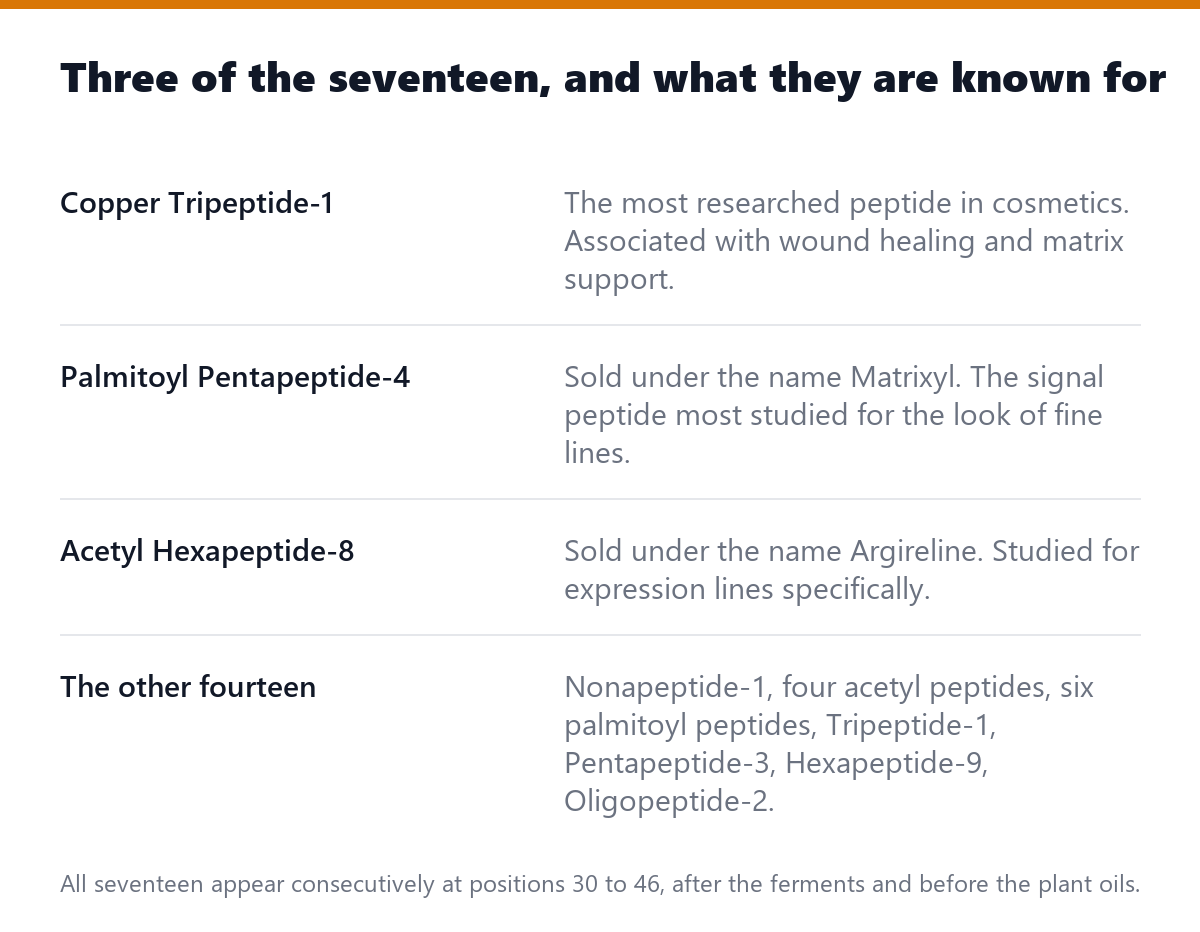
Consecutively, at positions 30 through 46 of the list. Every one of them is grouped together, after the ferment ingredients and the beta-glucan, before the plant oils and the thickeners.
Two readings of that, and both are fair.
The sceptical one: a block of seventeen ingredients that far down the list is, collectively, a small fraction of the formula. Divided seventeen ways, no single peptide is present in quantity. If you wanted one well-dosed peptide, this is not how you would build the product.
The generous one: peptides are active at low concentrations by design, which is what being a signal means. And several of the seventeen are the ones with actual literature behind them — copper tripeptide-1, palmitoyl pentapeptide-4, acetyl hexapeptide-8 — rather than seventeen obscure ones assembled for the count.
Adenosine sits just above the block at 28th. It is the ingredient in this formula most conventionally associated with the look of wrinkles.
The probiotic part
Lactobacillus ferment lysate is the second ingredient, straight after water. That is the highest position any active occupies in this cream, and it is what the Probioderm name refers to.
Ferment lysates are a well-established class in Korean formulation — the broken-down products of bacterial culture, used as conditioning and soothing agents. Lactobacillus ferment, fructooligosaccharides, fructan and inulin follow further down, which together read as a prebiotic-and-postbiotic framing rather than live cultures. Nothing in a shelf-stable cream is alive.
Beta-glucan, panthenol and soluble proteoglycan round out the soothing side. There is no niacinamide in this formula, which is worth knowing if you were expecting one.
Check the current price on Amazon
Who it suits
Skin that wants peptides in a cream, not a serum. Most peptide products are thin serums that need a moisturiser over them. This collapses two steps into one, and the base is a proper cream — shea butter, meadowfoam seed oil, cetearyl alcohol.
Normal to dry skin in its thirties and up. The formula is aimed squarely there and the richness matches.
Anyone whose skin is easily irritated by actives. There is no acid, no retinoid and no high-strength vitamin C here. It is a gentle formula, and gentleness is a real feature.
Who should skip it
If you read “lifting” literally. Nothing in a jar does that. Managing that expectation is the single most important thing to say about this product.
Oily or congestion-prone skin. Shea butter, palm oil and hydrogenated rapeseed oil make a heavier base than oily skin usually wants at night.
If fragrance is an issue. Fragrance is the final ingredient, which means very little of it, but it is present.
The base you will actually notice
The peptides are the marketing. The texture is what you experience twice a day, so it is worth reading.
Meadowfoam seed oil sits seventh — an unusual choice, and a good one. It is a notably stable oil with a light, non-tacky feel, which is why it turns up in creams meant to be worn under makeup. Cetearyl alcohol, glyceryl stearate and cetearyl olivate build the emulsion; shea butter and a small amount of palm oil add richness lower down.
The humectant side is glycerin and dipropylene glycol high up, with betaine, pentylene glycol and beta-glucan supporting. Nothing exotic, all of it sensible.
The result is a cream that is substantial without being greasy — closer to a rich lotion than a balm. If your comparison point is a heavy night cream, this is lighter than that.
Ferments, and why Korean formulas are full of them
Putting a ferment lysate in second position is a deliberate statement, so it is worth explaining what that class of ingredient is.
A ferment ingredient is the filtered output of culturing a microorganism on a substrate. What ends up in the bottle is not the organism but what it produced and what it broke down: amino acids, peptides, organic acids, sugars, sometimes vitamins. The appeal to formulators is that this arrives as a naturally complex mixture of small, water-soluble molecules.
The prebiotic framing — fructooligosaccharides, fructan, inulin — is the other half. Those are sugars that gut research associates with feeding beneficial bacteria; on skin the evidence is younger and thinner, and honesty requires saying so.
What is fair to say is that ferment lysates are well tolerated, hydrating, and have a long track record in Korean formulation. What is not fair is describing a shelf-stable cream as containing probiotics in the sense most people mean.
How to get something out of a peptide cream
Peptides are slow. Nothing here works in a week, and any product suggesting otherwise about peptides is overselling.
Three things that make the difference. Apply to slightly damp skin, because the humectants have more to work with. Use it consistently for at least eight to twelve weeks before judging, since that is the timescale on which signal peptides are studied. And pair it with daily sunscreen, because UV exposure degrades the structures peptides are meant to support faster than any cream rebuilds them.
That last point is not a throwaway. Sunscreen is the anti-ageing product; a peptide cream is a supporting one.
FAQ
Are more peptides better than fewer?
Not automatically. A single well-dosed peptide with research behind it is a defensible formulation; so is a broad complex at low levels. What is not defensible is treating the count itself as evidence of strength.
Can I use it with retinol or acids?
Yes. Peptides do not conflict with either. Use the active first and this as the cream on top.
Does it need to be refrigerated because of the probiotics?
No. There are no live organisms in it — the ingredients are ferment lysates and sugars, both shelf-stable.
Keep reading
Squalane vs Squalene: One Letter, Two Outcomes
Bakuchiol vs Retinol: Gentler Is the Whole Point
The bottom line
A comfortable, gentle, ferment-based cream with a broad peptide complex in the middle of the list. The peptide selection is better than the marketing count suggests, and the ferment lysate at second position is a real inclusion rather than a sprinkle.
Buy it as a well-made anti-ageing moisturiser. Do not buy it as a lift.