As an Amazon Associate I earn from qualifying purchases. This post contains affiliate links, which means we may earn a commission if you buy through them — at no extra cost to you.
Quick verdict
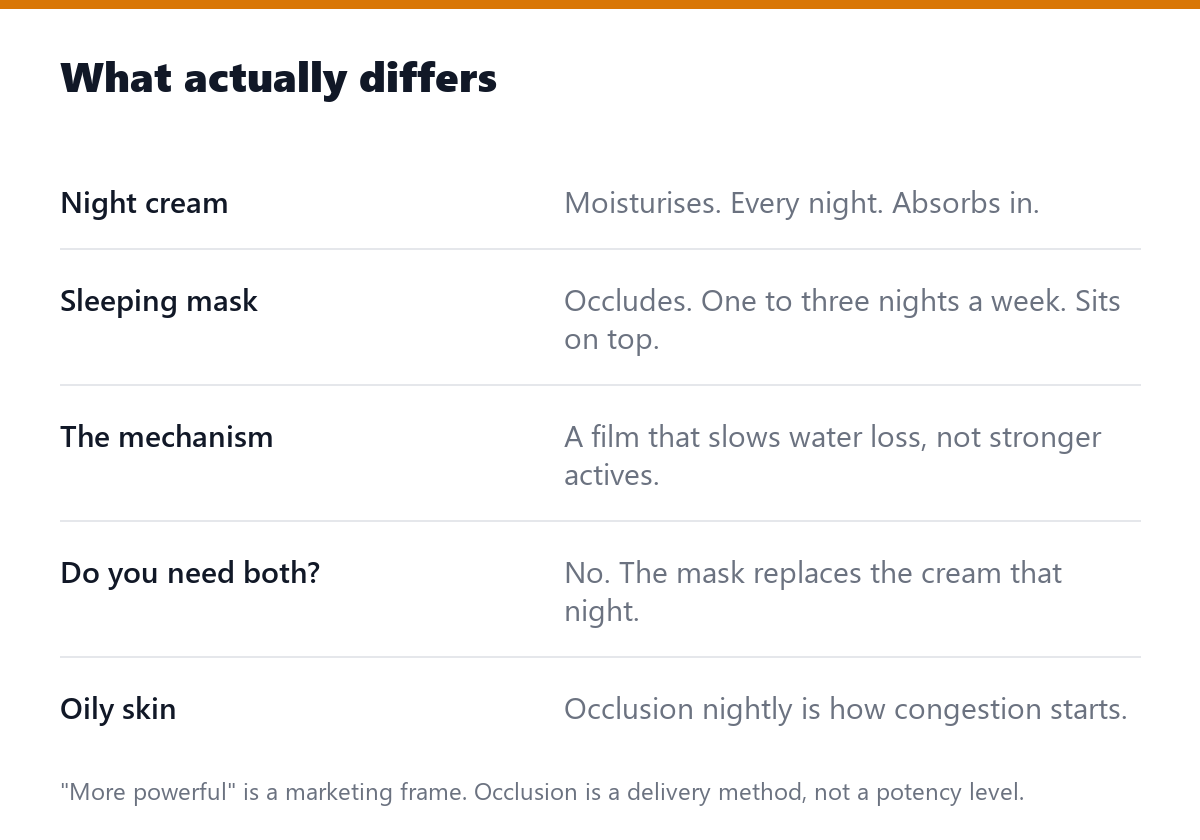
The difference is occlusion rather than potency. A sleeping mask forms a film that slows water loss overnight and holds whatever is underneath against the skin; a night cream moisturises without sealing as heavily. You do not need both every night — the mask replaces the cream on the nights you use it, one to three times a week, and daily use on oily or congested skin causes more problems than it solves.
A sleeping mask is usually explained as a stronger night cream — more potent, more concentrated, for when your skin needs extra help.
That is not quite what is happening, and the actual difference is more useful to know because it tells you exactly when to reach for one.
The difference is a film
The defining feature of an overnight mask is occlusion. It forms a layer on the surface that physically slows water evaporating from the skin, and holds whatever you applied underneath in contact with it for several hours.
That is a delivery mechanism, not a strength rating. The mask is not necessarily carrying stronger actives than your cream — it is keeping conditions favourable for longer.
Which reframes the whole comparison. A night cream moisturises. A sleeping mask seals. Both are useful and they are not on the same scale.
Why that means you should not use one nightly
Occlusion does not distinguish between what you want trapped and what you do not.
On dry, dehydrated skin, sealing overnight is exactly right — you lose less water and wake up more comfortable.
On oily or congested skin, sealing every night traps sebum along with the moisture. That is a reliable route to the congestion people then blame on whatever they applied underneath.
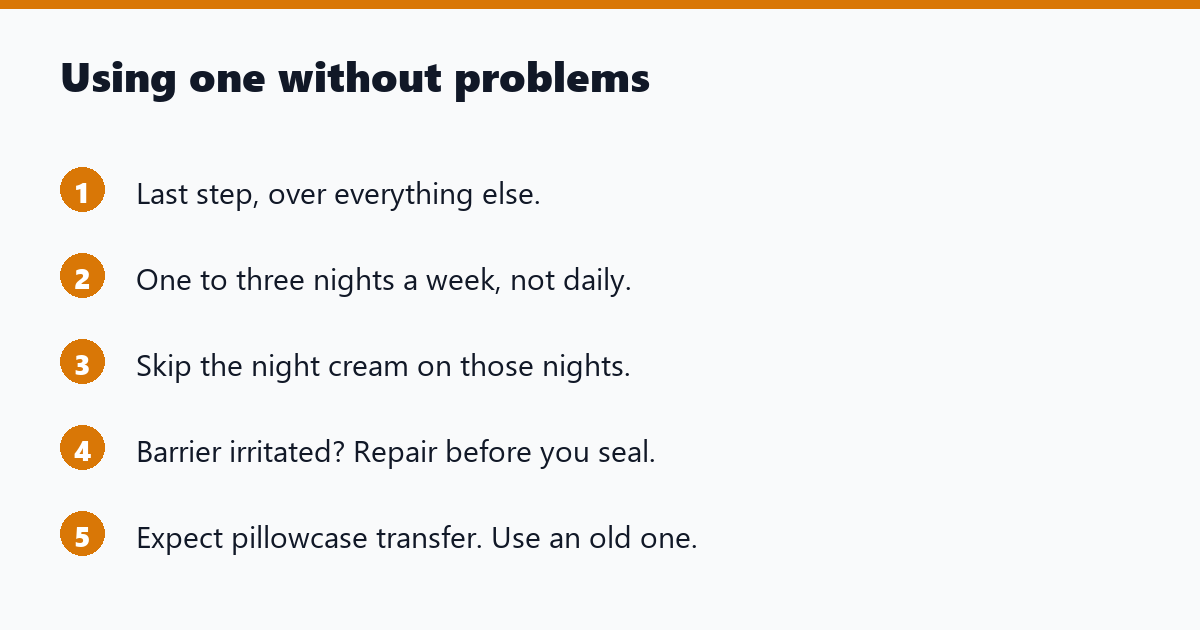
And on an irritated barrier, occlusion holds the irritation in place too. If your skin is currently stinging, repair before you seal rather than trapping the problem under a film.
One to three nights a week is the sensible range for most skin, and that is a frequency ceiling rather than a target.
You do not need both on the same night
This is the most common way money gets wasted here.
An overnight mask goes on as the last step, over everything. On the nights you use one, it replaces your night cream — it is doing the sealing job the cream would have done, more thoroughly.
Layering a mask over a rich cream mostly produces a heavy face and a marked pillowcase.
Check the current price on Amazon
What the format is genuinely good for
Dry skin in winter, or dry indoor air. The clearest case. Overnight is the longest uninterrupted stretch your skin gets, and slowing water loss across it makes a visible difference by morning.
The night before something. A short-lived plumping effect timed deliberately, the same logic as a hydrogel mask — with the important difference that a sleeping mask is designed to stay on, and a sheet mask is not.
Soothing after a rough week. A centella-based overnight mask over calm-but-tired skin is a reasonable weekly habit.
Check the current price on Amazon
The night cream is still the base
Whatever you do with masks, the product you use the other four to six nights matters more, simply because you use it more.
That is where a straightforward barrier cream belongs — ceramides, fragrance-free, unexciting, used every night. Consistency beats intensity in this category by a large margin.
Check the current price on Amazon
The unglamorous practicalities
- Pillowcase transfer is real. Occlusive products do not fully absorb, by design. Some of it ends up on the fabric.
- Apply thinly. A thicker layer does not seal better; it just transfers more.
- Give it fifteen minutes before bed if you can. Less transfer, same effect.
- Not with a retinoid on the same night, at first. Occlusion increases how much of an active reaches the skin, which is not what you want during the adjustment period.
Who this suits
Dry and dehydrated skin. The core use, and worth owning one for.
Anyone in cold or air-conditioned environments. Both dry the air, and overnight is when the loss adds up.
People who like a weekly ritual. Harmless, pleasant, and occasionally genuinely useful.
Who should skip it
Oily and congested skin, nightly. Occasionally is fine. Every night is asking for trouble.
Anyone with an irritated barrier right now. Sealing traps the irritation. Fix first.
People without a night cream yet. Buy the thing you will use every night before the thing you use once a week.
FAQ
Is a sleeping mask stronger than a night cream?
Not inherently. It is more occlusive, which makes whatever is underneath work for longer. Strength is about the actives, and a mask does not automatically have more of them.
Do I put it over my moisturizer?
It replaces the moisturizer on the nights you use it. Layering both is heavy and largely pointless.
How often?
One to three nights a week for most skin. Dry skin in winter can go higher; oily skin should stay at the low end.
Do I wash it off in the morning?
Yes — cleanse as normal. Whatever film is left is not doing anything useful once you are awake.
The bottom line
A sleeping mask is an occlusive layer, not a concentrated one. That is a real and useful thing to own, and it explains both when it helps and when it causes problems.
Use a plain night cream most nights, swap in the mask once or twice a week, and never use both at once. The category is simpler than the marketing makes it.