As an Amazon Associate I earn from qualifying purchases. This post contains affiliate links, which means we may earn a commission if you buy through them — at no extra cost to you.
Quick verdict
No standard defines oil-free, so it tells you nothing about oil control, pore-clogging or how a product feels. Oily skin still needs a moisturizer — skipping one is how skin ends up producing more. Judge texture and the position of humectants and emollients on the ingredient list, and ignore the phrase on the front.
The phrase oil-free moisturizer is printed on half the products aimed at oily skin, and it is one of the least informative labels in skincare.
There is no legal definition and no standard behind it. A brand decides it applies. That alone should change how much weight you give it, and there is a more useful question underneath.
What it does not tell you
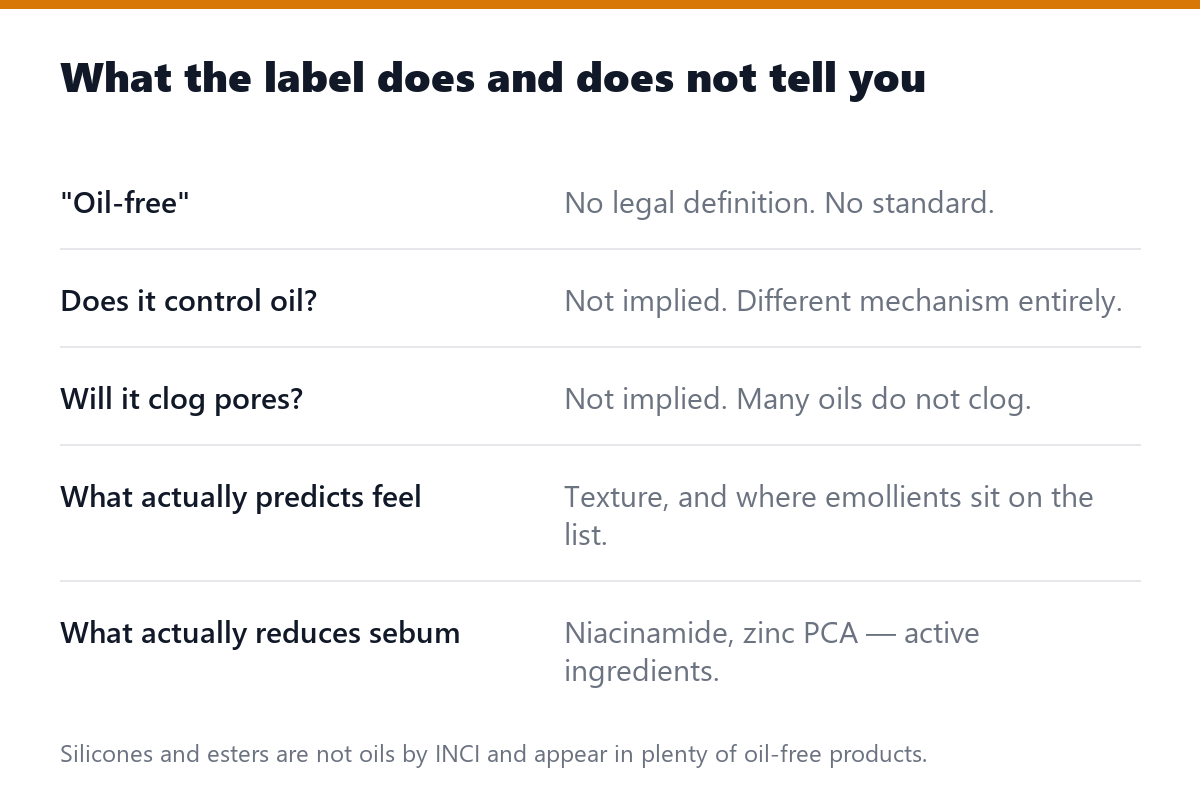
It does not mean the product controls oil. Removing oil from a formula and reducing the oil your skin produces are unrelated things. The second requires an active ingredient — niacinamide and zinc PCA are the common ones — and plenty of oil-free moisturizers contain neither.
It does not mean it will not clog pores. Pore-clogging potential varies by specific ingredient, not by whether something is technically an oil. Squalane is an oil by most people’s definition and is among the least likely things in skincare to cause congestion.
It does not mean the product is light. Silicones and synthetic esters are not oils on an INCI list, and a formula built on them can feel considerably heavier than one containing a small amount of squalane.
So an oil-free moisturizer can be heavy, pore-clogging and useless for sebum control while being entirely accurate on the label.
The bigger mistake: skipping it entirely
This is the one worth fixing before choosing a product at all.
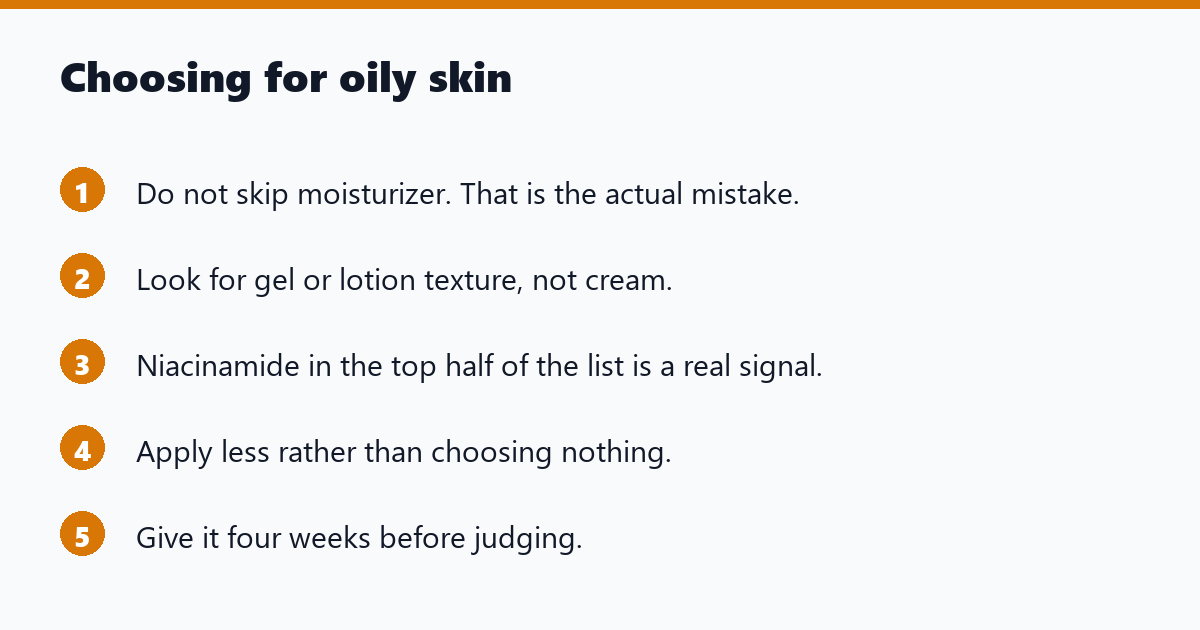
People with oily skin frequently skip moisturizer on the reasoning that their skin already produces plenty. What happens instead is dehydration — skin short of water rather than oil — and dehydrated skin tends to compensate by producing more sebum.
The result reads as “my skin is even oilier now,” which reinforces the original decision. It is one of the more reliable self-defeating loops in skincare.
Oily skin needs hydration. It just does not need a heavy occlusive cream to deliver it.
What to judge instead
- Texture, first. Gel, gel-cream, lotion, cream — in roughly that order of weight. This predicts how it feels far better than any claim on the front.
- Where the humectants sit. Glycerin high on the list means real hydration is happening.
- Whether there is an actual sebum ingredient. Niacinamide in the top half is meaningful. Its absence means the product hydrates and nothing more, which may be all you want.
- Fragrance. Oily skin is not more tolerant of it, and this is a twice-daily product.
The formats worth knowing
Lotions are the lightest thing that still counts as a moisturizer. Thin enough to disappear, substantial enough to seal. For genuinely oily skin in warm weather this is usually the right weight.
Check the current price on Amazon
Gel-creams and hydrating serums sit slightly heavier and suit combination skin — oily through the middle, normal elsewhere. Ingredients like beta-glucan do the hydration work without an oily finish.
Check the current price on Amazon
Niacinamide-led creams are the ones actually aimed at sebum rather than just avoiding oil. If shine by mid-afternoon is the complaint rather than dryness, this is the category to look at — we went through how much niacinamide is useful separately.
Check the current price on Amazon
Light creams still make sense for oily skin in winter or dry climates. Oily in August and oily in January are not the same condition, and a routine that never changes is a routine that is wrong half the year.
Check the current price on Amazon
Who this suits
Oily skin that has been skipping moisturizer. This is the group with the most to gain, and the change is usually noticeable within a few weeks.
Combination skin. A lighter texture across the whole face beats two products for two zones, which almost nobody sustains.
Anyone using actives. Retinoids and acids need something sealing them in, and “my skin is oily” is not an exemption.
Who should look elsewhere
Dry or dehydrated skin in cold weather. Light textures will not hold enough. You want lipids and a richer base.
Anyone with a compromised barrier. Fix that first — oil control is the wrong priority when skin is stinging.
People expecting acne treatment. Controlling shine and clearing breakouts are different problems with different products.
FAQ
Is oil-free better for acne-prone skin?
Not reliably. What matters is the specific ingredients rather than whether the formula contains something classified as an oil. Some oils are among the least likely ingredients to cause congestion.
Can oily skin skip moisturizer in summer?
Better to use less of something light than nothing at all. Skipping it tends to increase oil production rather than reduce it.
Does non-comedogenic mean anything?
Slightly more than oil-free, but it is also unregulated and based on testing methods that do not always predict real-world results. Treat both as loose signals rather than guarantees.
What about using a serum instead of a moisturizer?
A hydrating serum adds water without sealing it. Used alone it evaporates, which is the same limitation hyaluronic acid has. You still want something over the top, however light.
Keep reading
haruharu wonder Black Rice: Toner or Essence?
numbuzin Numbers: They Aren’t Strengths or Steps
The bottom line
An oil-free moisturizer is a product whose label tells you one technical fact and nothing you actually needed to know.
Read the texture, check where glycerin sits, look for niacinamide if shine is the concern, and stop skipping the step. The phrase on the front of the bottle can be ignored entirely without losing any information.