As an Amazon Associate I earn from qualifying purchases. This post contains affiliate links, which means we may earn a commission if you buy through them — at no extra cost to you.
Quick verdict
There is no legal or industry definition separating an essence, a serum and an ampoule — a brand decides which word goes on the box. The concentration ranges quoted around the internet are invented. Judge by texture and by where the active sits on the ingredient list, apply thin to thick, and stop trying to fit products into categories that were never real.
Search the ampoule vs serum question and you will get confident answers with numbers attached — essences at three to eight percent, serums at five to fifteen, ampoules at fifteen to thirty.
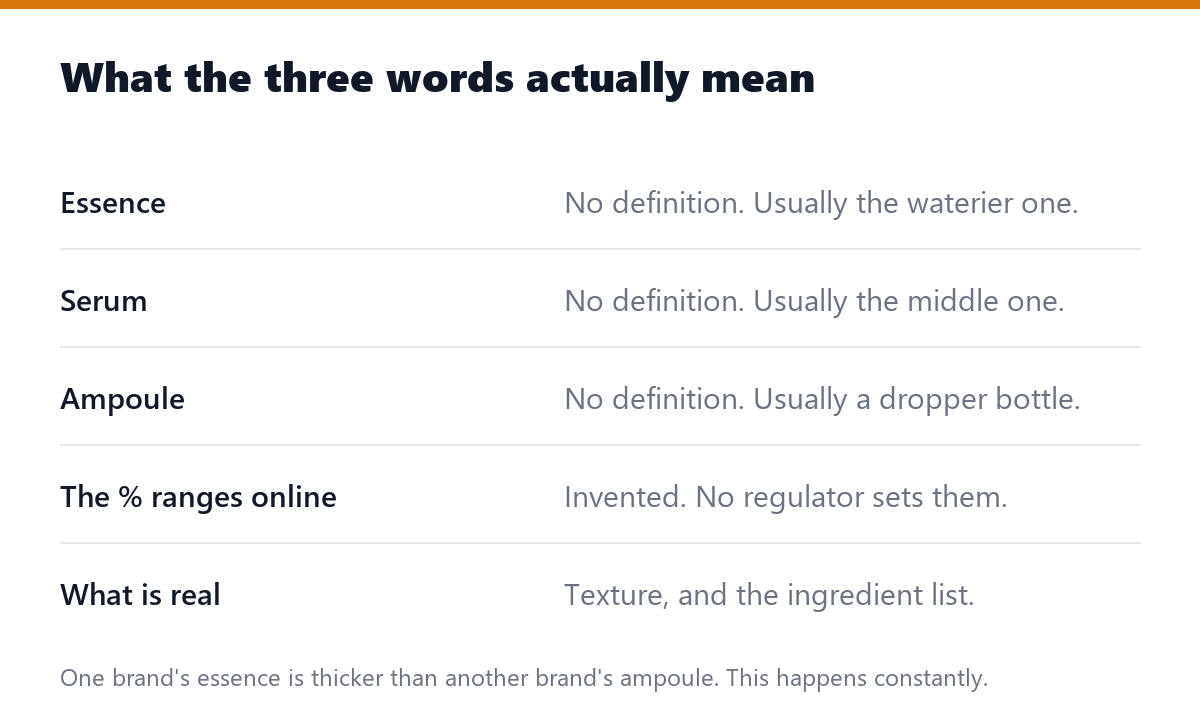
Those figures get repeated everywhere. No regulator sets them and no industry body defines them. They appear to have been invented, and once invented they were copied.
None of the three words is defined
There is no legal or standards-body definition of an essence, a serum or an ampoule. A brand decides which word goes on the box, and the decision is made by marketing.
The practical consequence is easy to observe: one brand’s essence is thicker than another brand’s ampoule. Products called serums range from water to gel. Ampoules are often defined by the dropper rather than by anything inside.
This is the same situation as “oil-free” and “cica” — a term everyone uses, nobody defines, and buyers treat as specification.
The loose ampoule vs serum conventions that do exist
The words are not random, they are just unreliable. Broadly:
- Essence tends to be the waterier one, often positioned right after cleansing.
- Serum tends to sit in the middle, and is the word most often used for a targeted treatment.
- Ampoule tends to come in a small dropper bottle and is positioned as the concentrated one.
Useful as a first guess. Useless as a basis for comparing two specific products, which is what people actually try to do with them.
Judge these instead of the category
Forget ampoule vs serum entirely and look at three things.
Texture, felt rather than described. This is what decides layering order and whether it will pill under sunscreen. A listing photo of the dropper does not tell you this; the word “ampoule” definitely does not.
Where the active sits on the ingredient list. If the ingredient you are buying it for appears below the preservatives, the concentration is token regardless of what the format is called.
Volume against expected use. A small bottle of something you use three drops of lasts a long time. A small bottle of something you use as a hydration layer does not.
Check the current price on Amazon
The one rule that survives
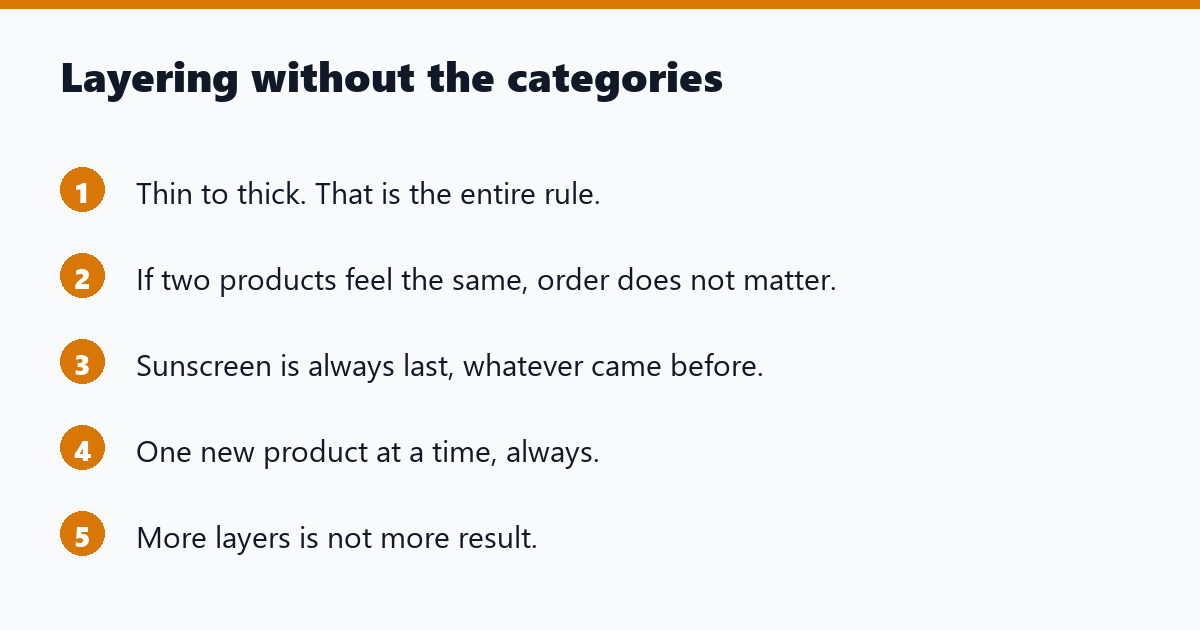
Thin to thick. That is the whole layering system, and it works because it is about physics rather than nomenclature.
A watery product applied over a rich one will not absorb. That is the only reason order matters. So if two products feel roughly the same, the order genuinely does not matter — and the elaborate step-numbering that Korean skincare is known for is not doing what people think it is.
Sunscreen is the exception and it is always last.
Formats and reformulations
Two things worth watching when you are buying by name rather than by list.
Sizes across a line. The same product often comes in a small and a large bottle. Start small — a hydrating ampoule you dislike is a small waste at 30ml and an annoying one at 100ml.
Check the current price on Amazon
Second-generation versions. Korean brands reformulate frequently and keep the name. A “2nd generation” or “renewal” version can have a meaningfully different ingredient list from the original, which is why a review from two years ago may describe a product you cannot buy any more. Check the list on the listing you are actually looking at.
Check the current price on Amazon
Who this matters for
Anyone building a routine from scratch. Knowing the categories are soft saves you buying three products that do the same thing under different names.
People comparing two products. Ignore the category words entirely and compare ingredient lists. It is faster and it actually answers the question.
Anyone with a ten-step routine. Several of those steps are probably the same product type. Consolidating loses you nothing.
Who can ignore this
Anyone whose routine already works. If your skin is happy, the names on the bottles are irrelevant.
People who enjoy the ritual. Layering is pleasant and harmless. Just do not expect the number of steps to correlate with results.
FAQ
Do I need all three?
No. Most routines need one hydrating layer and one treatment, whatever those are called. Buying an essence, a serum and an ampoule usually means buying three hydrating layers.
Is an ampoule stronger than a serum?
Sometimes, and you cannot tell from the word. Check where the active sits on the ingredient list — that is the only signal available to you.
Which goes on first?
Whichever is thinner. If you cannot tell them apart by feel, it does not matter.
What about emulsions and lotions?
Same situation — loosely conventional, formally undefined. They sit heavier than serums and lighter than creams, roughly, and brands use the words inconsistently.
Keep reading
haruharu wonder Black Rice: Toner or Essence?
numbuzin Numbers: They Aren’t Strengths or Steps
The bottom line
The ampoule vs serum distinction is a naming convention, not a specification. The concentration figures circulating online were invented and then repeated until they sounded official.
Judge texture and ingredient lists, layer thin to thick, and treat the word on the box as the least informative thing about the product.