As an Amazon Associate I earn from qualifying purchases. This post contains affiliate links, which means we may earn a commission if you buy through them — at no extra cost to you.
Quick verdict
A cleanser matched to skin’s own acidity never raises your surface pH, which means there is nothing to restore afterwards. That makes it a better fix than a pH balancing toner, because you are preventing the problem rather than reversing it twice a day. The trade-off is real: gentle cleansers do not remove sunscreen or heavy makeup on their own.
We have made the case for a pH balancing toner and ended it with an awkward conclusion: the better move is usually changing the cleanser instead of adding a product to undo what the cleanser did.
This is the other half of that. A low-pH cleanser solves the problem at the point where it is created.
The problem, briefly
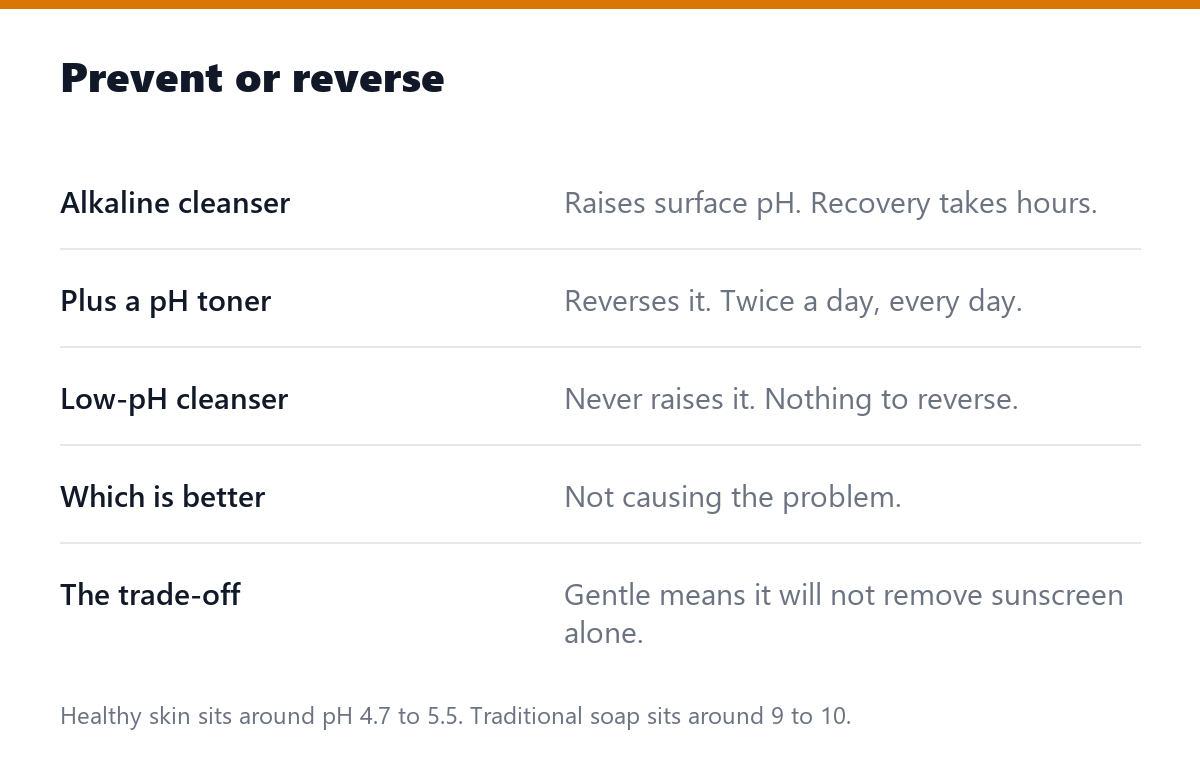
Healthy skin sits at roughly pH 4.7 to 5.5 — acidic. That acidity keeps the enzymes that maintain your barrier working and makes the surface inhospitable to bacteria you would rather not host.
Traditional soap sits around pH 9 to 10. Many foaming face washes are alkaline too. Wash with one and your skin’s surface pH rises, then drifts back over several hours. Do that twice a day and your skin spends a meaningful share of every day outside the range it works best in.
That squeaky feeling is the sensation of an alkaline, stripped surface. It was marketed to us as clean.
Why fixing the cleanser beats adding a toner
Both approaches end with your skin at the right pH. They are not equivalent.
A toner reverses the change after it happens. Between the wash and the toner, your barrier has already been through a swing it did not need. And you are buying and applying a product whose only job is to undo a different product you also bought.
A pH-matched cleanser prevents it. Nothing to restore, one fewer step, one fewer thing to buy.
The toner still earns its place if you like what else is in it — licorice, centella, panthenol. Just buy it for those rather than for the number.
What to look for in a low-pH cleanser
- A stated pH near 5.5. Anything in the 4.5 to 5.5 range is matched to skin. If a brand does not state it, that is itself informative.
- Amino-acid based surfactants rather than soap-based ones. Milder, and they work at a lower pH by nature.
- Fragrance-free. This is a twice-daily product on skin you have just made more permeable.
- Not a scrub, not an acid. A daily cleanser should clean. If it also exfoliates, it is not a daily product.
Check the current price on Amazon
The adjustment is psychological
This is the part that makes people abandon the switch in week one.
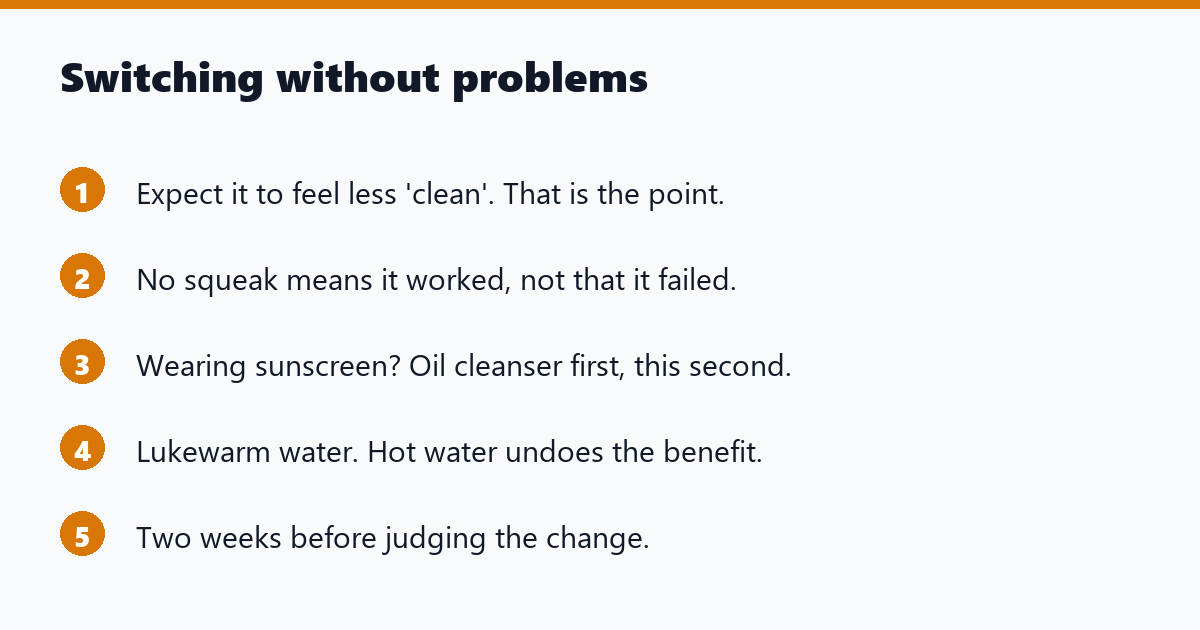
A gentle cleanser does not feel as satisfying. No squeak, no tightness, no sense of having scrubbed something off. Skin feels soft rather than stripped, and after years of associating tightness with cleanliness that reads as “it did not work.”
It did work. The sensation you were trained to want was the sensation of damage.
Give it two weeks. What you are looking for is not a feeling after washing — it is fewer reactions, less flaking, and skin that stops stinging when you apply things.
Check the current price on Amazon
The honest limitation
Gentle cleansers are gentle, and that has a cost.
A low-pH foam will not remove sunscreen or heavy makeup on its own. Sunscreen in particular is engineered to survive water, which is exactly why a water-based cleanser leaves it behind. Residue accumulates and shows up as congestion, which people then blame on the sunscreen.
The fix is an oil cleanser first on any day you wore either. Oil dissolves what water cannot; the gentle foam then removes the oil. Two mild steps beat one aggressive one.
Check the current price on Amazon
Who this suits
Anyone whose skin feels tight after washing. The clearest case, and the change is usually noticeable within two weeks.
Sensitive and reactive skin. A stable acidic surface is one fewer thing provoking it, every single day.
People using actives. Retinoids and acids already stress the barrier. The cleanser should not be adding to it.
Who can skip it
Anyone already using a modern gel or cream cleanser. Most are formulated at a low pH already. Check before replacing something that is working.
People wanting a deep-clean sensation. You will not get it, and chasing it is what caused the problem.
FAQ
How do I know if my current cleanser is alkaline?
The squeak test. Tight, squeaky skin immediately after rinsing means alkaline. Skin that feels soft and slightly cushioned means low-pH. Bar soap is always alkaline.
Do I still need a pH toner?
Not for the pH. Buy one if you want what else is in it, and skip it otherwise.
Is a low-pH cleanser enough on its own?
In the morning, usually yes. At night it depends entirely on whether you wore sunscreen or makeup — if you did, it is the second step rather than the only one.
Will it help with acne?
Indirectly. A stable barrier and an acidic surface are less hospitable to acne bacteria, but a cleanser is on your face for a minute. Actual treatment needs a leave-on active.
Keep reading
haruharu wonder Black Rice: Toner or Essence?
numbuzin Numbers: They Aren’t Strengths or Steps
The bottom line
A low-pH cleanser prevents the problem that a pH balancing toner exists to reverse, which makes it the better of the two purchases and one fewer step.
Expect it to feel less dramatic. That is not the product underperforming — it is the absence of the damage you had learned to interpret as clean.