
As an Amazon Associate I earn from qualifying purchases. This post contains affiliate links, which means we may earn a commission if you buy through them — at no extra cost to you.
Quick verdict
Some PDRN products use salmon-derived DNA fragments and others use a plant-derived version from ginseng. Neither has strong evidence for what it claims when applied to skin rather than injected, so buy either one as a well-formulated hydrating cream and treat the acronym as packaging. If you avoid animal-derived ingredients, the plant version is a genuine reason to choose one over the other.
Anyone who has looked at Korean skincare in the last two years has run into PDRN, and almost everyone buying a PDRN cream assumes it means one thing: salmon DNA.
That is where it started, and it is no longer the whole story. Some products carrying the same three letters use a plant-derived version made from ginseng root instead, with no salmon in them at all — and the front of the box will not tell you which you are holding.
What PDRN is meant to be
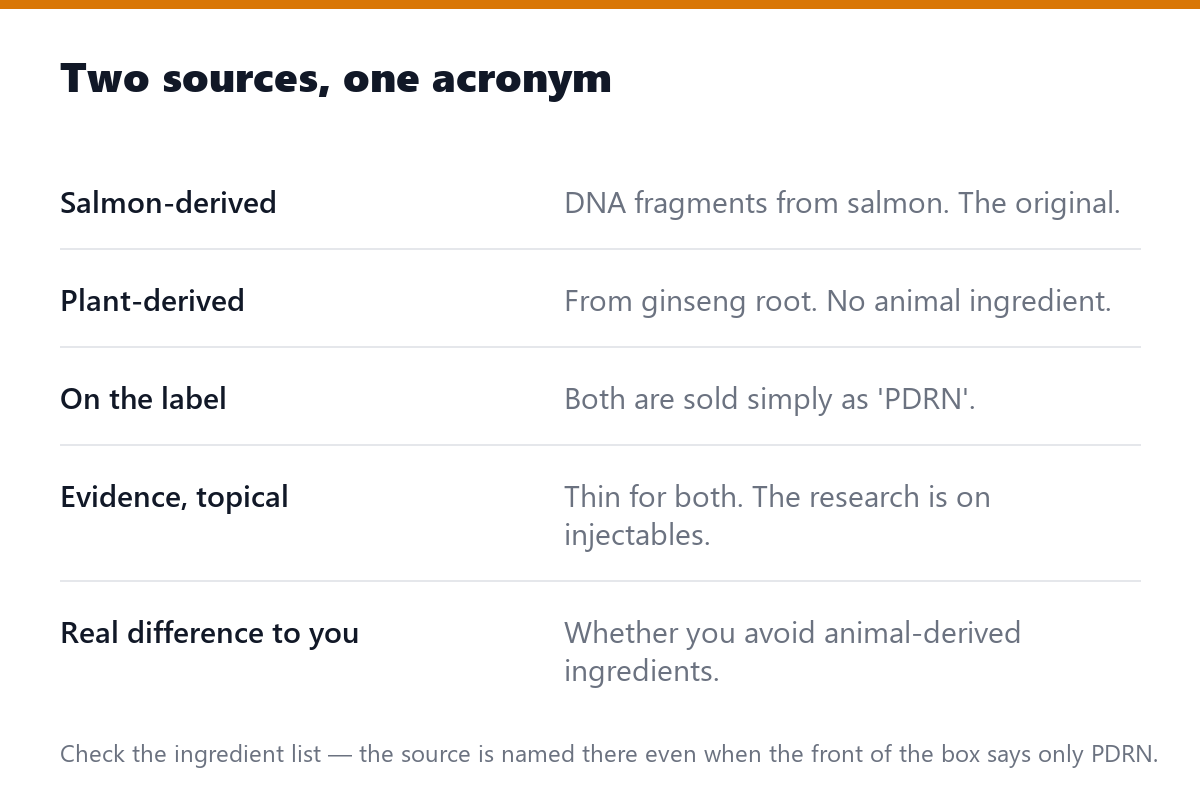
PDRN stands for polydeoxyribonucleotide — fragments of DNA. The original material is extracted from salmon, chosen because the DNA sequence is compatible enough with human cells to be tolerated.
Its reputation comes from clinical use, where it is injected, with genuine research behind it in wound healing and skin repair. We went through the gap between that evidence and a bottle of serum in detail. The short version: your skin barrier is built to keep large molecules out, and the injectable research does not transfer to something you apply.
That caveat applies equally to everything below.
The plant-derived version
Some Korean brands now use a PDRN sourced from ginseng root rather than salmon. It is marketed under the same acronym and positioned as working through the same pathway.
Two honest observations about this.
First, it is a real and meaningful difference for some buyers. If you avoid animal-derived ingredients for ethical or religious reasons, a salmon-derived product is not acceptable and a ginseng-derived one is. That is a genuine reason to check the source, and the only one that is unambiguous.
Second, it does not resolve the evidence problem. Swapping the source does not make a topical version better supported. Both are interesting ingredients with the same gap between what the clinical literature studied and what is in the jar.
Check the current price on Amazon
The ppm numbers
PDRN listings compete on concentration — figures quoted in ppm, sometimes with the percentage helpfully alongside.
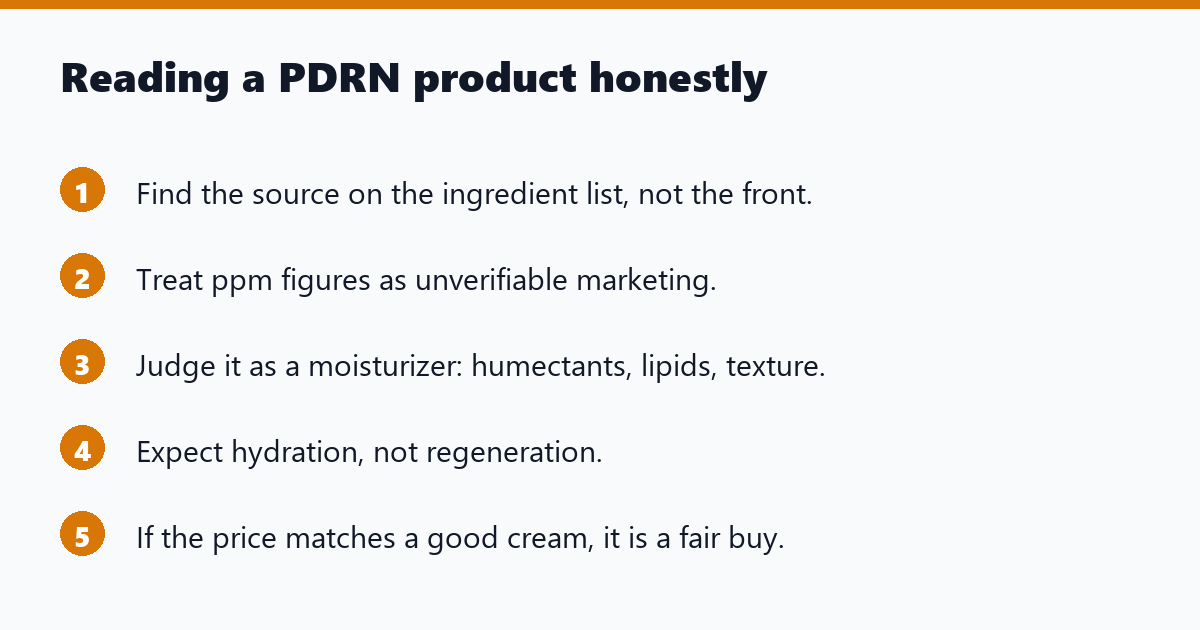
Treat these carefully. Ingredient lists do not carry percentages, so a ppm figure appears in marketing copy and nowhere you can verify it. There is also no standard defining what is being measured — the DNA fragments themselves, or the extract solution containing them. Two products quoting the same number may not contain the same thing.
This is the same problem we found with collagen percentage claims, and the same answer applies: judge what you can verify.
Judge a PDRN cream as a moisturizer
This is the useful reframe, and it is not a dismissal.
PDRN creams are generally well-formulated hydrating products. The better ones pair the headline ingredient with things that have no evidence problem at all — niacinamide, ceramides, squalane, panthenol, peptides. Those ingredients do real work regardless of what the acronym on the front is doing.
So read the rest of the ingredient list. If it is a good cream at the price of a good cream, buying it is entirely reasonable. If you are paying a premium specifically for the PDRN, you are paying for the least verifiable part.
Check the current price on Amazon
Serum, cream or capsule
Serums put the ingredient in a light layer that needs sealing afterwards. Fine, but it is a step rather than a routine.
Creams combine the claim with an occlusive base, which means you are at least getting a moisturizer out of it whatever the PDRN does.
Capsule formats — visible beads suspended in gel — separate the active from the base until you apply it. The stability argument is real for genuinely unstable ingredients. It is also a strong visual, and the visual is doing some of the selling.
Check the current price on Amazon
Who this suits
Anyone who wants a comfortable hydrating cream and likes the texture. That is a completely valid reason to buy one.
People avoiding animal-derived ingredients. The plant-derived versions are the reason to read the source line, and the one place the distinction genuinely matters.
Sensitive skin. These formulas tend to be low-irritation by design, with no acids or retinoids in the base.
Who should skip it
Anyone buying it for regeneration. The evidence for that is about injections. A cream will hydrate you.
Anyone paying a large premium for the letters. Compare it against a plain ceramide cream at the same price and see which ingredient list you prefer.
People wanting firmness results. Peptides have more behind them, and retinoids more still.
FAQ
Is plant PDRN better than salmon PDRN?
There is no good evidence either way for topical use. The difference that is certain is the source — relevant if you avoid animal-derived ingredients, and otherwise not something you can act on.
How do I tell which one I am buying?
Read the ingredient list rather than the front of the box. The source is named there — salmon-derived entries reference sodium DNA or salmon extract, plant-derived ones reference ginseng.
Does a higher ppm mean a better product?
Not something you can verify. The figures appear in marketing rather than on the ingredient list, and there is no standard for what is being counted.
Is PDRN safe for sensitive skin?
Generally, yes — these are usually gentle formulas without actives. As always the risk sits in the rest of the ingredient list, particularly fragrance, rather than in the headline ingredient.
Keep reading
haruharu wonder Black Rice: Toner or Essence?
numbuzin Numbers: They Aren’t Strengths or Steps
The bottom line
A PDRN cream may contain salmon-derived DNA fragments or a plant-derived equivalent from ginseng, and the packaging usually will not say which without you looking for it.
For almost everyone the source makes no practical difference, because the topical evidence is thin either way. Buy one because the rest of the formula is good and the texture suits you — and if you avoid animal ingredients, now you know to check.