As an Amazon Associate I earn from qualifying purchases. This post contains affiliate links, which means we may earn a commission if you buy through them — at no extra cost to you.
Quick verdict
If you are buying a product for firmness, buy peptides rather than collagen. Collagen in a jar sits on the surface as a humectant; peptides are small enough to get somewhere. The caveat is that ‘six peptides’ is a breadth claim, not a strength claim — they do different jobs, they sit low in ingredient lists, and none of them work as fast as the marketing suggests.
Half of Korean skincare is sold on collagen and the other half on peptides, and most people treat them as the same promise at different prices. They are not, and the difference decides which one is worth your money.
A peptide serum is the version of that promise that can actually reach somewhere. Collagen, applied to your face, cannot.
Why collagen in a jar does not work
Collagen is a large protein. The outer layer of your skin is a barrier specifically evolved to keep large molecules out, and it is extremely good at its job.
So collagen applied topically sits on the surface. It is not absorbed, it does not join your own collagen, and it does not become structure. What it does do is hold water against the skin, which makes it a perfectly decent humectant — just an expensive one wearing a misleading name.
We have been through this with a collagen cream and a collagen mask, and the answer is the same each time: real products, real hydration, wrong story.
Peptides are the fragments that fit
Peptides are short chains of amino acids — pieces of protein rather than whole ones. Being small is the entire point: they are small enough to get past the barrier that stops collagen.
What they do once through is more modest than the advertising suggests. Some peptides act as signals that encourage skin to behave as though it needs to repair. Others are built to relax the muscle movement that creases skin. Others are mostly soothing. “Peptide” is a category, not an effect, and two peptide products can do completely different things.
What “six peptides” actually means
Here is a worked example, because the numbers on the front of these bottles are doing a lot of work.
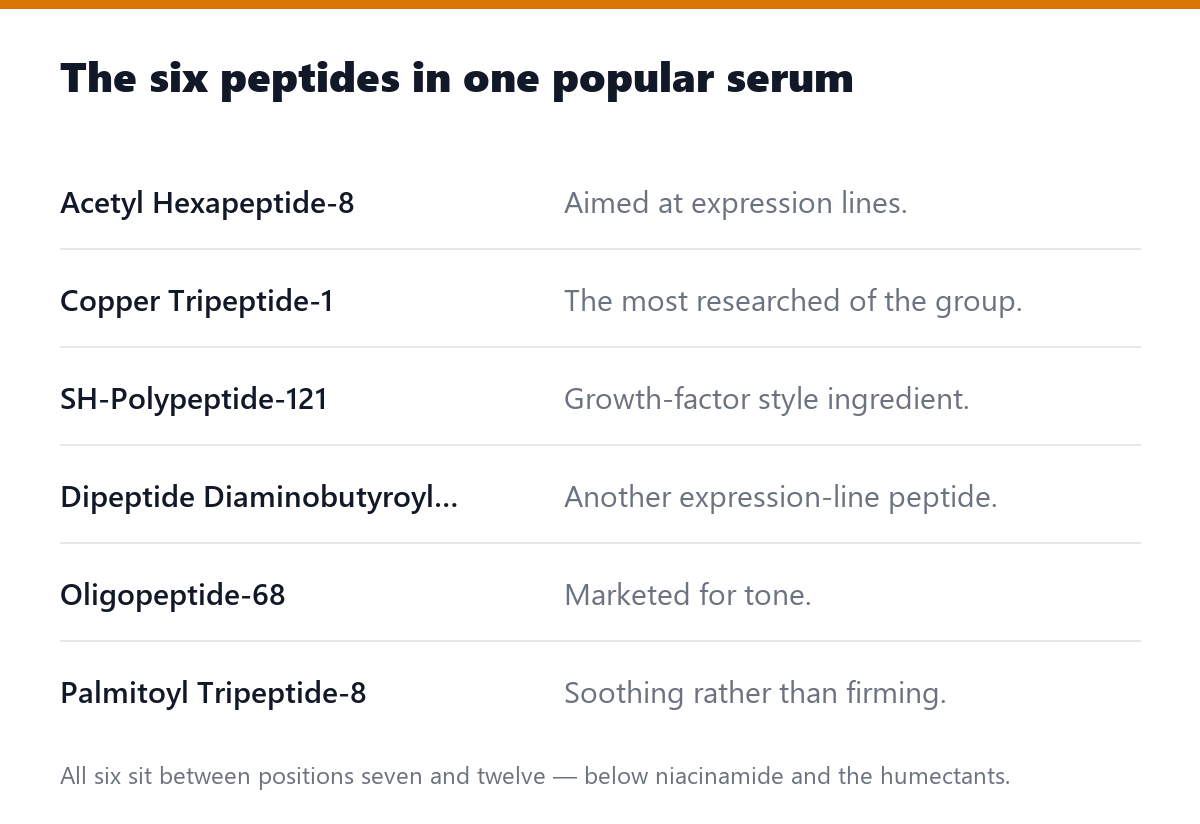
One of the most popular Korean peptide boosters advertises six peptides. Its own product page does not name them. The ingredient list does: acetyl hexapeptide-8, copper tripeptide-1, SH-polypeptide-121, dipeptide diaminobutyroyl benzylamide diacetate, oligopeptide-68 and palmitoyl tripeptide-8.
Two things follow from reading that list rather than the label.
They are not six of the same thing. Two target expression lines, one is a copper peptide associated with repair, one is a growth-factor style ingredient, one is sold for tone and one is essentially soothing. Six peptides is a breadth claim — it means the formula touches several mechanisms lightly, not that it hits one hard.
They all sit between positions seven and twelve. Below the water, the humectants and the niacinamide. Present in real but small amounts, which is normal for peptides and worth knowing before you expect dramatic results.
Of the six, copper tripeptide-1 is the one with the longest research history — it came out of wound-healing work rather than cosmetics, which is a better provenance than most skincare ingredients can claim.
Check the current price on Amazon
Collagen plus peptides, on one label
Plenty of products carry both words, and that is not a contradiction. The collagen hydrates, the peptides signal. It is only misleading when the collagen gets the headline and the peptides are the afterthought — which is usually the way round it goes, because collagen is the word people search for.
Read the position of each on the list. If the peptides are below the preservatives and the collagen is near the top, you are buying a hydrating product with a peptide garnish.
Check the current price on Amazon
Ampoule-format peptide products tend to be more concentrated and are used in smaller amounts, which is a reasonable way to buy into the category without replacing your whole routine.
Check the current price on Amazon
What to expect, honestly
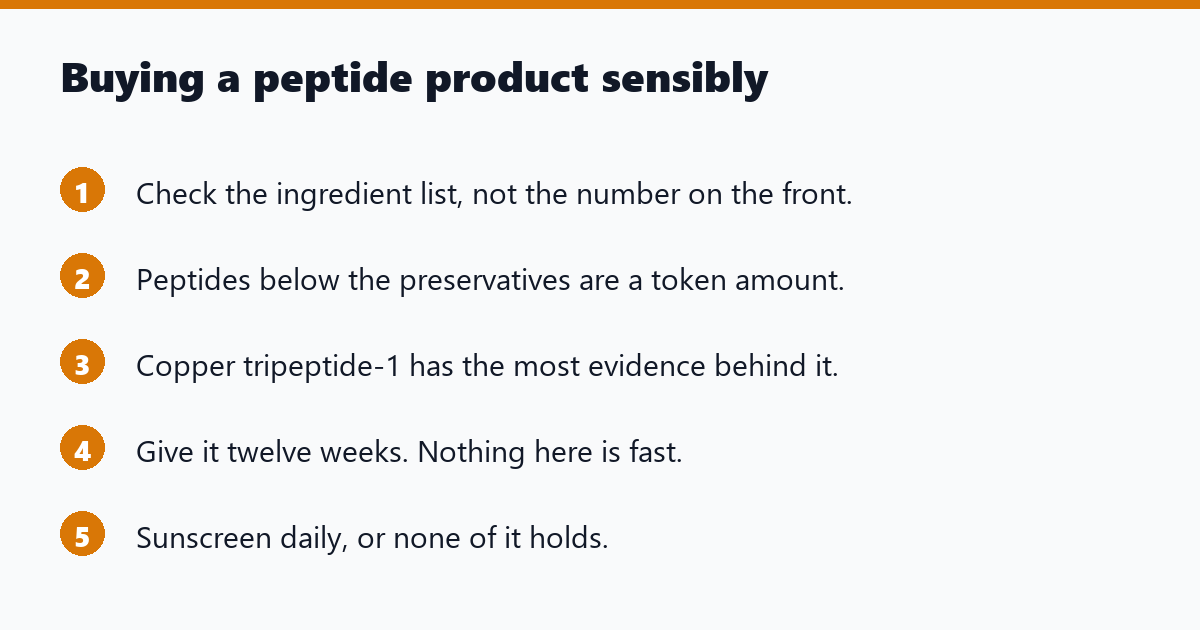
Peptides are slow. Twelve weeks is a fair minimum before judging one, and the change is a gradual improvement in how skin looks rather than a before-and-after.
They are not retinoids. If you want the strongest evidence for firmness and lines, that is retinoids, and it is not close. Peptides are the gentler option for people who cannot tolerate a retinoid or do not want the adjustment period.
Sunscreen decides the outcome. Ultraviolet exposure breaks down the collagen you already have faster than any serum builds it. A peptide serum without daily sun protection is filling a bath with the plug out.
Who this suits
Anyone who cannot tolerate retinoids. Peptides do not cause the peeling, redness and adjustment period that puts people off, and they can be used daily from the start.
Early firmness concerns. This is prevention-adjacent territory and peptides are a sensible, low-risk thing to add.
People already running actives. Peptides do not conflict with acids, retinoids or vitamin C, so they slot in without rearranging anything.
Who should skip it
Anyone wanting visible results this month. Not the category. Look at retinoids, or at professional treatments.
Anyone whose routine lacks sunscreen. Fix that first. It matters more than every serum on this page combined.
Anyone buying collagen expecting structure. It will hydrate you. That is all it will do.
FAQ
Do peptides actually work?
Some do, modestly, over months. Copper tripeptide-1 has the strongest research behind it. The honest summary is that peptides are a real but gentle category oversold as a dramatic one.
Is more peptides better?
Not necessarily. Six peptides at low concentrations touching six mechanisms is a different proposition from one well-dosed peptide. Neither is obviously better, but the number on the bottle is not a strength rating.
Can I use a peptide serum with vitamin C or acids?
Yes. Peptides are undemanding and do not conflict with the usual actives. Introduce one thing at a time so you know what is doing what.
Does drinking collagen work better than applying it?
Different question with a different evidence base, and outside what a skincare product can claim. What is settled is the narrow point here: collagen applied to the surface of your face does not become collagen in your skin.
Keep reading
Korean Face Mists: What Water in a Bottle Can Do
The pH 5.5 Toner: Fixing a Problem Your Cleanser Made
The bottom line
Collagen on your face is a humectant with good marketing. A peptide serum is the version that can get past the door — as long as you buy it for what peptides genuinely do, which is quiet, slow, and worth having rather than transformative.
Read the ingredient list to find out which peptides you are getting and where they sit. The number on the front of the bottle will not tell you.