As an Amazon Associate I earn from qualifying purchases. This post contains affiliate links, which means we may earn a commission if you buy through them — at no extra cost to you.
Quick verdict
Mists are a comfort tool, not a treatment step. Sprayed on bare skin with nothing over them they can leave you drier than before, because evaporating water takes some of yours with it. Used over makeup, between layers, or as a toner substitute they earn their place — and the ones with oil or a thicker base behave differently from plain water in a bottle.
A Korean face mist is one of the easiest things in skincare to sell and one of the easiest to misuse. It feels immediately good, which is exactly why people reach for it at the wrong moments.
The physics is not complicated, and once you have it, the whole category sorts itself into three situations where a mist is genuinely useful and one where it works against you.
The part nobody puts on the bottle
Most mists are predominantly water with humectants dissolved in it. Humectants attract water and hold it near the surface of the skin. That is the entire mechanism, and it has a catch.
Water on the surface of your skin evaporates. As it goes, it can take some of your own moisture with it — the humectant pulls from whatever is nearest, and if the air is dry, the nearest reservoir is your skin rather than the room.
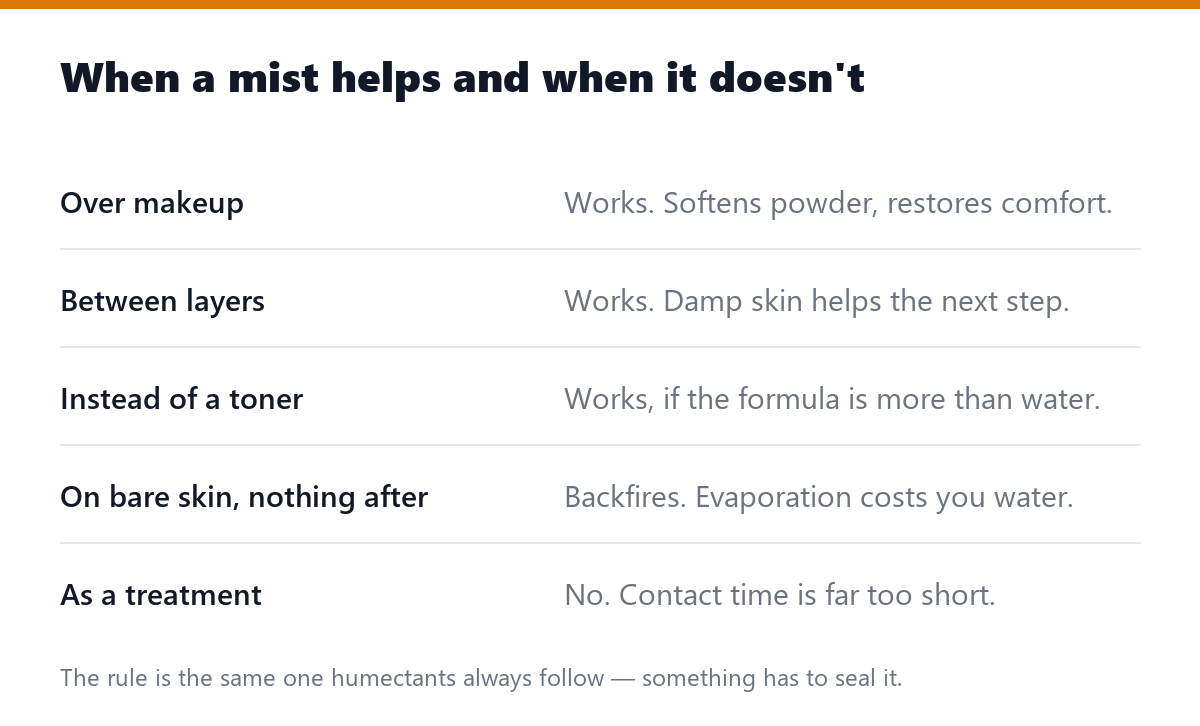
So spraying a mist on bare skin and letting it dry with nothing over the top is the one use that can leave you worse off. This is the same limitation hyaluronic acid has, and it applies to every humectant product ever made.
That is not an argument against mists. It is an argument for knowing what you are doing with one.
The three times a mist earns its place
Over makeup. This is the strongest case and the one that has nothing to do with skincare claims. A fine mist settles powder, removes that flat, dusty look, and makes a face feel comfortable again several hours in. Nothing else does this job.
Between layers. Applying products to slightly damp skin helps them spread and absorb, and a mist is the tidiest way to get damp skin mid-routine. A practical trick rather than a product benefit, but a real one.
As a toner substitute. If the formula is more than water — and some are — a mist can replace the hydrating step entirely, with less mess and no cotton pad.
They are not all the same thing
This is where the category gets more interesting than it looks, because “mist” describes a delivery format rather than a formula.
Two-phase oil and water mists separate in the bottle and need shaking before use. The oil layer is the point: it leaves something behind after the water goes, which is precisely what a plain water mist cannot do. These give a visible glow and suit dry skin and makeup-setting far better than a watery formula.
Check the current price on Amazon
Serum-style sprays are thicker than a mist and sold as a serum you spray. The format is genuinely convenient. The active claims deserve the usual scepticism — ingredients like PDRN are unproven topically regardless of how they are dispensed, and a spray does not change that.
Check the current price on Amazon
Jelly and essence mists sit thickest. They cling rather than evaporate immediately, which is the closest a spray gets to solving the evaporation problem on its own. Still not a moisturizer.
Check the current price on Amazon
Soothing mists built on panthenol or centella are aimed at comfort rather than hydration — reactive skin, post-sun, air conditioning. If your skin gets hot and irritated rather than dry, this is the version to buy.
Check the current price on Amazon
What to look for
- Something other than water and glycerin. An oil phase, a thicker base, or a soothing agent is what separates a useful mist from an expensive spray bottle.
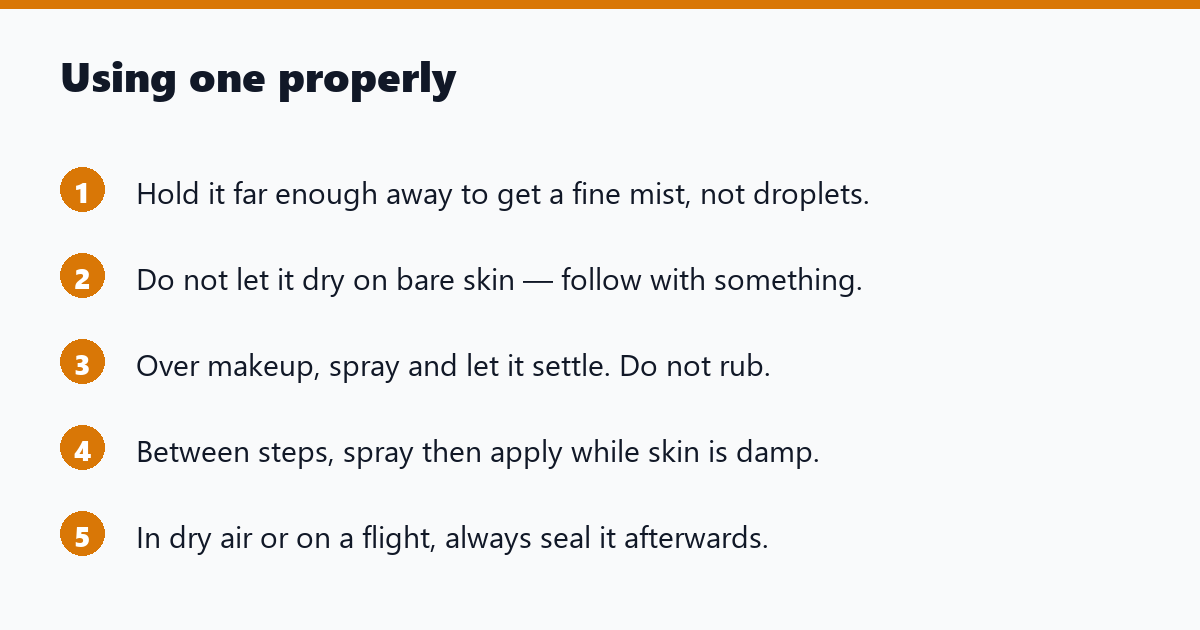
- A fine nozzle. A mist that comes out in droplets will run down your face and ruin makeup instead of setting it. This matters more than the ingredient list for the over-makeup use.
- Alcohol-free, if you are spraying it repeatedly. Denatured alcohol high in the list evaporates fast and takes moisture with it — the opposite of the reason you bought it.
- Ignore treatment claims. Contact time is seconds. Nothing meaningful gets treated in seconds.
Who this suits
Anyone who wears makeup. The setting-and-refreshing use is the one no other product covers, and it is worth owning a mist for that alone.
People in dry offices or on planes. With the caveat that you must follow it with something, otherwise you are speeding up the problem.
Reactive skin that runs hot. A cool soothing mist is a genuine comfort tool during a flare.
Who should skip it
Anyone hoping to replace a moisturizer. A Korean face mist cannot do that. There is nothing occlusive in most of them.
Anyone with a compromised barrier. Repeated wetting and drying is the wrong thing for skin that already cannot hold water. Fix the barrier first.
Anyone buying it for actives. Whatever is in it, it is on your face for moments before it evaporates or gets absorbed into the next layer.
FAQ
Can a mist replace toner?
If the formula is substantial enough, yes. A watery mist that dries in seconds is not doing what a hydrating toner does, but a jelly or essence mist reasonably can.
Will spraying over makeup ruin it?
Only if the nozzle is coarse or you spray too close. A genuinely fine mist sets makeup rather than disturbing it. Let it settle rather than patting it in.
How often can I use one?
As often as you like, provided you are not letting it dry repeatedly on bare skin. Over makeup or between layers there is no meaningful limit.
Do the two-phase oil mists pill under makeup?
They can if you use too much or spray too close. A light pass from a distance is the whole technique. The oil is also what makes them the better choice for a dry, matte-looking face.
Keep reading
The pH 5.5 Toner: Fixing a Problem Your Cleanser Made
haruharu wonder Black Rice: Toner or Essence?
The bottom line
A Korean face mist is a comfort tool that happens to be sold in the skincare aisle. Used over makeup, between layers, or as a hydrating step with something over the top, it does a real job well.
Sprayed on bare skin and left to dry because it felt nice, it is the one skincare product that can leave you drier than it found you. Same bottle, opposite outcomes, decided entirely by what you do in the ten seconds afterwards.