As an Amazon Associate I earn from qualifying purchases. This post contains affiliate links, which means we may earn a commission if you buy through them — at no extra cost to you.
Quick verdict
pH 5.5 toners are genuinely useful if your cleanser is alkaline — bar soap, foaming cleansers that leave skin squeaky. They restore the acidic surface your skin needs to defend itself. If you already use a low-pH cleanser, the toner is solving a problem you no longer have, and you are better off buying a toner for what else is in it.
Every Korean toner seems to advertise a number now, and pH 5.5 toner is the most common one on the shelf. It sounds technical enough to be meaningful and vague enough to skip past, so most people buy it without knowing what it is for.
It has a specific job. Understanding that job also tells you when you can skip it entirely — which is more often than the marketing would like.
Your skin is supposed to be acidic
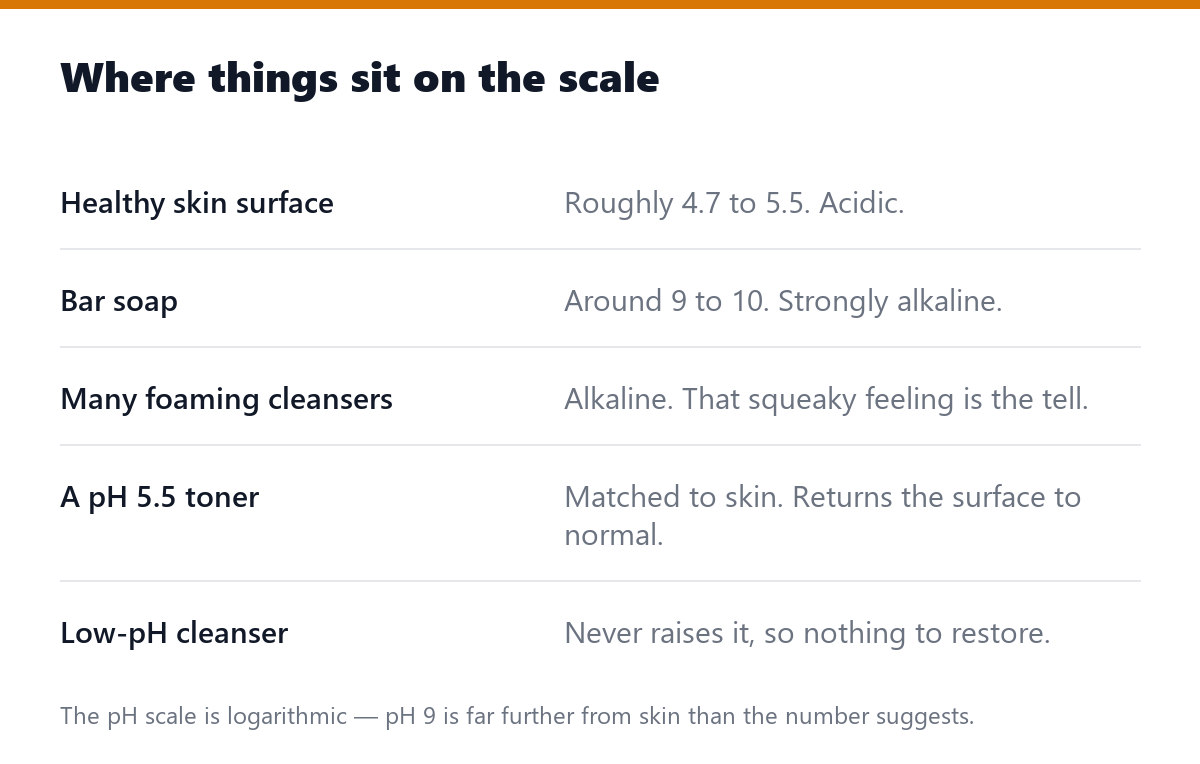
The surface of healthy skin sits at roughly pH 4.7 to 5.5 — acidic, not neutral. This is sometimes called the acid mantle, and it is not decorative. The acidity does real work: it keeps the enzymes that maintain your barrier functioning correctly, and it makes the surface inhospitable to the bacteria you would rather not have colonising it.
Push that pH up and both of those things degrade. The barrier repairs itself more slowly, and the surface becomes friendlier to the wrong organisms.
What raises it is almost always your cleanser
Here is the part the toner marketing leaves implicit.
Traditional soap sits around pH 9 to 10. Many foaming face washes are alkaline too. The pH scale is logarithmic, so the distance between a cleanser at 9 and skin at 5 is far larger than those numbers make it look.
Wash with something alkaline and your skin’s surface pH rises. It does recover on its own, but recovery takes hours — and if you are cleansing twice a day, your skin spends a substantial part of every day outside the range it works best in.
That squeaky, tight feeling after washing is the sensation people were taught to associate with clean. It is actually the feeling of a stripped, alkaline surface.
So what the toner does
A pH 5.5 toner returns the surface to where it started, immediately, instead of waiting for it to drift back over several hours. That is the entire mechanism. It is not mystical and it is not nothing.
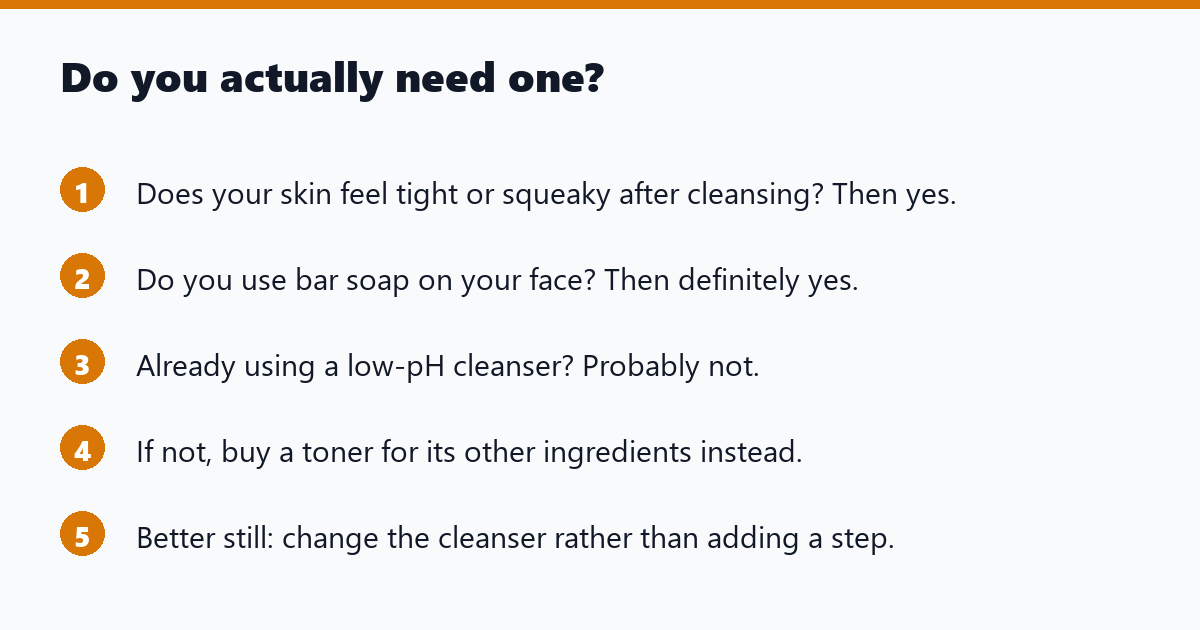
Which leads directly to the useful conclusion: the toner is worth buying in proportion to how badly your cleanser behaves.
If you wash with bar soap, or a foaming cleanser that leaves you squeaky, a pH-matched toner afterwards is a real improvement to your routine. If you already use a low-pH cleanser — most modern gel and cream cleansers are formulated that way — your skin’s pH was never raised, and there is nothing to restore.
The better fix, if you have the choice, is changing the cleanser rather than adding a step. Not raising the pH beats lowering it again.
Then judge the toner on everything else
If your cleanser is already fine, that does not make these products pointless. It just means you should stop buying them for the number and start buying them for the rest of the formula, which is where they actually differ.
Licorice-based toners lean towards dullness and uneven tone. Licorice root has a long history in brightening formulas, and a toner built around it is doing a different job from one built around soothing agents.
Check the current price on Amazon
Soothing toners built on madecassoside and panthenol are aimed at skin that is reactive, heated or recovering. Madecassoside is the centella-derived compound with the most evidence behind it, and panthenol is a dependable comfort ingredient. This is the version to reach for if your skin gets upset easily.
Check the current price on Amazon
Milky or essence-style toners sit at the richer end and blur into the essence category entirely. They suit dry skin and feel like too much on oily skin.
Check the current price on Amazon
What to look for
- Check your cleanser first. This is the whole decision. A toner cannot out-perform fixing the step that caused the problem.
- Alcohol-free. A toner is a leave-on layer applied to freshly cleansed skin. Denatured alcohol high in the list works against everything else in the bottle.
- Buy for the second ingredient story. Licorice, centella, panthenol — the pH is table stakes and the rest is the actual product.
- Watch the format. Some are meant to be wiped with cotton, some patted in. Wiping adds mechanical exfoliation you may not want daily.
Who this suits
Anyone who still uses soap or a squeaky foaming cleanser. The clearest case. You are undoing measurable damage.
Reactive and easily-irritated skin. A stable, acidic surface is one fewer thing provoking it, and the soothing versions add a second benefit.
People building a first routine. A gentle toner is a low-risk way to add a step without adding an active.
Who should skip it
Anyone already using a low-pH cleanser. Your skin’s pH is not being disturbed. Spend the money on sunscreen.
People wanting visible results. This is maintenance, not treatment. Nothing here fades marks or clears congestion.
Anyone with too many steps already. If your routine has grown past what you actually complete every night, a toner is the first thing to cut.
FAQ
Does skin not rebalance its own pH?
It does, over a few hours. The argument for the toner is about how much of your day skin spends outside its normal range when you cleanse twice daily, not about permanent damage from a single wash.
Is 5.5 the right number?
Anything in roughly the 4.5 to 5.5 range is matched to skin. 5.5 has become the marketing convention rather than a uniquely correct figure — do not treat a toner at 5.0 as worse.
Does a pH toner replace a moisturizer?
No. Most of these are watery and contain little or nothing occlusive. It is a preparation step, and the moisturizer still has to happen.
Can I use one with exfoliating acids?
Yes, and it can help. Acids work at a low pH by design; a pH-matched toner before or after does not neutralise them. If acids leave your skin uncomfortable, the problem is frequency, not the toner.
Keep reading
haruharu wonder Black Rice: Toner or Essence?
numbuzin Numbers: They Aren’t Strengths or Steps
The bottom line
A pH 5.5 toner restores an acidic surface that an alkaline cleanser disturbed. That is a real, specific, modest benefit — and it is worth exactly as much as your cleanser is bad.
Check that first. If your cleanser is already gentle, buy your toner for the licorice or the centella or the texture, and treat the number on the front as the least interesting thing about it.