
As an Amazon Associate I earn from qualifying purchases. This post contains affiliate links, which means we may earn a commission if you buy through them — at no extra cost to you.
Quick verdict
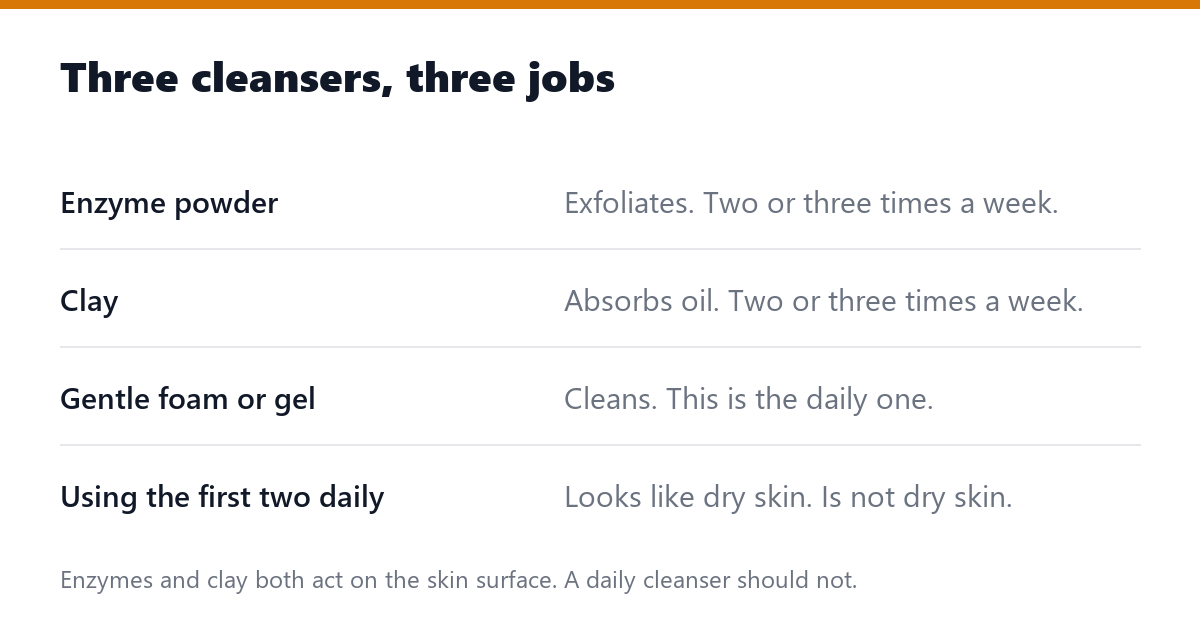
Enzyme powders and clay cleansers do more than clean — they exfoliate and absorb, which makes them treatment steps rather than daily washes. Use a plain gentle foam or gel every day, and bring the other two in two or three times a week. The damage from getting this wrong looks exactly like dry skin, which is why people respond by moisturizing harder.
Three products sold in the cleanser aisle do three completely different things, and only one of them belongs in your routine every day.
A powder cleanser is an exfoliant. A clay cleanser is an oil absorber. A gentle foam or gel is a cleanser. The packaging does not make this obvious, and the consequences of mixing them up look like a different problem entirely.
What an enzyme powder actually is
These stay dry in the jar because the active part cannot be stable in water. You add the water yourself, which activates enzymes that break down keratin — the protein in dead surface skin cells.
That is exfoliation. It is gentler than acids and far gentler than a scrub, because there is nothing abrasive and the process is biochemical rather than mechanical. But gentler is not the same as suitable for daily use.
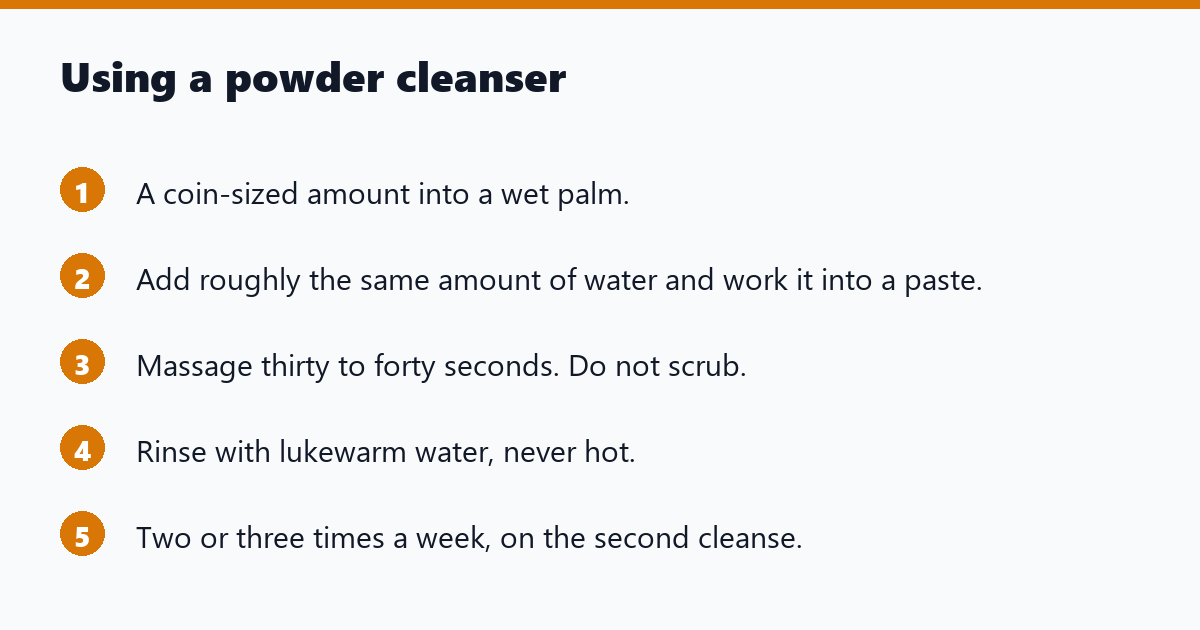
Used two or three times a week it is one of the more elegant ways to exfoliate — no grains, no stinging, no sun sensitivity to manage. Used every morning it quietly wears down the surface your skin needs to hold water.
Check the current price on Amazon
Clay is doing something else again
Clay does not exfoliate. It absorbs — oil, and to a lesser extent whatever is dissolved in it.
For congested, oily skin that is genuinely useful, and a clay cleanser is a faster version of a clay mask because the contact time is short. The trade-off is the same one clay always carries: it does not distinguish between excess oil and the oil your barrier needs.
Use it where the congestion is rather than over your whole face, and treat it as a two-to-three-times-weekly step.
Check the current price on Amazon
The boring one is the important one
A plain gentle foam or gel cleanser is the least interesting product in this article and the one you should own.
It has one job: remove what is on your skin without removing what is in it. Amino-acid based foaming cleansers do this well because the surfactants are milder than traditional soap-based ones, and because they sit at a pH matched to skin rather than well above it.
If your cleanser leaves you squeaky, that is not clean — that is an alkaline surface and a stripped barrier, and no amount of moisturizer afterwards fully compensates.
Check the current price on Amazon
Why getting this wrong is hard to spot
Here is the part that traps people.
Over-cleansing does not feel like over-cleansing. It feels like dry skin — tightness, flaking, sensitivity that was not there before. So the natural response is to buy a richer moisturizer, which treats the symptom while the cause repeats twice a day.
The tell is the sequence. If your skin feels fine immediately after cleansing and tight fifteen minutes later, that is dryness. If it feels tight immediately, the cleanser is the problem.
How they fit together
- Every day, morning and night: the gentle foam or gel. That is the whole daily routine.
- Two or three nights a week: swap in the enzyme powder as your second cleanse.
- Two or three times a week, on congested areas: the clay.
- Never on the same night: powder and clay together is two treatments stacked, and skin does not thank you for it.
And if you are already using an acid exfoliant, the enzyme powder replaces it rather than adding to it. Count your total exfoliation across the week, not per product.
Who this suits
Oily and congested skin. All three have a place, with the daily cleanser doing most of the work and the other two as scheduled treatments.
Anyone who dislikes acids. Enzyme powders are a genuine alternative — no stinging, no purging period, no added sun sensitivity.
People who travel. A powder is not a liquid, which solves a small but real problem with hand luggage.
Who should skip them
Dry or currently irritated skin. Neither exfoliation nor oil absorption is what you need. Use the gentle cleanser and nothing else until things settle.
Anyone already exfoliating twice a week. You are at the ceiling. Adding a powder cleanser means removing something else.
People wanting fewer steps. A good daily cleanser plus sunscreen beats an elaborate cleansing routine every time.
FAQ
Can I use a powder cleanser every day?
Not advisable. It is an exfoliant, and daily exfoliation wears down the barrier regardless of how gentle the method is. Two or three times a week is the ceiling for most skin.
Does a powder cleanser replace my regular cleanser?
On the nights you use it, yes — it goes in the second-cleanse position. On other nights you still need a normal cleanser.
Is clay too harsh for sensitive skin?
It can be, and short contact time is what makes a clay cleanser more manageable than a clay mask. Use it on congested areas only rather than across the whole face.
What about double cleansing?
These are all second-step cleansers. If you wear sunscreen or makeup, an oil cleanser still comes first — none of these three removes water-resistant sunscreen properly on their own.
Keep reading
haruharu wonder Black Rice: Toner or Essence?
numbuzin Numbers: They Aren’t Strengths or Steps
The bottom line
A powder cleanser and a clay cleanser are treatments that happen to be rinsed off. They earn a place in a routine two or three times a week, and they cause slow, hard-to-diagnose damage when used daily.
Buy the boring gentle cleanser for every day, then add one of the other two on a schedule. That order round is what most routines get backwards.