As an Amazon Associate I earn from qualifying purchases. This post contains affiliate links, which means we may earn a commission if you buy through them — at no extra cost to you.
Quick verdict
Malassezia feeds on fatty acids in a specific carbon-chain range, so the rule is chemical rather than brand-based: avoid most plant oils, free fatty acids and many -ate esters, and lean on squalane and caprylic/capric triglyceride. Published ‘safe lists’ disagree on borderline esters, so checking the ingredient panel yourself is more reliable than trusting a list. This is a helpful framework, not a diagnosis — persistent breakouts need a doctor.
Two websites will tell you the same serum is fungal acne safe and fungal acne triggering. Neither is lying. The disagreement is real, and understanding why is what lets you stop relying on either.
Fungal acne safe skincare is not a certification. It is a chemistry rule applied to an ingredient list, and the rule has genuinely blurry edges.
What fungal acne is, and is not
The popular name is misleading. What people call fungal acne is Malassezia folliculitis, an overgrowth of a yeast that lives normally in hair follicles. Ordinary acne involves bacteria, oil and blocked pores. These are different problems that happen to look similar.
The usual clue is uniformity: small bumps of similar size, often across the forehead, hairline, chest or upper back, often itchy, and unresponsive to the acne products that normally work.
Worth saying plainly: this is a medical condition and this article is not a diagnosis. If bumps persist, a doctor can confirm what it is and prescribe an antifungal, which is the treatment. Changing your skincare only removes the fuel.
The one rule everything else comes from
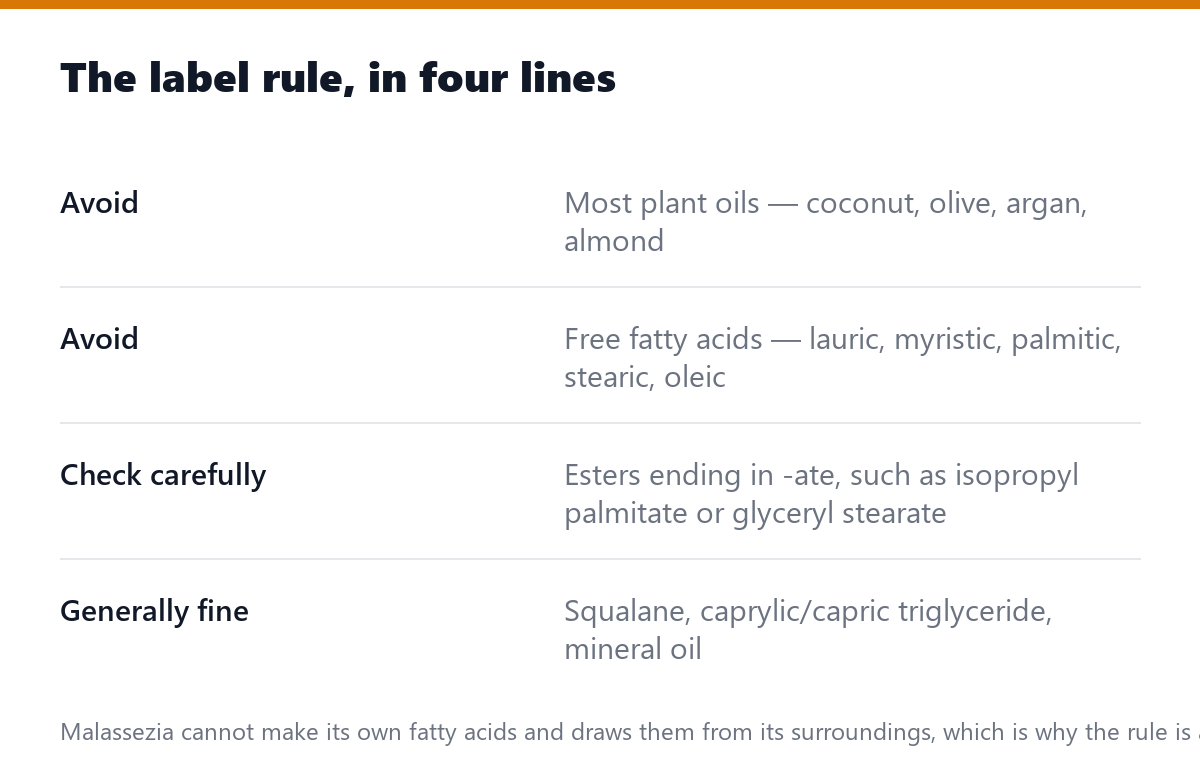
Malassezia cannot manufacture its own fatty acids. It takes them from its surroundings — including from the products you apply.
Laboratory work indicates it feeds on fatty acids in a carbon-chain range of roughly C11 to C24. That single fact generates the whole avoid-list:
Most plant oils are triglycerides of fatty acids in exactly that range. Coconut, olive, argan, sweet almond — all food.
Free fatty acids named on labels — lauric, myristic, palmitic, stearic, oleic — likewise.
Many esters, which are a fatty acid joined to an alcohol. These often end in -ate: isopropyl palmitate, glyceryl stearate, and dozens of others.
Fermented ingredients are the contested category. Galactomyces and Saccharomyces ferments are commonly avoided during an active breakout on the reasoning that broken-down compounds may feed the yeast.
What stays on the shelf
Squalane is the important one. It is a hydrocarbon rather than a fatty acid, so it is not food for this yeast, and it is the emollient that fungal-acne routines are usually built around. It is also, separately, one of the better emollients for oily skin — provided you buy the right spelling.
Caprylic/capric triglyceride is built from shorter chains (C8 and C10) that fall below the feeding range, and is generally treated as fine.
Mineral oil is not a fatty acid at all.
Beyond emollients, the humectants are all unproblematic: glycerin, butylene glycol, propanediol, hyaluronic acid, panthenol. So are most actives — niacinamide, acids, and the soothing extracts.
Why the safe lists disagree
Here is the part that makes label-reading worth learning, and three real examples make it concrete.
Torriden DIVE-IN serum is a hyaluronic acid serum with no plant oils and no free fatty acids — and it contains polyglyceryl-10 laurate, an emulsifier built on a C12 chain. Strict checkers flag it. Lenient ones note it is an emulsifier at low levels rather than an oil, and pass it.
The SKIN1004 Water-Fit Sun Serum contains coco-caprylate/caprate, an ester whose name contains both a short chain and a coconut-derived one. Different lists reach different verdicts on it.
The beplain Mung Bean cleansing foam is the easy case, and it shows why: it is a rinse-off product built on glycerin and amino-acid surfactants with no oil phase at all. Contact time is seconds and nothing is left behind.
The pattern is that rinse-off products are rarely the problem and leave-on emollients usually are, and that the arguments happen over emulsifiers in the middle of a list, where the quantity is small and the chemistry is arguable.
Check the current price on Amazon
How to check a label in one minute
Scan for oils first. Any ingredient with “oil”, “butter” or “seed” in the name, in a leave-on product. That catches most of it.
Then scan for the fatty acid names. Lauric, myristic, palmitic, stearic, oleic — as words on their own.
Then look at the -ate words, and note where they sit. An ester in the top five is a real consideration; one near the end of a long list is a smaller one.
Judge leave-on and rinse-off differently. A cleanser that contains an ester is a far smaller exposure than a cream that sits on skin for eight hours.
That is the method. It is more reliable than any list, because it is the reasoning the lists are built on.
Building a routine while you sort it out
Cleanser: the easiest step to get right, because rinse-off. A low-pH, oil-free foam is both fungal-acne-friendly and better for your barrier generally — the pH is the part that matters.
Hydration: a humectant serum with no oil phase. This is where hyaluronic acid earns its place, with the polyglyceryl caveat above for you to weigh.
Check the current price on Amazon
Moisture: squalane, on its own or in a simple formula, rather than a rich cream.
Sunscreen: the hardest step, because sunscreens need emollients to spread. A fluid, low-oil formula is the usual compromise, and reading its panel matters more than for anything else in the routine.
Check the current price on Amazon
The steps people forget: hair and laundry
Malassezia folliculitis shows up on the forehead, hairline, chest and back more often than on the cheeks — and those are exactly the places your hair products touch.
Conditioners and hair masks are built on fatty alcohols and cationic conditioners, and they run down your hairline, neck and back in the shower. If your breakouts follow that map, the conditioner is worth suspecting before the face serum is. Rinse hair with your head tilted forward, and wash your face after conditioning rather than before.
Heavy leave-in oils and hair balms sit against the hairline all day. They are the single most overlooked source.
Pillowcases collect whatever your hair leaves behind. Changing them more often costs nothing and is a reasonable thing to try while you sort the rest out.
What this approach cannot do
It does not treat anything. Removing fuel is not the same as removing yeast. Antifungal treatment does that, and it comes from a doctor.
It is not a reason to strip your routine bare. A damaged barrier makes every skin problem worse, and abandoning moisturiser entirely is a common overcorrection.
It may be the wrong rule for you entirely. If the bumps are ordinary acne, an oil-free routine helps only incidentally, and you are avoiding ingredients for no reason. That uncertainty is the strongest argument for getting it diagnosed rather than self-treating from a list.
FAQ
Is fungal acne contagious?
No. The yeast lives on almost everyone’s skin already. What varies is whether it overgrows.
Can I still use niacinamide, acids or retinoids?
Yes. None of them are fatty acids and none feed the yeast. Only the oil and ester side of a formula is at issue.
Are all Korean products high-risk because of the ferments?
No. Ferments are common in Korean formulation, but plenty of Korean products are oil-free and humectant-led. The cleanser and serum above are both Korean.
How long until I know if it worked?
Give a changed routine several weeks before judging. If nothing improves in that time, the problem is probably not what you assumed, which is again a reason to have it looked at.
Keep reading
Arencia Vitamin C Booster Shot: Which Vitamin C Is It?
Sheet Mask vs Serum: Same Ingredient, Different Job
The bottom line
Fungal acne safe skincare comes down to one rule — Malassezia eats fatty acids in a particular size range — and to the habit of reading a panel for oils, fatty acids and esters.
Learn the rule and the disagreements between lists stop mattering, because you can see what each list was arguing about. Then get the bumps diagnosed, because skincare choices manage the conditions and medicine treats the cause.