As an Amazon Associate I earn from qualifying purchases. This post contains affiliate links, which means we may earn a commission if you buy through them — at no extra cost to you.
Quick verdict
Pilling is a physical problem, not a formula defect. It happens when a film-forming layer is rubbed before it has set, or when two layers cannot mix. Fix the order and the drying time first and most pilling disappears. If it persists, the fastest change is swapping to a thinner, fluid sunscreen rather than replacing your whole routine.
You finish your routine, smooth on sunscreen, and little grey rolls appear under your fingers. Most people blame the sunscreen and buy a new one. That is usually the wrong conclusion.
Sunscreen pilling is a physical event, not a formula defect, and it is caused by the interaction between layers at least as often as by the top layer itself.
What is actually rolling up
The rolls are not dead skin, and they are not sunscreen alone. They are a mixture of the film-forming ingredients from every layer you applied, lifted off by friction before they had set.
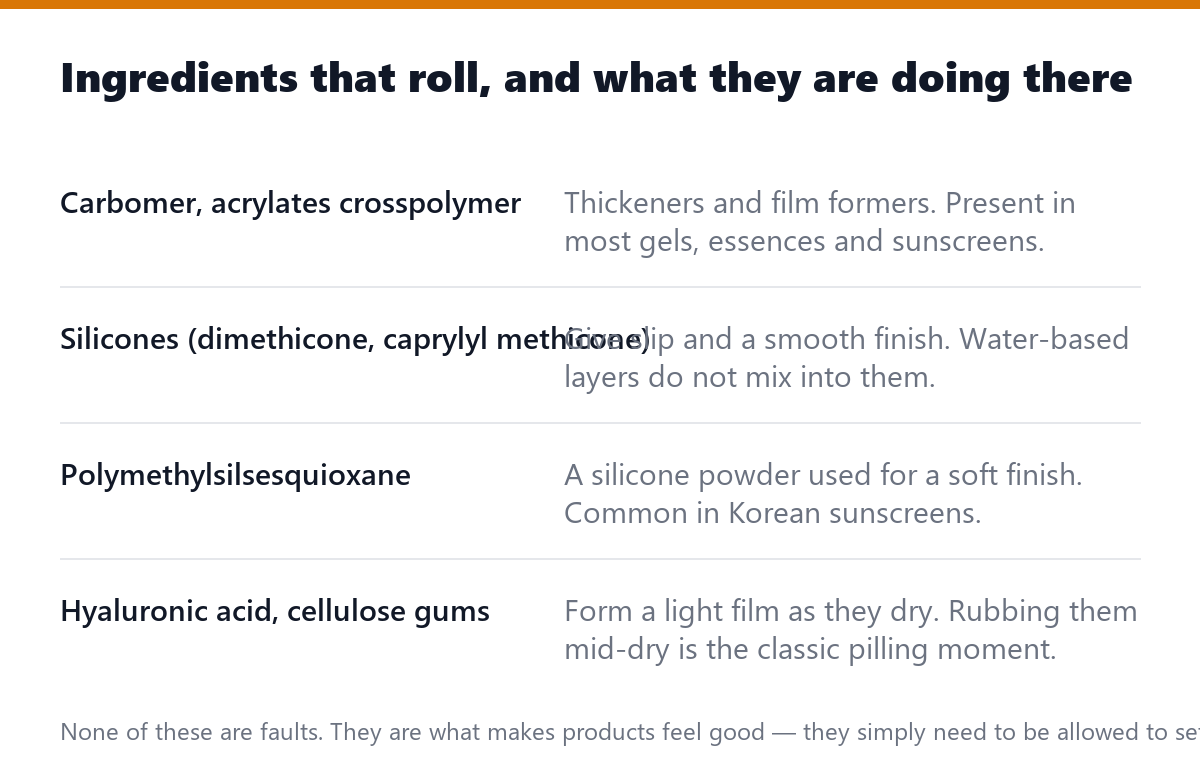
Almost every modern skincare product contains something that forms a film as it dries — a thickener like carbomer, an acrylates crosspolymer, hyaluronic acid, a cellulose gum. These are what give a product body and a pleasant finish. They are also what balls up when you rub them at the wrong moment.
Once you see it that way, the three real causes become obvious.
Cause 1: you did not wait
The most common cause by a wide margin.
A layer needs its water to evaporate before the film it leaves behind is stable. Applying the next product too early re-wets that half-formed film, and the friction of spreading gathers it into rolls.
The fix: give each layer 30 to 60 seconds, and give the layer under sunscreen a full minute. Wait until skin feels dry to a fingertip rather than tacky. This alone solves most cases and costs nothing.
Cause 2: silicone and water do not mix
Silicones — dimethicone, caprylyl methicone, and silicone powders like polymethylsilsesquioxane — sit on the surface and repel water. A water-based serum applied on top of a silicone layer does not blend into it; it sits on top and is rubbed off.
This is why the order matters more than the count. Water-based goes first, silicone-containing goes later, and the two should not be sandwiched back and forth.
Many Korean sunscreens contain silicones for their smooth finish — the SKIN1004 Water-Fit Sun Serum, for example, has caprylyl methicone and a silicone powder in it. That is a feature, and it is also a reason to put nothing water-based on top of it.
The fix: thinnest to thickest, water-based before silicone-based, and sunscreen last. If you are unsure which of your products is which, the category names will not help you — the texture will.
Cause 3: too many films stacked
Toner, essence, serum, ampoule, eye cream, moisturiser, sunscreen. Seven layers is seven films, and the total load eventually exceeds what will sit flat on skin.
Korean routines get blamed for this, somewhat unfairly — the problem is not the number of steps but the number of film-forming steps. Three hydrating layers that each contain carbomer behave very differently from three layers where one is a watery toner and one is an oil.
The fix: on days you wear sunscreen and makeup, cut one middle layer. The one to cut is whichever product is doing the same job as its neighbour.
Cause 4: the skin underneath is flaking
Dry, flaking skin gives the product nothing flat to sit on, and the flakes come off with the product.
If pilling started recently and your skin has been dry, this is the likely cause. Gentle exfoliation once or twice a week clears the surface — but only gentle, and not while skin is irritated, because over-exfoliated skin flakes more. Which acid to start with matters here.
If your cleanser is stripping skin every morning, fix that first. A harsh cleanser creates the dryness that everything above is trying to compensate for.
What to change if it still pills
Once timing and order are right, the fastest remaining lever is the sunscreen’s own texture.
A thin, fluid sunscreen layers over more things without rolling. A serum-textured SPF has a lighter film and spreads with less friction, which is the practical argument for that format — we looked at what that texture buys you in the SKIN1004 Water-Fit Sun Serum review.
Check the current price on Amazon
A ceramide-rich sunscreen suits skin that pills because it is dry. If flaking is the root cause, a sunscreen that also conditions the surface treats the cause rather than working around it. The Purito Daily Soft Touch carries five ceramides plus cholesterol for that reason.
Check the current price on Amazon
What does not help
Applying more. More product means more film, which pills more.
Rubbing harder. Friction is the mechanism. Press and pat instead of rubbing.
Blaming mineral sunscreens specifically. Zinc oxide formulas do pill more readily because of the powder load, but the same rules fix them. Mineral formulas have their own trade-offs, and pilling is only one of them.
Switching everything at once. Change one variable, wait a week, and you will know which layer was responsible.
How to find the guilty layer
If the timing fixes did not work, you can identify the culprit in about four days without buying anything.
Day one: sunscreen on bare skin. Cleanse, wait, apply sunscreen and nothing else. If it pills even here, the sunscreen genuinely does not suit your skin’s surface, and that is when replacing it is the right call. If it does not pill, the sunscreen is innocent and something underneath it is responsible.
Then add one layer back per day. Moisturiser on day two, serum on day three, toner on day four. The day it starts rolling again names the layer.
In our experience of reading these formulas, the layer that most often turns out to be responsible is a thick hydrating gel or a heavily silicone-based primer sitting directly under the sunscreen — two film-formers with nothing between them.
Once you know which product it is, you have a real choice: move it earlier in the routine, use less of it, use it at night only, or replace just that one thing.
The order that works
For most people, most mornings:
Cleanse, then one watery layer (toner or essence) patted in, then one treatment if you use one, then moisturiser, wait a minute, then sunscreen pressed on rather than rubbed. Makeup after another minute.
That is five steps and two waits, and it pills far less than a seven-step routine applied quickly.
FAQ
Is pilling a sign the product is bad?
No. It is a sign two layers are incompatible or one was rubbed before it set. A product that pills in one routine can be flawless in another.
Does pilling mean my sunscreen is not protecting me?
Yes, in the places where it rolled off. That is the real cost of pilling — you lose coverage exactly where the rolls formed. Reapply over those areas.
Can I fix pilling with a primer?
Sometimes, but a primer is another film-forming layer. It is more reliable to remove a layer than to add one.
Why does it only happen with makeup?
Because foundation is usually the most friction-heavy step. Wait longer before it, and apply it by pressing with a sponge rather than dragging a brush.
Keep reading
Arencia Vitamin C Booster Shot: Which Vitamin C Is It?
Sheet Mask vs Serum: Same Ingredient, Different Job
The bottom line
Pilling is a timing and order problem before it is a product problem. Wait a full minute before sunscreen, keep water-based layers below silicone-based ones, and cut one redundant step on makeup days.
If it still happens after that, change the sunscreen’s texture rather than the whole routine — a thinner fluid for most skin, or a ceramide-rich one if the pilling is really dryness in disguise.