As an Amazon Associate I earn from qualifying purchases. This post contains affiliate links, which means we may earn a commission if you buy through them — at no extra cost to you.
Quick verdict
Microneedle eye patches are a genuine step up from ordinary hydrogel patches for hydrating and smoothing fine, crepey under-eye lines. They do not lift eye bags, which are caused by fat and structure no topical product can move. Buy them for smoother under-eyes before an event or makeup, not as a substitute for a treatment that changes structure.
A patch covered in tiny needles sounds like it should do more than a gel patch. It does do more. It just does not do the thing on the box.
Microneedle eye patches are the newest version of the under-eye patch, and the CHARDE Eye Bag Lift 1100 Shot patch — named for its needle count — is a popular example. Understanding what the needles achieve, and what eye bags actually are, is the difference between being pleased with these and being disappointed by them.
What a dissolving microneedle is
These are not the metal needles used in clinics. They are tiny cones made largely from hyaluronic acid, set in a patch. Pressed onto skin, they sit in the very top layers and dissolve over the wearing time, releasing what they carry.
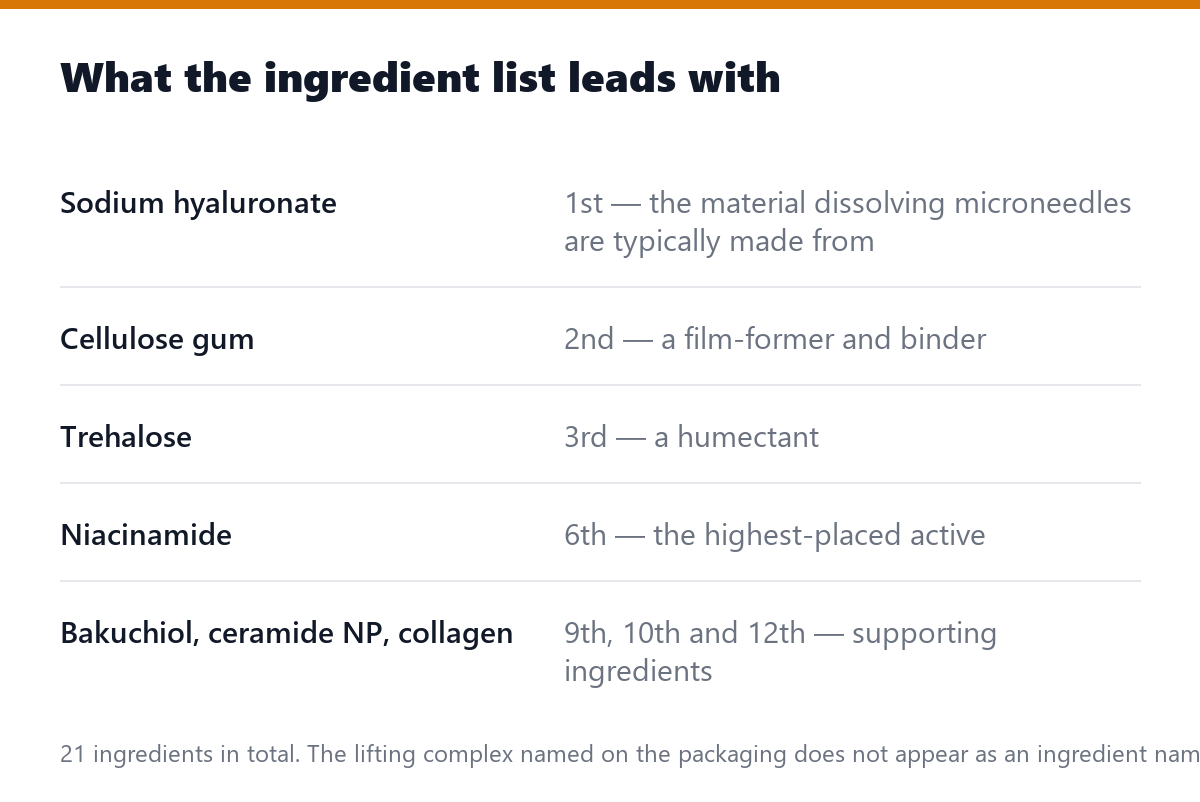
The ingredient list fits that picture: sodium hyaluronate is first, followed by cellulose gum, a binder and film-former, and trehalose, a humectant.
The appeal is delivery. An ordinary patch sits on top of the skin and relies on ingredients crossing the surface on their own. A dissolving needle places its material just below the outermost layer, which is a genuine advantage for hydration and for small molecules.
What it is not is in-office microneedling. Clinic treatments use deeper, controlled injury to trigger repair. A dissolving at-home patch is shallow and gentle by design. They are different tools that share a word.
Why eye bags are the wrong target
This is the part the packaging skips.
Under-eye bags are mostly structural. With age, the fat that cushions the eye can push forward, the tissue holding it back loosens, and the skin over it thins. The result is a bulge that casts a shadow beneath it. It is anatomy, not surface texture.
No topical product repositions fat or tightens the tissue holding it. That applies to creams, to hydrogel patches and to microneedle patches alike. We made the same point about dark circles in the piece on what Korean eye patches can and cannot fix — two of the three causes of under-eye darkness sit below where any patch reaches.
What can change quickly is puffiness — temporary fluid, worse in the morning and after salty food or poor sleep — and fine, crepey lines from dehydration. Those respond. Structural bags do not.
What the patch can genuinely do
Smooth dehydrated under-eye skin. This is its real strength. Hyaluronic acid delivered just below the surface plumps crepey skin, and fine lines caused by dryness soften visibly. This is where a microneedle patch clearly outperforms a plain gel patch.
Improve how concealer sits. Concealer creases into dry lines. Hydrated, smoother skin underneath is the most practical benefit of any under-eye patch, and the reason to use one before makeup.
Reduce morning puffiness, a little. Some of this is simply the patch being cool and resting on the area. It helps; it is not dramatic.
The ingredients beyond the needles
Niacinamide is sixth, the highest-placed active, and useful for the thin, sometimes uneven skin under the eye. Centella asiatica extract follows at eighth.
Bakuchiol sits ninth — often described as a gentler retinol alternative. Under the eye, gentleness is the priority, and we set out what bakuchiol can and cannot replace in the bakuchiol versus retinol comparison. Ceramide NP, jojoba seed oil and tocopherol support the barrier, and dipotassium glycyrrhizate, from liquorice root, is a soothing ingredient.
Collagen appears twelfth. As with every collagen claim, it works as a moisturiser rather than rebuilding anything — collagen molecules are too large to get in, which is the reason peptides exist.
The packaging promotes a lifting complex with a percentage attached. We could not match that name to anything on the published ingredient list, so we are not repeating the figure.
Check the current price on Amazon
Who they suit
Dry, crepey under-eyes. The best match by a distance. If your concern is fine lines from dehydration, this is a real improvement over ordinary patches.
Anyone whose concealer creases. Use one before makeup on days it matters.
People who already like eye patches and want a step up. The delivery is genuinely different.
Who should skip them
Anyone hoping to reduce true eye bags. Structural bags need a structural answer — that is a conversation with a dermatologist or surgeon, not a patch.
Very sensitive or broken skin around the eyes. Even gentle microneedles are a mild physical stimulus. Skip them on irritated, eczema-prone or freshly treated skin.
Anyone wanting a daily treatment on a budget. These are an occasional-use product. For everyday hydration, an eye cream or a simple hyaluronic acid serum is the more economical habit.
How to use them
Apply to clean, completely dry skin. The needles dissolve on contact with moisture — apply to damp skin and they start dissolving before they are in place.
Press gently, then leave them alone. Press with a fingertip so the needles make contact across the whole patch. Do not rub or reposition.
Follow the wear time on the packet. Microneedle patches are often designed for longer wear than gel patches, and the instructions differ between products.
Keep them off the same night as strong actives. Avoid retinoids and exfoliating acids on the area immediately before or after.
Microneedle patch or ordinary gel patch?
Both have a place, and they are good at different things.
A hydrogel patch is the better tool for a quick morning de-puff. It is cool, it can go on damp skin, you can wear it while making coffee, and it comes off in twenty minutes. Its limit is that everything it carries has to cross the skin surface on its own.
A microneedle patch is the better tool for dehydrated, crepey skin and fine lines. The needles place hyaluronic acid just below the outer layer, which a gel patch cannot do. The trade-offs are that it needs completely dry skin, it asks for a little more care in application, and it is not something to wear daily.
A practical way to use both: a gel patch on rushed mornings when puffiness is the issue, and a microneedle patch the evening before something where you want smooth under-eyes and concealer that stays put.
Whichever you choose, the limit is the same. Neither changes the structure underneath. The difference between them is how well they handle the surface — and on the surface, the microneedle patch is the stronger of the two.
FAQ
Do microneedle patches hurt?
Most people describe a faint prickle on application at most. They are designed to be painless. Stop if your skin stings or reddens and stays red.
Will they get rid of dark circles?
Only if the darkness is partly from dehydrated, crepey skin. Circles from visible blood vessels or from the shadow of a hollow are below where the patch reaches.
How often can I use them?
Follow the packet, and give your skin a break between uses. These are an occasional treatment, not a daily step.
Keep reading
UNOVE Deep Damage Treatment: It’s Not the Keratin
BIOHEAL BOH 3D Lifting Cream: 17 Peptides, One Question
The bottom line
Microneedle eye patches are a real improvement on ordinary patches for smoothing and hydrating the under-eye area, and the CHARDE formula is sensibly built around hyaluronic acid, niacinamide and gentle supporting ingredients.
They do not lift eye bags, because nothing topical does. Buy them for smoother, better-hydrated under-eyes and for makeup that sits well — not for the name on the box.