As an Amazon Associate I earn from qualifying purchases. This post contains affiliate links, which means we may earn a commission if you buy through them — at no extra cost to you.
Quick verdict
A serum is the treatment and a sheet mask is the event. Masks win on immediate plumpness and on comfort for irritated skin, because occlusion is a real mechanism. They lose on active concentration — the essence in a packet is mostly water and humectants, and the ingredient on the front is often present in parts per million. Buy masks for how skin looks tonight; buy serums for how it behaves in three months.
A sheet mask and a serum can name the same active on the front of the packaging and be doing almost unrelated things.
The sheet mask vs serum question is usually answered with “both, they are teammates,” which is true and unhelpful. Here is the more useful version: they differ on three axes, and knowing which axis you care about tells you which to buy.
The mechanism a mask has that a serum does not
Occlusion. A sheet sits on the face and stops water evaporating for twenty minutes.
That is not a small thing. Skin under an occlusive layer takes up water from the essence and from itself, and the upper layers swell slightly. Swollen skin is smoother, lines look shallower, and the surface reflects light more evenly. This is why the mirror after a sheet mask is genuinely convincing.
It is also why the effect fades. Nothing was added to the skin’s structure — water moved, and water leaves again over the following hours unless you seal it in. That is the honest frame for every sheet mask, and it is the same point we made in the DERMAL collagen mask review.
A serum has no occlusion at all. It is applied and absorbed, and whatever it does, it does through the ingredients rather than through the physics.
The concentration a serum has that a mask does not
Here is the part that is rarely said plainly, so an example is more useful than a generalisation.
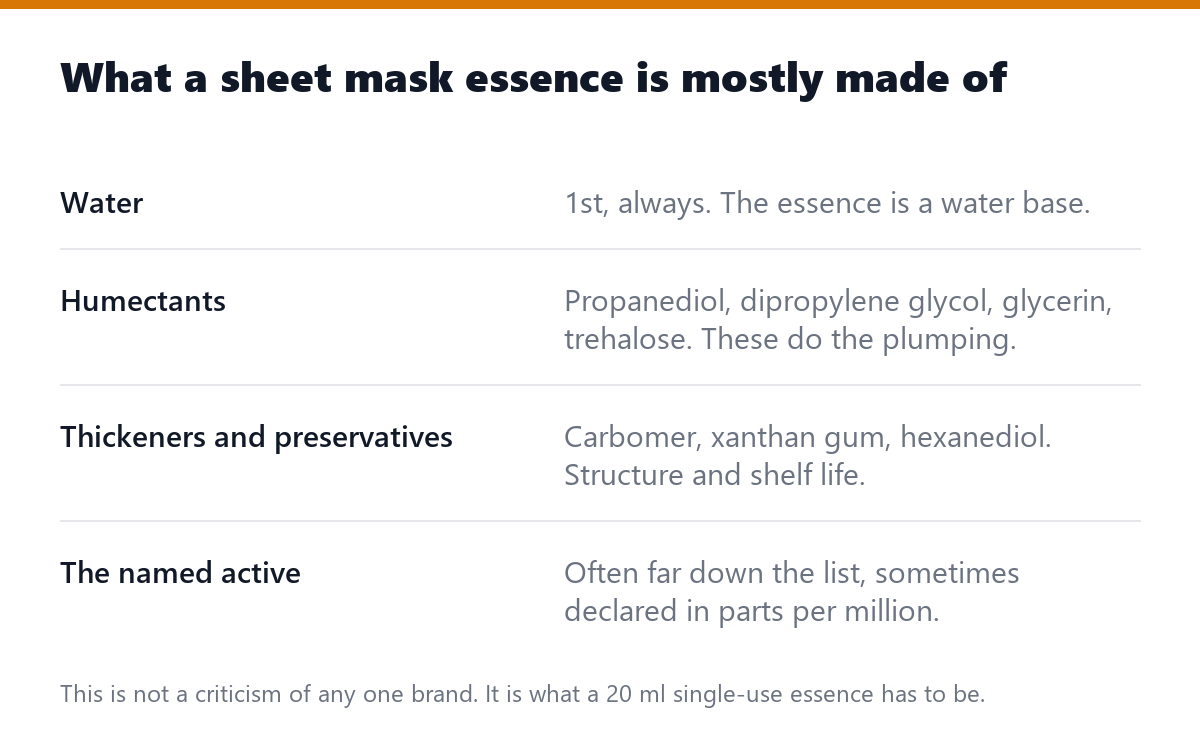
Take a well-regarded madecassoside sheet mask — the MEDIHEAL Madecassoside Essential Mask, named after the calming centella compound. Its ingredient list declares madecassoside at 10 ppm. That is ten parts per million, or 0.001%.
Niacinamide is the second ingredient in the same list, above every humectant. Centella asiatica extract is nineteenth, and asiaticoside, asiatic acid and madecassic acid sit near the bottom alongside the amino acids.
Read that honestly and it says: this is a well-hydrating niacinamide-and-humectant essence with a centella label claim. Which is a perfectly good thing to be — but it is not a treatment dose of the ingredient in the product name.
That is not a MEDIHEAL problem. It is a format problem. A single-use packet holding roughly 20 ml of essence, sold in a ten-pack, cannot carry the actives of a treatment serum and stay at that price. The economics decide the formula.
If you want a specific compound working on your skin, the compound needs to be high in the list of something you use daily. Reading a centella label properly is the skill that makes this visible.
The frequency question, which decides most of it
Skin changes on the timescale of weeks, not evenings. Cell turnover, barrier lipid production, pigment behaviour — none of these respond to a single exposure.
A serum is used daily, which is the only pattern that produces the slow changes people actually want. A mask is used occasionally, which produces an immediate change and no cumulative one.
The exception is a mask designed for daily use, which changes the maths — that is exactly the argument for something like the VT Cica Daily Soothing Mask, sold in thirty-sheet packs. Daily masking is a real strategy for irritated skin. It is expensive per use, and it is the only version of masking that competes with a serum on consistency.
Check the current price on Amazon
When the mask is the right buy
When you need skin to look good tonight. Nothing in skincare produces a faster visible change than twenty minutes of occlusion. This is a legitimate use, not a lesser one.
When skin is irritated and you want it left alone. A calming essence under a sheet, with no rubbing and no actives, is genuinely soothing. Comfort is a real outcome.
When the air is dry. Heating, air conditioning and flights all pull water out of skin, and occlusion is the direct counter.
When you want to try a texture before committing. A ten-pack is a cheap way to find out whether a brand’s essence suits you.
When the serum is the right buy
Whenever the goal is a change rather than a moment. Fine lines, tone, congestion, barrier strength — all of these need daily application of something concentrated.
When you are choosing where money goes. A serum used every day for three months does more than thirty masks used once a week. If the budget only stretches to one, it is the serum.
When the active is the point. Retinoids, vitamin C, acids, peptides — none of these belong in a once-weekly format.
Using both without wasting either
Three rules cover it.
Mask on clean skin, before the serum. The essence is water-based and thin, so it belongs early. Anything thicker underneath blocks it. If the ordering of these categories has never been clear to you, nobody defines them consistently — thinnest first is the working rule.
Always seal afterwards. The single most common mistake is stopping after the mask. All that water is sitting in skin with nothing holding it there, and in dry air it evaporates within the hour, sometimes leaving skin drier than before. Moisturiser is not optional after a mask.
Do not sleep in one. As the sheet dries it reverses direction and pulls water back out. We wrote about the overnight mask that people specifically get wrong, and the principle applies to all of them.
The sheet itself matters more than the ingredient list
This follows directly from the concentration point. If the essence in most masks is a water-and-humectant base, then the real difference between a cheap mask and a good one is the material holding it against your face.
Cotton and non-woven sheets are the standard and the cheapest. They hold plenty of essence, and their weakness is fit — a flat sheet on a three-dimensional face lifts at the nose and the jaw, and wherever it lifts, occlusion stops.
Hydrogel sheets are a gel rather than a fabric, usually supplied in two pieces. They cling closely, they stay cool, and they dry out more slowly, which means the reversal problem arrives later.
Bio-cellulose is the thin, slightly translucent material that adheres almost like a second skin. It gives the best contact of the three and costs the most.
So judge a mask on whether it stays flat against your face for the full twenty minutes. That is the variable controlling the only mechanism it has. A mask gapping at the sides of the nose is not delivering occlusion there, whatever is printed on the front of the packet.
FAQ
Can a sheet mask replace my serum?
Not for anything cumulative. It can replace a hydrating serum on the evening you use it, and that is the limit of the substitution.
Should I rub in the leftover essence?
Yes, on the neck and hands. Not on the face for a second round — the face has taken up what it is going to take up, and more layers of the same water-based essence sit on top rather than adding anything.
Are expensive sheet masks better?
Mostly they differ in the sheet material and the essence texture rather than in active content, because the format caps active content regardless of price. Comfort and fit are worth paying a little for; a dramatic ingredient list on a sheet mask is worth paying less attention to.
How often should I use one?
As often as you like, if it is a hydrating or calming mask — there is nothing in one to overdo. Masks carrying acids or strong actives are a different matter and should follow the same caution as any exfoliant.
Keep reading
SKIN1004 Water-Fit Sun Serum: What “Serum” Buys You
Squalane vs Squalene: One Letter, Two Outcomes
The bottom line
A serum is what changes skin. A sheet mask is what changes how skin looks this evening, through a real mechanism that has nothing to do with the ingredient on the front of the packet.
Buy masks knowing that. They are worth owning, they are pleasant, and they work at exactly the thing they work at. Just do not expect the named active to be doing the heavy lifting when it is declared in parts per million.