
As an Amazon Associate I earn from qualifying purchases. This post contains affiliate links, which means we may earn a commission if you buy through them — at no extra cost to you.
Quick verdict
Excellent at what they actually do — twenty minutes of concentrated hydration that visibly smooths and de-puffs before an early start or after a bad night. They will not fix dark circles, because the common causes are the vessels underneath and the shadow from hollowing, and nothing you place on the surface reaches either. Buy them as a morning tool, not a treatment.
Korean eye patches are one of the few skincare products that deliver a visible result inside half an hour, which is exactly why they get bought for something they cannot do.
They are very good at one thing. Understanding why they fail at the other saves you buying them repeatedly hoping for a different outcome.
Why under-eyes look dark
“Dark circles” describes an appearance, not a cause, and there are three quite different causes hiding behind the phrase.
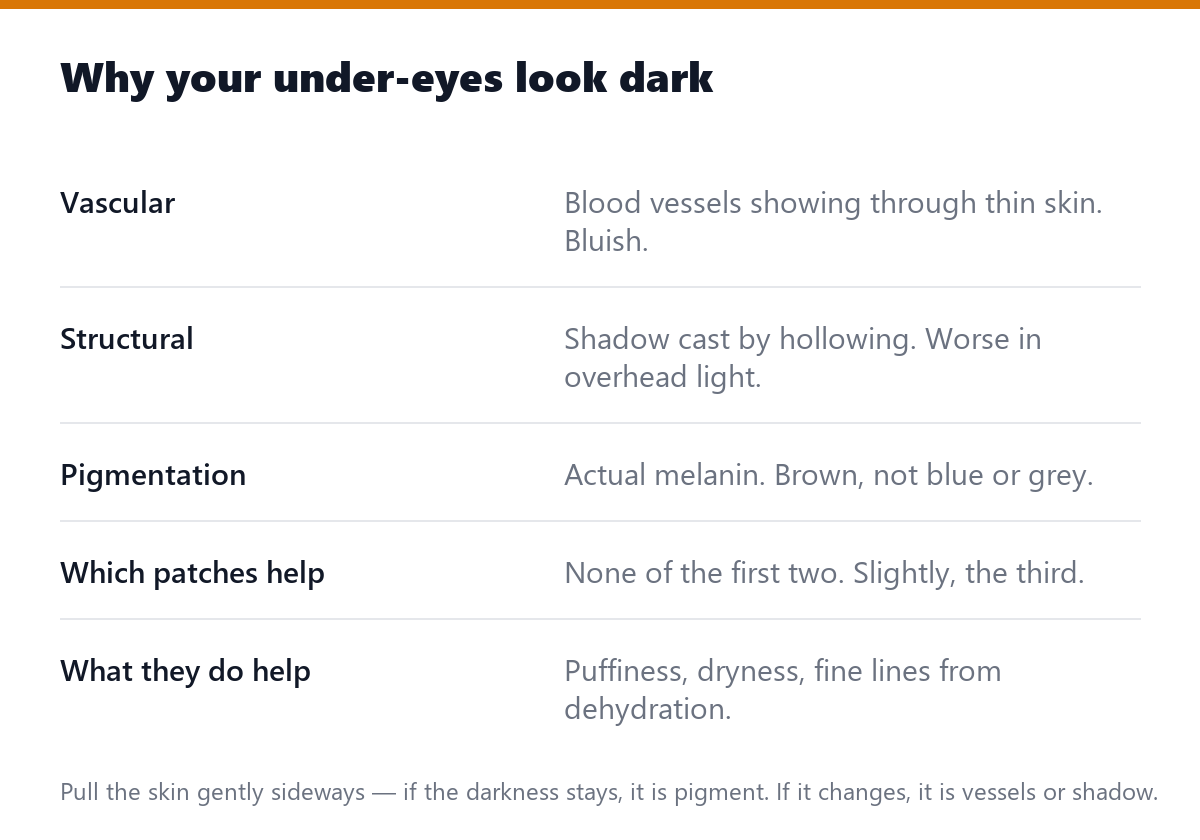
Vascular. The skin under your eyes is the thinnest on your body. The blood vessels beneath it show through, especially when you are tired or dehydrated and they are dilated. This reads as bluish or purple.
Structural. As the fat pad under the eye thins with age, a hollow forms, and the hollow casts a shadow. This is why some people look worse under overhead lighting and fine in daylight — the darkness is literally a shadow.
Pigmentation. Actual melanin deposited in the skin, which appears brown rather than blue or grey. Genuinely common in some skin tones and after rubbing or eczema.
There is a five-second test. Pull the skin gently sideways. If the darkness stays put, it is pigment. If it lightens or shifts, it is vessels or shadow.
What Korean eye patches can reach
A hydrogel patch sits on the surface and holds water and a few ingredients against the skin for twenty minutes.
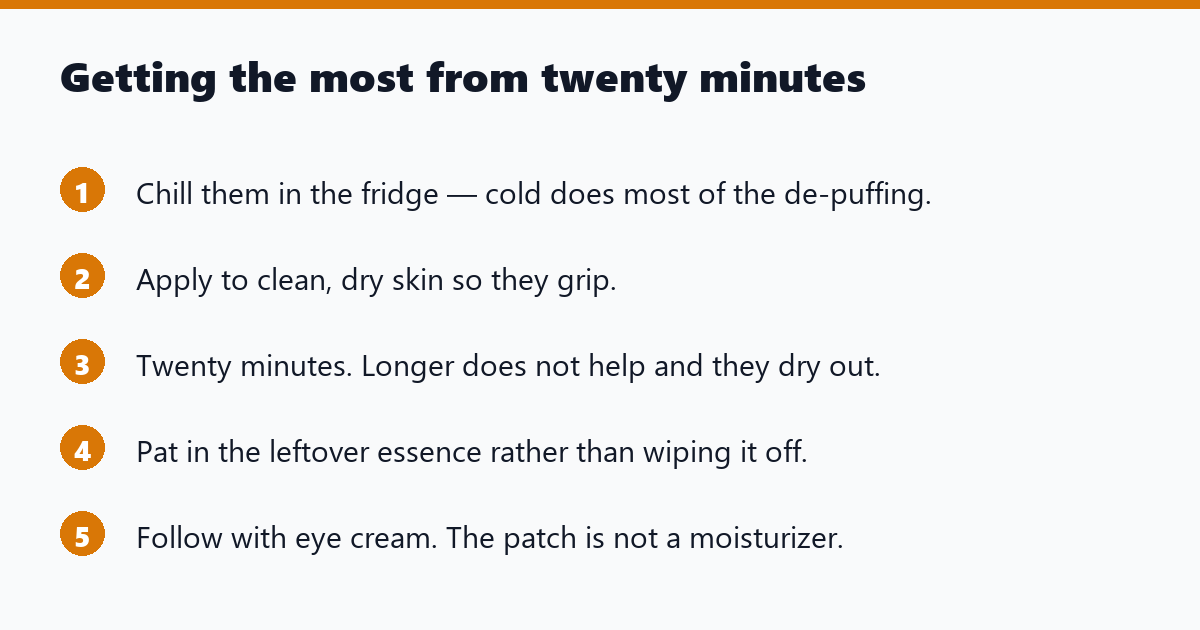
That is enough to hydrate the surface substantially, which plumps up fine crepey lines caused by dryness. It is enough to reduce puffiness, especially if the patch is cold — the temperature does at least as much of that work as anything in the formula. Caffeine, which appears in most of these, constricts blood vessels temporarily and adds to the effect.
What it cannot do is change the thickness of your skin, refill a hollow, or reach vessels sitting beneath. So for two of the three causes, the patch is working on the wrong layer entirely. For the pigmentation type it can contribute slightly, through niacinamide and similar ingredients, but twenty minutes of contact is not how pigment gets treated.
So what are they for?
Judged as a tool rather than a treatment, Korean eye patches are excellent and there is no real substitute.
The morning after a bad night. Puffiness is the one under-eye problem that genuinely responds fast, and cold patches are the most effective thing you can do about it in twenty minutes.
Before makeup. Concealer creases in dry, crepey skin. Hydrating that skin first is the difference between concealer sitting smoothly and settling into lines by lunchtime. This is the use most worth the money.
Before an event. Same logic as a sheet mask — a short-lived improvement, timed deliberately.
Check the current price on Amazon
What to look for in a patch
- Hydrogel rather than paper. Hydrogel grips, holds more essence, and does not slide down your face. Paper patches dry out in minutes.
- Fragrance-free. This is the thinnest, most reactive skin you have, applied for twenty minutes at a time. There is no argument for fragrance here.
- Caffeine, if puffiness is the concern. It is the ingredient with the clearest short-term effect for that specific problem.
- Count, not claims. These are consumable. A large pack you use twice a week beats a small luxury pack you ration.
- Ignore collagen on the label. Collagen molecules are too large to penetrate — it works as a humectant, not as structure. Peptides are the version that gets somewhere.
Who this suits
Anyone whose under-eyes puff up. The clearest case, and the fastest visible result in skincare.
People who wear concealer. The pre-makeup hydration use alone justifies owning a pack.
Dry, crepey under-eyes. Fine lines caused by dehydration genuinely improve, for a few hours.
Who should skip them
Anyone with vascular or structural dark circles. No topical product reaches either. Concealer, sleep, and — if it matters to you enough — a dermatologist.
Anyone expecting permanent change. The effect lasts hours. That is the deal.
Anyone who rubs their eyes. Chronic rubbing causes both pigmentation and laxity. Stopping does more than any patch.
FAQ
How often can I use them?
Daily is fine. There is nothing active enough in a hydrogel patch to overdo, and the limiting factor is cost rather than tolerance.
Should I leave them on longer for better results?
No. Once the patch begins to dry it starts drawing moisture back out — the same reason sleeping in a mask backfires. Twenty minutes, then take them off.
Do they help wrinkles?
They temporarily plump lines caused by dryness, which looks like an improvement and is not the same as treating them. Established lines need retinoids or procedures.
Are they better cold?
For puffiness, noticeably. Keep the jar in the fridge — the cold is doing real work, not just feeling nice.
The bottom line
Korean eye patches are a genuinely good twenty-minute tool sold as a solution to a problem most of them cannot touch.
Work out which kind of dark circle you have first. If it is puffiness or dryness, buy a large pack and keep it cold. If it is vessels or shadow, save your money — that darkness is beneath the layer any patch can reach.