As an Amazon Associate I earn from qualifying purchases. This post contains affiliate links, which means we may earn a commission if you buy through them — at no extra cost to you.
Quick verdict
Many Korean sunscreens sold in the US are reformulated with a different set of UV filters, because the filters used in Korea are not approved here. Same brand, same name, different product — which means the reviews you read do not transfer. Check the active ingredients panel before you buy, not the brand.
Someone watches a review of a Korean sunscreen, reads a hundred comments agreeing it is the best thing they have ever put on their face, finds it on Amazon, buys it — and gets something that behaves differently.
They are not imagining it, and it is usually not a counterfeit. It is frequently a different formula wearing the same name, and the reason is regulatory rather than commercial.
Sunscreen is a drug in the United States
This is the fact everything else follows from. In Korea, the EU, Japan and Australia, sunscreen is regulated as a cosmetic. In the US, the FDA regulates it as an over-the-counter drug.
That means a US sunscreen can only use UV filters on the FDA’s approved list. It also means a Drug Facts panel, an Active Ingredients section with stated percentages, and a much slower path for anything new.
And the list has barely moved. The FDA had approved no new sunscreen filter since the late 1990s, while Korean and European formulators spent those twenty-five years working with a considerably larger toolbox.
What that looks like in practice
Round Lab’s Birch Juice Moisturizing UVLock is a useful example, because it is one of the most recommended Korean sunscreen products in the US and both versions are publicly documented.
The Korean product is SPF 50+ PA++++, built on DHHB, Ethylhexyl Triazone, Diethylhexyl Butamido Triazone and Tinosorb M.
The US product is SPF 45, Broad Spectrum, built on Avobenzone 2.7%, Homosalate 13.5% and Octisalate 4.5%.
Those two lists have no filter in common. Not a substitution or a tweak — a different UV system in a bottle with the same name and the same birch-sap branding.
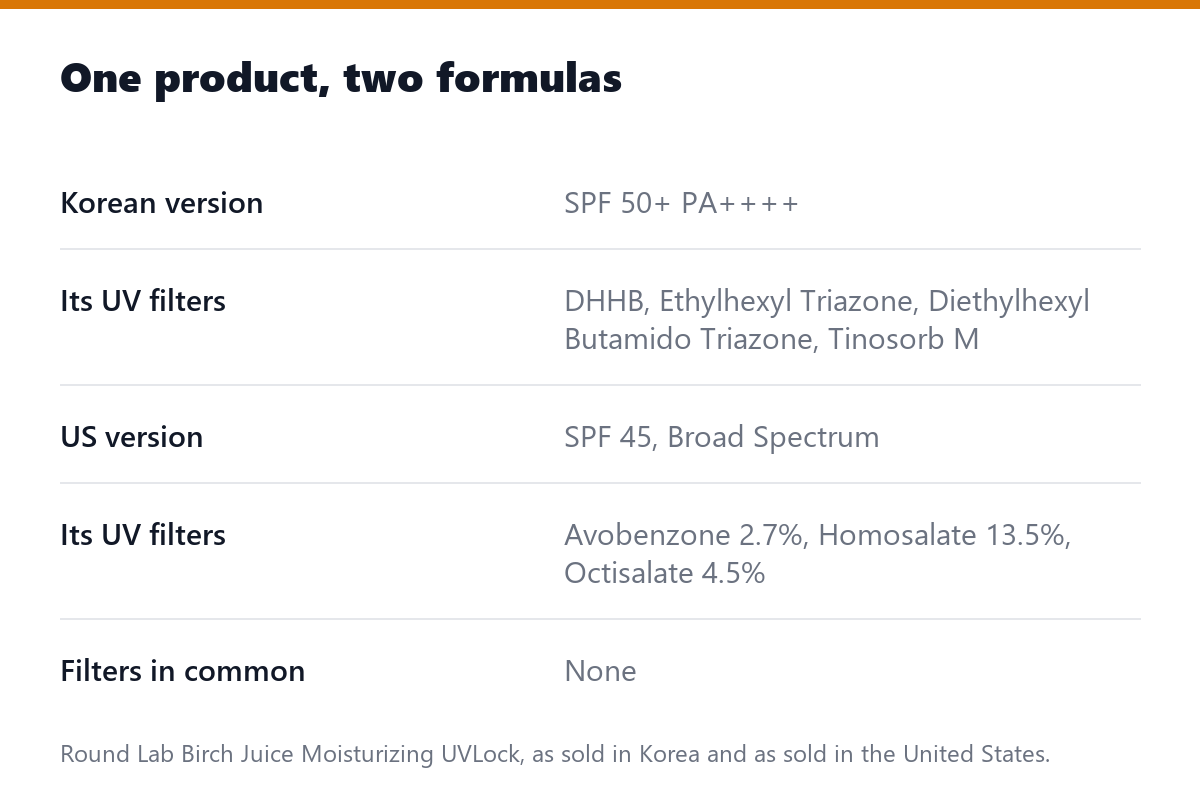
This is not Round Lab being evasive. Every one of the four filters in the Korean formula is unapproved in the United States. To sell here at all, the product had to be rebuilt from the filters the FDA permits.
Why the filters matter beyond the number
It would be easy to read SPF 50+ against SPF 45 and conclude the US version is slightly weaker. That is the least important difference.
There is a neat proof of that sitting in the FDA’s own drug label database. Round Lab has registered two US versions of this sunscreen with DailyMed — one labelled SPF 45, one labelled SPF 50 — and both carry an identical active panel: Avobenzone 2.7%, Homosalate 13.5%, Octisalate 4.5%. Same filters, same percentages, same labeler, two different numbers on the front of the tube. The SPF figure is the result of a clinical test, not a description of what is in the bottle. Which is exactly why comparing it against a Korean SPF 50+ tells you almost nothing.
UVA protection is the real gap. The PA rating on Korean packaging is a graded UVA measurement — PA+ through PA++++. The US has no equivalent grade. It has a single pass-or-fail designation, Broad Spectrum, and a product either earns it or does not.
To be fair to the US system: that test is not trivial. Broad Spectrum requires a critical-wavelength measurement taken after the sample has been exposed to UV, so a product carrying the label has demonstrated it still absorbs UVA after irradiation. A US sunscreen labelled Broad Spectrum is genuinely protecting you against UVA.
What it will not tell you is how much. PA++++ and PA++ both reduce to “Broad Spectrum” on a US label, so you lose the ability to compare two products on the axis Korean packaging makes explicit.
The other difference is the one people actually notice: texture and finish come from the filter system. The newer filters used in Korea are largely responsible for the lightness, the absence of white cast, and the lack of that heavy occlusive feel — the exact qualities that made Korean sunscreen popular in the first place. Homosalate at 13.5% behaves differently on skin than Tinosorb M does. Reviews of the Korean formula are not describing the bottle Amazon ships you.
What changed in August 2026
There is real news here, and it is being reported with more optimism than it deserves.
In June 2026 the FDA issued a final order adding bemotrizinol — sold internationally as Tinosorb S — to the approved list at concentrations up to 6%. It is the first new sunscreen active in the US monograph since the 1990s, and the order takes effect on 9 August 2026.
That is genuinely significant. Bemotrizinol is a strong, photostable, broad-spectrum filter and its arrival will improve what US formulators can build.
Here is the part that is being skipped. Bemotrizinol is Tinosorb S. It is not Tinosorb M, which is a different molecule (MBBT). Also still unapproved: Uvinul A Plus (DHHB) and Uvinul T 150 (Ethylhexyl Triazone).
Look back at the Korean Round Lab formula — DHHB, Ethylhexyl Triazone, Diethylhexyl Butamido Triazone, Tinosorb M. Not one of those four is affected by this rule change. That specific formula remains unsellable in the US after 9 August, and the same holds for a large share of the Korean sunscreens people are hoping to see arrive intact.
The gap has narrowed. It has not closed.
How to tell which one you are looking at
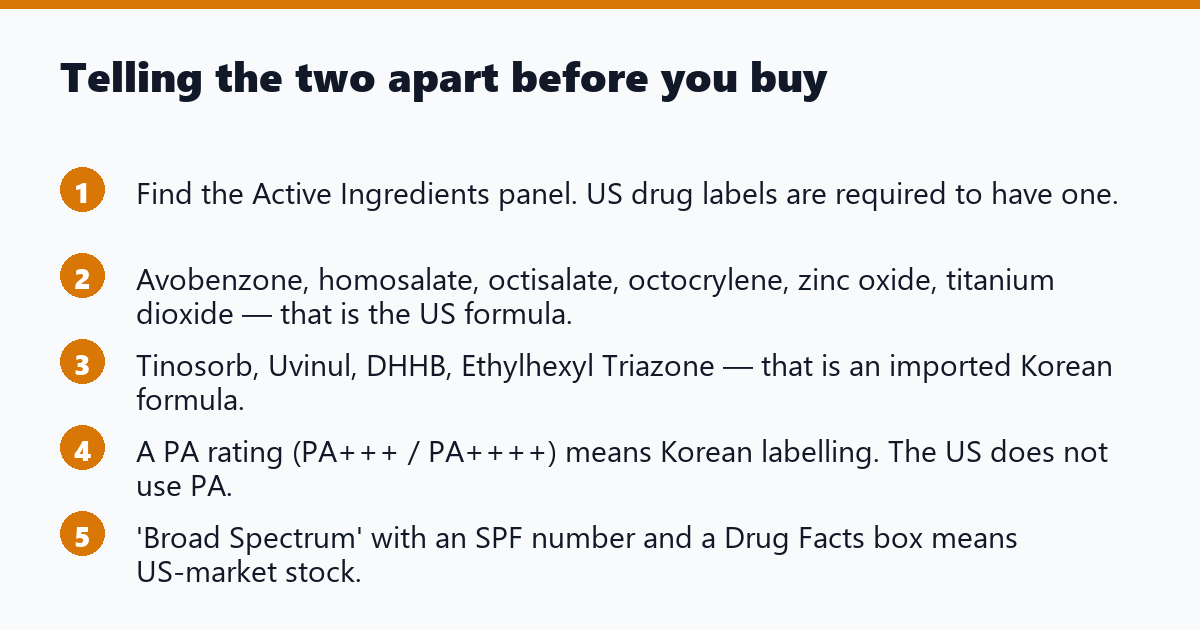
Read the active ingredients, not the brand name.
- Avobenzone, homosalate, octisalate, octocrylene, zinc oxide, titanium dioxide — US-compliant formula, legitimately sold here.
- Tinosorb, Uvinul, DHHB, Ethylhexyl Triazone, Diethylhexyl Butamido Triazone — the Korean formula, imported.
- A PA rating on the packaging — Korean labelling. US drug labels do not carry PA.
- A Drug Facts box — US-market packaging.
- Still unsure? Check the FDA’s register. Sunscreen is a drug here, so every US-market sunscreen has to be filed with DailyMed. Search the brand. If the exact product is not listed, you are almost certainly looking at an import — and Round Lab, to take one example, has several sun products on sale through US marketplaces that appear nowhere in that register.
Both can appear on the same marketplace, sometimes under near-identical titles. The listing photograph is worth enlarging before you decide.
Is the imported version a problem?
A fair question, and the answer is not a simple yes.
Grey-market imports are legal to buy for personal use and the Korean formula is not dangerous — it is regulated to a standard many people consider stricter than the American one for UVA in particular. The real issues are prosaic: storage and handling. Sunscreen degrades with heat, and a bottle that has spent a summer in an unclimatised warehouse or a container ship is a different proposition from one that has not. Expiry dating and batch codes on grey-market stock are also harder to verify.
If you want the Korean texture and you accept those trade-offs, that is a reasonable choice made with open eyes. What is not reasonable is assuming the US listing gives you the Korean formula, and then concluding the product is overrated when it does not behave as promised.
So is the US Round Lab worth buying?
Judged on its own terms rather than as a substitute — yes, and this is the framing that matters.
It is a Broad Spectrum SPF 45 with a lotion-like, hydrating base, no fragrance, and a formula built around panthenol and purslane extract for sensitive skin. Avobenzone, homosalate and octisalate are the standard American toolkit, and using them well is a formulation skill in its own right.
Buy it because you want a light, fragrance-free, hydrating US sunscreen and you like how Round Lab builds a base. Do not buy it because a Korean review told you it disappears into the skin — that review was about a different set of filters.
Check the current price on Amazon
FAQ
Is SPF 45 enough?
Yes. The difference between SPF 30 and SPF 50 in laboratory conditions is small — roughly 97% versus 98% of UVB filtered. Application amount and reapplication matter far more than the number, and almost everyone under-applies. A sunscreen you will actually put on generously beats a higher number you use sparingly.
Does the US version leave a white cast?
Avobenzone, homosalate and octisalate are all organic filters rather than mineral ones, so the cast risk is low — white cast comes primarily from zinc oxide and titanium dioxide. What changes is the feel: the American filter set is generally heavier and more emollient than the Korean one.
Why doesn’t the FDA just approve the European filters?
Because sunscreen’s drug classification means each new filter needs a full safety and effectiveness review under the OTC monograph process, rather than the cosmetic-ingredient review used elsewhere. Bemotrizinol took years and reached a final order in 2026. The others are in various stages of the same queue.
Do other Korean brands do this too?
Widely. Any Korean brand distributing officially in the US faces the same constraint, so US-market sunscreen from those brands is generally reformulated. The SPF number changing between markets is the usual visible sign.
Keep reading
SKIN1004 Centella Ampoule: Seven Ingredients, One Job
AHA, BHA, or PHA? Start With the Right One
The bottom line
The phrase Korean sunscreen covers two different things in the US market: the product formulated for Korea, and the product a Korean brand rebuilt to be sellable here. They share a name and very little else.
Neither is a bad purchase. But the reviews, the comparisons and the enthusiasm attach to one of them, and the listing you are about to click may be the other. The active ingredients panel is the only place that answers the question, and it takes about five seconds to read.