As an Amazon Associate I earn from qualifying purchases. This post contains affiliate links, which means we may earn a commission if you buy through them — at no extra cost to you.
Quick verdict
For oily or combination skin dealing with blackheads and rough texture, these dual-acid pads are a solid, low-effort pick — as long as you stick to one to three uses a week. Sensitive skin and retinoid users should sit this one out.
The Medicube Zero Pore Pad is the exfoliating toner pad most people run into first when they start looking at K-beauty pore care. The pitch is simple enough: wipe your face, get smaller-looking pores. The reality is more specific than that, and whether these are worth your money comes down almost entirely to your skin type.
This is not a product that works for everyone. It is a genuinely good product for a fairly narrow group of people, and a bad idea for another group. Sorting out which one you are is the whole decision.
What these pads actually are
Each pad has two different sides, and this is the part that gets glossed over in most descriptions.
The embossed side is textured. It does mechanical exfoliation, meaning it physically lifts away dead skin and surface debris as you wipe. The smooth side is the delivery vehicle for the hydrating and soothing portion of the formula. You use them in that order: textured first, smooth second.
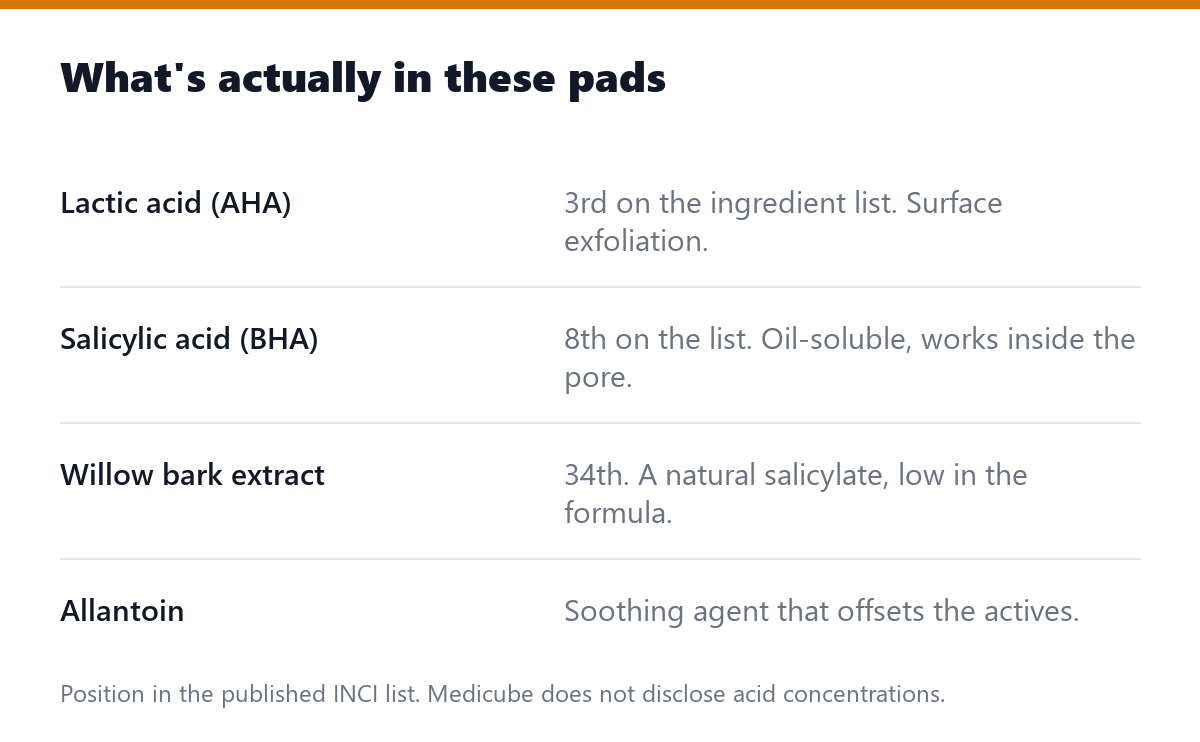
Chemically, the formula runs on two acids. Lactic acid, an AHA, sits third on the published ingredient list, which puts it high in the formula. It loosens the bonds holding dead cells to the surface of your skin. Salicylic acid, a BHA, sits eighth. It is oil-soluble, and that is what lets it get down inside a pore and break up the sebum sitting there.
Further down the list are willow bark extract, a natural salicylate, and allantoin, a soothing agent that takes some of the edge off the actives.
One thing worth flagging: retailer listings frequently quote exact acid concentrations for these pads, and the figures are not consistent between sellers. Medicube does not publish concentrations in its own ingredient documentation. Treat any specific percentage you see as marketing copy rather than a verified number — the ingredient ordering above is the part you can actually check.
That combination is the reason the pads behave the way they do. AHA works on the surface. BHA works inside the pore. Most single-acid products do one or the other.
What to look for in an exfoliating pad
If you are comparing these against the other options filling that category, three things separate a pad worth buying from one that just costs you money.
- Which acid, and how much. BHA is what you want for clogged pores and blackheads because it is oil-soluble. AHA is for surface texture and dullness. A pad with only AHA will not do much for congestion no matter how the label is written.
- Whether there is anything soothing in the formula. Acids plus physical scrubbing is a lot to ask of your skin at once. Ingredients like allantoin or panthenol are not marketing filler here — they are what keeps a twice-weekly habit sustainable.
- Pad texture. A pad that is too rough turns exfoliation into abrasion. Dual-textured designs exist specifically so you are not scrubbing with the same surface you are meant to soothe with.
Who these are genuinely good for
If your skin is oily, combination, or acne-prone, you are the target audience for the Medicube Zero Pore Pad, and the reported results line up with what the formula should do.
The most consistent feedback from reviewers is about congestion rather than pore size. People describe fewer blackheads around the nose and less roughness on the chin after a couple of weeks of regular use. That tracks with a BHA doing its job.
They also suit anyone who has struggled to stick with a separate exfoliating step. A pre-soaked pad removes the friction of measuring out a liquid exfoliant and finding a cotton round, and consistency matters more than potency with this category.
Check the current price on Amazon
Who should skip these
This is the part worth reading twice, because the failure cases here are not subtle.
If your skin is genuinely sensitive, be careful. Reviewers with reactive skin report redness, particularly across the cheeks, after the first few uses. The combination of acids and a textured pad is aggressive for a compromised barrier. If you go ahead anyway, start at once a week and only on the areas that are actually congested.
If you use a retinoid, do not stack these on top of it. Retinoids already accelerate cell turnover. Adding acids and mechanical exfoliation on the same night is how people end up with a damaged barrier and weeks of recovery. Alternate nights at minimum, and skip the pads entirely while your skin is adjusting to a new retinoid.
If your skin is currently irritated, wait. Active breakouts that are inflamed, windburn, peeling from a previous product — none of that is improved by exfoliating over the top of it.
One more thing that comes up repeatedly and is not a dealbreaker but is worth knowing: the hydrating side can leave a slightly tacky finish. Some people are still aware of it ten minutes later. If you dislike that feeling on your skin, you will notice it here.
How to use them without causing problems
The frequency guidance matters more than most people assume, and overuse is the single most common way this product goes wrong.
- Normal to combination skin: once or twice a week.
- Very oily skin: two to three times a week.
- Sensitive skin: start at once a week, and only where you need it.
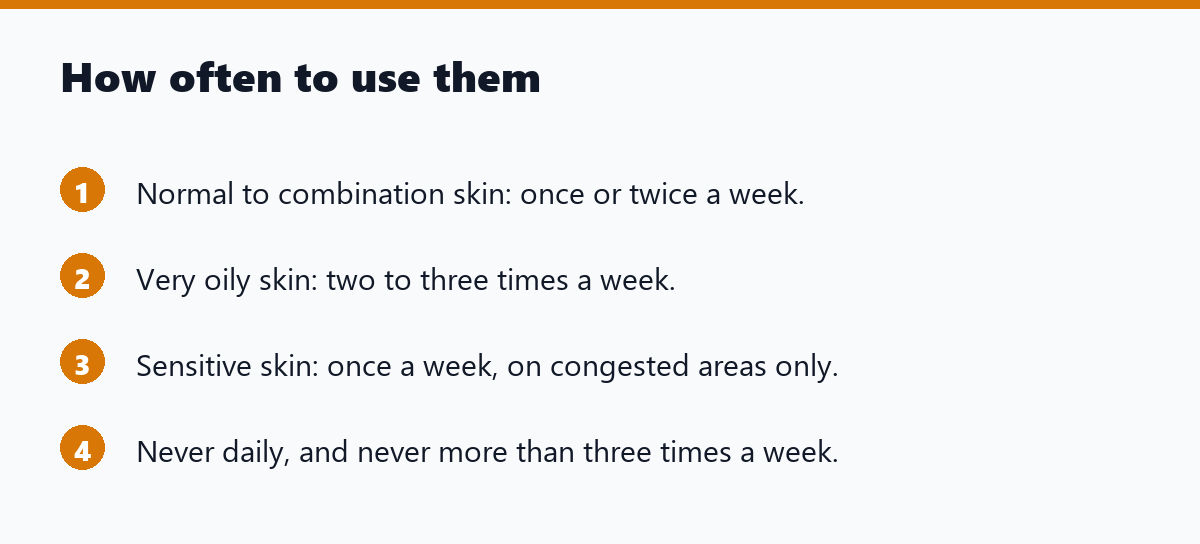
Do not use these daily, and do not exceed three times a week regardless of skin type. More frequent exfoliation does not produce faster results; it produces a stripped barrier, which ironically makes oil production worse.
Wipe with the textured side first, working gently over congested areas rather than scrubbing. Flip to the smooth side and go over the same area. Follow with sunscreen the next morning without exception, because AHAs increase sun sensitivity.
What to realistically expect
Here is the honest version, and it is worth setting against the marketing.
The Medicube Zero Pore Pad will not make your pores disappear. Pore size is largely genetic, and no topical product changes it. What exfoliation does is clear the debris sitting inside the pore, and a pore that is not packed with oxidised sebum casts less of a shadow, so it reads as smaller. That is a real, visible difference — it is just not the same thing as shrinking a pore.
Timeline-wise, reviewers describing before-and-after results are generally talking about two to four weeks of consistent use, not overnight change. If nothing has shifted after a month of correct use, this is probably not the right product for your particular congestion.
A jar holds 70 pads, which at a twice-weekly cadence works out to a reasonable stretch of use per jar rather than something you are replacing constantly.
FAQ
Can I use these every day?
No. Two to three times a week is the ceiling even for very oily skin, and once or twice is right for most people. Daily use of acids plus physical exfoliation damages the skin barrier, which shows up as redness, tightness, and often more oil rather than less.
Are these safe with retinol or tretinoin?
Not on the same night. Both are exfoliating processes and using them together is a well-documented route to irritation. Alternate nights if you want to use both, and hold off on the pads entirely during the first several weeks of starting a retinoid.
Will these help with acne?
They can help with the congestion type — blackheads, clogged pores, the bumpy texture that comes from trapped sebum — because salicylic acid works inside the pore. They are not a treatment for inflammatory or cystic acne, and exfoliating over active inflamed breakouts usually makes them worse. That situation needs a dermatologist, not a toner pad.
Keep reading
Medicube Collagen Jelly Cream: What It Can and Can’t Do
Medicube Kojic Acid Turmeric: Gel Mask or Wrapping Mask?
The bottom line
If you have oily or combination skin, deal with blackheads around your nose, and want one step that handles both exfoliation and oil control, the Medicube Zero Pore Pad does the job the formula suggests it should — provided you respect the frequency limits.
If your skin is sensitive, or you are already running a retinoid, the risk-to-benefit here is poor and there are gentler ways to get to the same place.